Revisiting “A Native Hill” upon the writer’s passing.
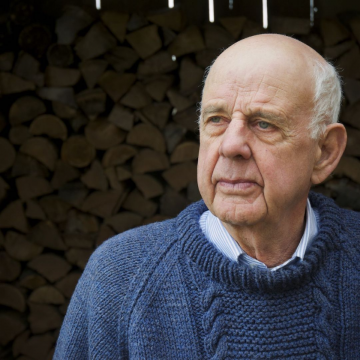
Wendell Berry — writer, farmer, teacher, and environmentalist, a man who bloomed where he was planted and helped us see the beauty and value in doing so — died August 31st in Port Royal, Kentucky. He was 92.
As a native Kentuckian, I can’t remember a time when I didn’t know of Berry. He loomed large in the state’s literary landscape. He appeared at local book fairs and events. He taught my brother freshman English at the University of Kentucky. Bluegrass Magazine, which my mother founded and edited, once featured Berry on its cover with the headline, “The Last Honest Man in America.”
Now, that man is gone, and we’re all the poorer for it. But he leaves behind a clear and well-articulated vision in his essays, poems, and novels.
When I heard of Berry’s passing, I re-read his essay “A Native Hill” and thrilled again at the clarity of his style, the sonorousness of his voice, and the morality of his worldview. In it, he describes a conversation he had with a New Yorker who tried to convince him to stay in the city for the sake of his literary career after Berry announced he was moving home to Kentucky. Berry admitted that the literary world mattered to him, but that:
“the world would always be most fully and clearly present to me in the place I was fated by birth to know better than any other.”
His point, which he makes so beautifully in this expansive essay, is that Port Royal was his place. He knew the people, walked every square mile of its hollows and ridges, and understood its less-than-perfect history.
Returning to his birthplace inspired Berry. “I came to see myself as growing out of the earth like the other native plants and animals.”
He began to ask the big questions — “What is this place? What is in it? Where is its nature? How should men live in it? What must I do?” — queries that assume place is as much about what people put into it as what they get out of it.
Berry proposed in the piece another way to live — not subsuming the land to our purpose but understanding it. He decried Kentucky’s early settlers, who quickly built a road through the wilderness, as “placeless people.”
“Because they belonged to no place, it was almost inevitable that they should behave violently toward the places they came to,” he wrote. “We still have not, in any meaningful way, arrived in America.”
I shudder when I read those words anew, recognizing in them not only myself but many of us. How different would our world be if more of us bloomed where we were planted? Would our communities be stronger, our earth cleaner and more habitable?
Berry’s prescriptions are not always practical, but they never fail to inspire me as a writer and a human being. “A Native Hill” was published in 1968, when Berry was 34, but the themes it explores were the same ones he wrestled with throughout his life.
“Every day I am confronted by the question of what inheritance I will leave,” he wrote. That question does have an answer: It’s a grand inheritance, indeed.
Rest in peace, Wendell Berry.
Anne Cassidy has been published in many national magazines and newspapers, including the Washington Post, the New York Times, and the Christian Science Monitor. She blogs daily at “A Walker in the Suburbs.”