Recalling the literary bond between Jane Kenyon and Alice Mattison.
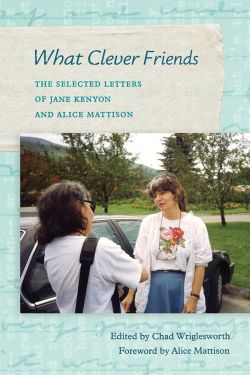
What Clever Friends: The Selected Letters of Jane Kenyon and Alice Mattison was my slow read all summer. Knowing Kenyon had died in 1995, I wanted to make their story of writing and friendship last.
Usually, I’m a quick reader, which served me well at the Bennington Writing Seminars (motto: “Read a hundred books, write one”). Terms began with brief on-campus residencies, during which students met in workshop with the faculty member who would be their mentor for the semester. Off campus, work continued by correspondence. Each month, the student mailed a “packet” containing a manuscript draft, notes on readings, and a letter about writing issues and intertwined life-stuff. The mentor responded with edits, suggestions, and a letter of their own.
Mattison was my first mentor; we met in January 2007. Winter was so cold in Vermont, my eyelashes froze while I walked across campus. But in workshop (and later by mail), Mattison was warm — and blunt, insightful, and incisive. Twenty years on, we’re still in touch.
In a summer residency, poet Donald Hall (Kenyon’s widower) gave a reading. If memory serves, Mattison introduced him; Hall was also her friend.
Mattison’s foreword describes first meeting Kenyon in 1979 at a “poetry fair” in Cambridge, Massachusetts. After Mattison read, a woman approached from the audience and “spoke her name in a low, calm voice: ‘Jane Kenyon.’”
Mattison already admired her work; intermittent correspondence soon began. Over time, the two formed an ongoing writing workshop with poet Joyce Persikoff. Kenyon and Hall lived in New Hampshire; Mattison in New Haven with husband Edward and three sons; and Persikoff outside of Boston. After exchanging manuscripts and critiques by mail, they met quarterly.
Beyond the workshop, Mattison and Kenyon visited occasionally and wrote weekly, sometimes daily. They wrote about progress and blocks, acceptances, rejections, money, reviews. About life with spouses, families, dogs. Cooking, food, gardening. Kenyon’s church community, Mattison’s shifts at the soup kitchen. Family illness and their own medical problems: Kenyon’s depression, Mattison’s poor vision.
Each often believed in the other more than the friend believed in herself. They encouraged, sustained, pushed, pushed back, understood, misunderstood, argued, and made up. Coach and adversary combined; not offering “tough love” but honest love.
“Dear Janie,” Mattison writes on October 18th, “I hope you’re sitting at your desk for an hour a day, too, whether you’re writing or not. When I come to see you, I’m going to check your time sheets, so be careful. Much love and hugs.”
“Dear, dear Chum,” Kenyon replies two days later. “Now I’m going to dispense advice — you don’t have to hurry the Big One…Let it grow in the dark like a mushroom. And don’t pick it too soon…Lots of love, Janie.”
Friends for life — or for as long as their time together lasted, just 15 years. Mattison was with Kenyon the day before Kenyon died of leukemia in 1995.
Ten years later, Chad Wriglesworth, a “scholar and professor,” asked Mattison “whether I might let him edit a book of letters between Jane Kenyon and me.”
Hall was his wife’s literary executor. Neither Mattison nor Kenyon had retained copies of her own letters, but each had kept the ones received from the other. Mattison deliberated about publishing them:
“Legally, I had the right to decide only about my own letters…I wasn’t sure Jane would have said yes. Our letters reflected our intense friendship…Jane told me secrets that she didn’t want Don to know. But she was generally unguarded. I thought that if she had survived him she would have talked and written about those parts of her life.”
Mattison and Hall were friends and occasional correspondents. Sometime earlier, she’d been angry to learn he had “shipped off” Mattison’s letters to him to his own University of New Hampshire archive. Now she learned from Wriglesworth he’d also deposited Mattison’s letters to Kenyon in his archive, as well.
Hall was, Mattison avers, “a publicity hound” and was unsurprisingly “delighted” with Wriglesworth’s proposal. She sent Hall copies of Kenyon’s letters, redacting “a few paragraphs, just to make certain that Don never saw them” while he was alive. (He died in 2018; the letters as published are edited for privacy.)
Consenting to Wriglesworth’s proposal, Mattison went to New Hampshire to read her own letters to Kenyon, “afraid I wouldn’t like them.” Instead, she found, “I had forgotten many events...but remembered my feelings…My love and grief had not changed.”
Mattison, Hall, and Wriglesworth all hoped publishing the friends’ correspondence would renew attention to Kenyon’s work. Mattison’s foreword concludes:
“Jane’s letters, like her poems, end decades too early. Reading both, I have a constant sense of what isn’t there — what would have been there if she had lived. But her letters to me add many more words to what we all have from Jane. I am grateful to Chad Wriglesworth beyond anything I can say…”
Prior to reading What Clever Friends, I had only read Kenyon’s Otherwise: New & Selected Poems. The title poem, on the contingent gift of an ordinary day, verges on a mantra for me. Although I had read most of Mattison’s novels, stories, and collected craft essays published after 2004, I was unfamiliar with her earlier work.
To better understand the friends’ dialogue about work in process, I acquired Kenyon’s Collected Poems and Mattison’s first published story collection, Great Wits. These became my concordances, demonstrating that What Clever Friends achieves and surpasses Wriglesworth’s, Hall’s and Mattison’s original hope of renewing attention to Kenyon.
What Clever Friends introduces Kenyon’s private voice, and Mattison’s, too, and it invites further reading of both authors. Throughout the letters and in her foreword, Mattison downplays her relative talent and importance. Kenyon disagreed. Had she lived, perhaps she would have written a gentle, tart rebuttal to Mattison’s self-deprecation.
What Clever Friends requires and speaks in both women’s voices, creating a combined narrative of colleagueship, differences in writing style, practice, and process, and differences in living. Above all, it tells the story of a friendship becoming love and outlasting death.
Ellen Prentiss Campbell’s collection of love stories is Known By Heart. Her collection Contents Under Pressure was nominated for the National Book Award; her novel The Bowl with Gold Seams won the Indy Excellence Award for Historical Fiction. Frieda’s Song was a finalist for the Next Generation Indie Book Award, Historical Fiction. Blogging as “Girl Writing” in the Independent bi-monthly, she lives in Washington, DC. For many years, Ellen practiced psychotherapy. Her new novel is Vanishing Point.