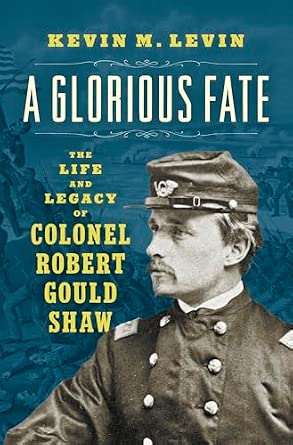
A Glorious Fate: The Life and Legacy of Colonel Robert Gould Shaw
- By Kevin M. Levin
- University of North Carolina Press
- 328 pp.
- Reviewed by Fergus M. Bordewich
- October 2, 2026
Recalling a Union officer fueled (at least partly) by a belief in abolition.
In May 1863, a star-studded cast of abolitionist luminaries including Frederick Douglass, William Lloyd Garrison, Wendell Phillips, and thousands of African Americans joined in a moment of electrifying pageantry: the presentation of colors to the newly formed 54th Massachusetts Infantry, soon to become legendary as the most famous unit of Black volunteers to serve in the Civil War. At the head of the regiment stood the handsome young Boston Brahmin Col. Robert Gould Shaw, scion of one of that city’s most well-connected abolitionist families. Most of the regiment’s men were skilled craftsmen, tradesmen, and farmers, many of them well-educated for their time, among them two of Douglass’ own sons.
Barely two months later, the 54th would earn its place in history when it stormed the Confederate stronghold known as Battery Wagner outside Charleston, South Carolina, an event vividly dramatized in the 1989 film “Glory.” At its head was Shaw, who died on the fort’s parapet, riddled with bullets, at 25 years old. He was almost immediately celebrated as a martyr in the cause of antislavery, often mentioned in the same breath as John Brown, and memorialized by artists, most notably in one of the war’s finest marble monuments, by Augustus Saint-Gaudens, which stands today opposite the Massachusetts State House.
In the engrossing and highly readable A Glorious Fate, author Kevin M. Levin, a prolific writer on Civil War subjects, deftly unpacks Shaw’s legend to unveil the man beneath the myth. Levin finds him to be, in many respects, an unlikely hero. Born to parents who avidly embraced a gamut of reformist causes, including involvement with the experimental countercultural community known as Brook Farm, Shaw enjoyed a cossetted childhood. Several years of education and bohemian life in Europe followed, and after that, entry into Harvard, though more as a matter of assumed right than scholarly ambition. On the whole, Shaw comes across as a pleasant if somewhat frivolous and aimless young man who, although he professed opposition to slavery, expressed little of his parents’ fervor.
The Civil War turned Shaw from a dilettante into a man of purpose. He volunteered for service in 1861 and quickly took to soldiering, which gave structure and direction to his wayward life. By 1863, he was battle-hardened, having survived several close brushes with death and the loss of many of his closest friends in combat. Having risen to the rank of captain, he considered remaining in the army even after the war was over.
Levin suggests that Shaw’s leadership of the 54th Massachusetts derived less from a deep-rooted affinity for African Americans than from a driving ambition for higher rank and a desire to distinguish himself in battle. (Massachusetts governor John Andrew, a close friend of the family, had insisted on a commander with an antislavery background for the state’s first Black regiment.) It nevertheless took considerable moral courage for Shaw to accept the appointment, since white officers who took service in Black regiments were subject to shaming and insults from racists in the military. Once in command, Shaw proved deeply loyal to his men, forgoing his own salary until Black troops received pay equal to that of whites. (Parity would come only after his death.)
While Levin has reduced the size of the marble pedestal on which Shaw’s legend has rested, he does not, ultimately, diminish the character of a man who, after all, died unhesitatingly at the head of his troops in a battle that was a badly planned, suicidal fiasco with little hope of success. Rather, he shows us how patriotism, chance, ambition, and a moral impulse, however equivocal, can inspire heroism and self-sacrifice in a fairly ordinary figure — one who, despite his flaws, played a crucial role in advancing the cause of freedom.
Fergus M. Bordewich’s most recent book is Centennial: The Great Fair of 1876 and the Invention of America’s Future.