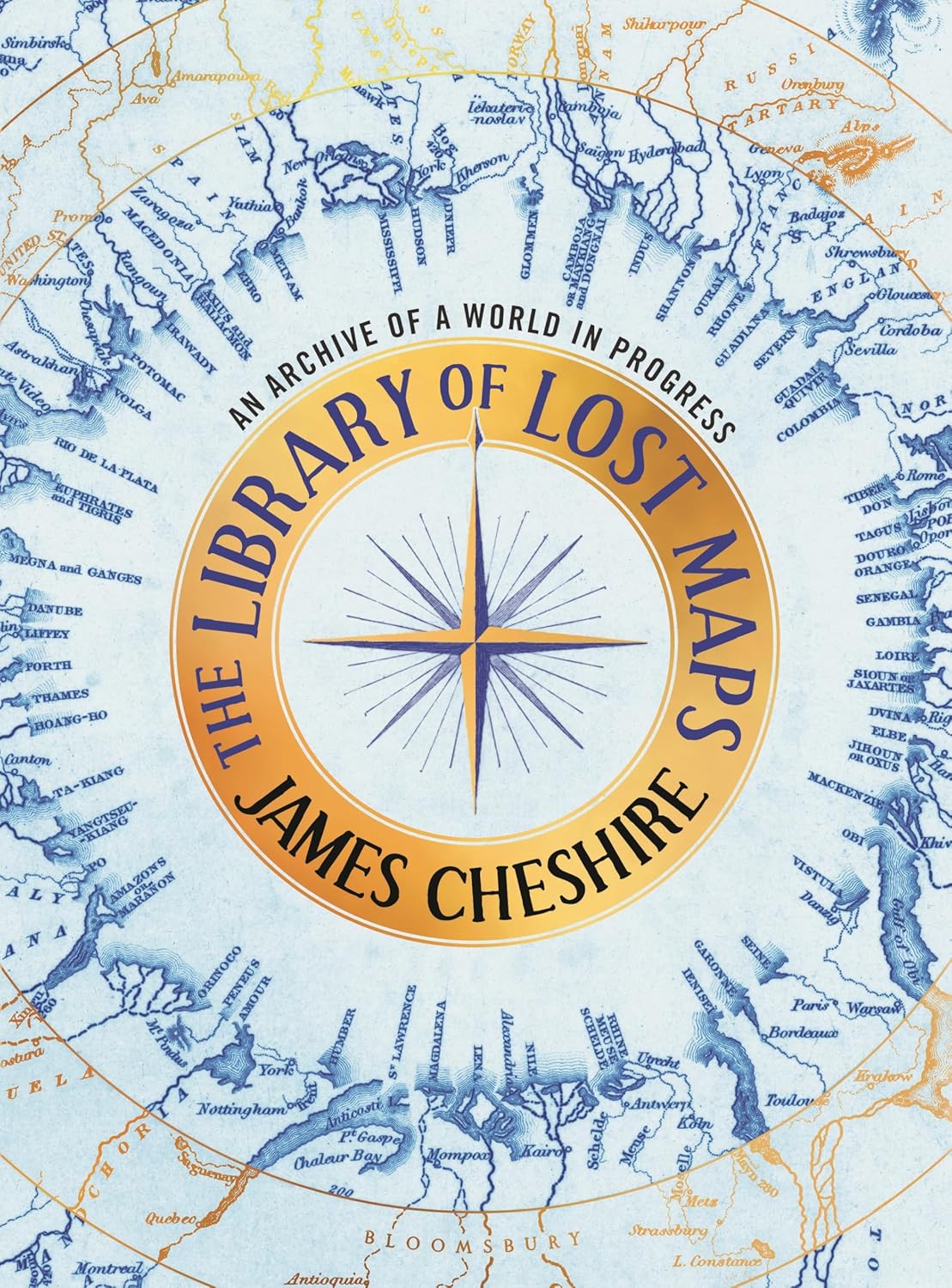
The Library of Lost Maps: An Archive of a World in Progress
- By James Cheshire
- Bloomsbury Publishing
- 384 pp.
- Reviewed by Jennifer Bort Yacovissi
- February 26, 2026
An exquisite homage to the charts that plot the way.
Just as there are people who have an emotional response to the tactile sensation of a real book, and people who use a physical dictionary knowing the inherent serendipity of words just waiting to be discovered, there are people who understand what it means to use a corporeal map. (That Venn diagram may, in fact, be three fully overlapping circles; I know I’m smack in the center.) GPS is a great invention, albeit a blunt instrument, for finding the shortest, least-trafficked path from Point A to Point B. In contrast, a good physical map is an encyclopedic wonderland of information daring the user to get lost within its borders.
If you’re in that circle, too, then James Cheshire’s The Library of Lost Maps is for you.
The Map Room at University College London (UCL), despite boasting one of the largest academic collections in the U.K., had mostly been abandoned in the 20 years since its longstanding librarian retired. Though Cheshire is a cartographer working at UCL, his focus on mapping digital data meant he hadn’t bothered to spend any time with the dusty paper collection. Once he went through the Map Room door in the summer of 2022, though, it didn’t take him long to realize what he’d been missing.
Part of the need for the supposedly obsolete maps housed in this collection is to revisit the world as it once was. How many countries evaporated and how many others shimmered into being after each world war? How are old maps being used to shape the world today? Chesire writes:
“I saw how Putin’s worldview was crystallised by the abundance of maps from the Soviet Union that charted the borders of the empire he wishes to restore. His troops were even seen carrying copies of them as they marched across the border [into Ukraine]…I have never been more convinced about the importance of maps not just to witness history, but to shape it.”
Cheshire walks us roughly chronologically through selected highlights of the Map Room’s holdings, starting in the early 19th century — when maps first started to be made available to the general public — and gives us the backstories of many of the men (and some women) who dedicated themselves to developing accurate maps.
UCL was founded in 1826 (at the time, “the only secular university in England”). That year also saw the establishment of the Society for the Diffusion of Useful Knowledge (SDUK), a learned group with the mission of disseminating information to the masses in affordable and accessible forms. One of its major undertakings was to publish a high-quality, inexpensive world atlas, which SDUK did by establishing a subscription model and distributing individual maps to subscribers as they were finished.
Fifteen years later, in 1844, the collection of 224 maps was complete, and the “SDUK atlas remains one of the most successful mapping projects ever,” writes Chesire, having sold 3 million copies by its completion. In the Library of Congress, the author came upon Teddy Roosevelt’s globe, which was created in 1882 from SDUK maps.
It didn’t take long before maps were used to show the world as the maker wished it to be rather than as it actually was. These aspirational maps became a method of world-building during the post-World War I peace conferences. It was here the Germans learned that maps carry innate authority, valid or invalid, by the simple fact of their existence.
With color, gloss, and boldly drawn borders, maps were used by delegations to sell their version of the way the world ought to be. In the interwar period, led primarily by Karl Haushofer — a German professor and cartographer who gave the jailed Adolf Hitler and Rudolf Hess their own personal university seminar on geopolitics, complete with reading assignments — Nazis learned the essential messaging capabilities of Motherland-centric maps. Thus, a generation of German schoolchildren was taught about their country’s borders from maps that reflected what the Reichstag wanted to see.
By the time the Nazis were on full war footing in the late 1930s, they were second to none in their mastery of mapmaking (and map collecting) in support of their aims. The Map Library received a collection of German intelligence handbooks covering an array of European countries in detail. Contrast that with the findings of a British commission exploring the failure to protect Norway from the Nazis:
“Our leaders and their troops were again and again handicapped by their ignorance of climatic and geographical peculiarities, by the lack of detailed knowledge of harbours, landing grounds, and storage facilities, and even by the ignorance of the general qualities and prejudices of the Norwegian people.”
Of all the cartographic journeys Cheshire takes us on, the most fascinating to me (and to him, I think) is that of mapping the ocean floor. It’s startling to be reminded of just how recently the theory of plate tectonics was validated. What’s revelatory is learning how the meticulous, yearslong project — driven primarily by two dedicated cartographers, Marie Tharp and Bruce Heezen, and an artist who made the maps come alive in the world’s imagination, Heinrich Berann — produced the maps that made the theory concrete and incontrovertible.
The existence of the Mid-Atlantic Ridge was already known at the beginning of the project; what Tharp and Heezen showed was the existence of a rift valley inside it. Later, scientists were able to verify that the rift — which girdles Earth — was the newest part of the ocean floor, with the oldest mantle occurring near the coastlines, proving that continents were being pushed apart from the middle of the ocean. Explains Chesire:
“We tend to think of maps as useful or beautiful, but rarely as revolutionising science. The quest to map the ocean floor shows how map-making can have huge real-life scientific implications and the way that it takes only a few remarkable people — and one remarkable woman in particular — to utterly transform how we see the world.”
Of the many objectively true entities drawn on maps — mountain ranges, river gorges, climatological data, population distribution — one subjective item is purely manmade: borders. The lines of division are not drawn on our planet, a crucial early lesson that Merlin taught his student, the once and future King Arthur, by turning him into a hawk.
Much like the Nazis with their interwar maps, and Putin with his USSR-resurrection fever dream, the Trump administration has been playing with aspirational maps a lot lately. We graduated from those long-ago Sharpie markings on a hurricane map to the newly christened Gulf of America, and from fantasy pics of Canada as the 51st state to podcaster-in-chief Katie Miller brandishing an image of Greenland emblazoned in red, white, and blue. (Though, by now, that incident was several Minnesota news cycles ago.) We’re not the first country to use maps as a saber-rattling exercise, but it does seem awfully 19th century. So much for the Pax Americana.
The Library of Lost Maps is a beautiful book filled with vivid renderings of the maps Cheshire discusses. They aren’t large enough to study on the page, but they’ll certainly push you to grab that atlas off the shelf and start poring over it — which will make you sad that you didn’t save all those wonderful fold-out NatGeo maps you had as a kid.
Never fear, though: Berann’s original hand-painted World Ocean Floor map is held at the Library of Congress. “The texture of the paint intensifies the remarkable 3D effect that Berann was able to achieve,” writes Chesire, “and the miniscule details are incredible — looking closely, I could see the embers of volcanoes atop sea mounts barely larger than a pinhead.” Meet you there!
Jennifer Bort Yacovissi’s novel, Up the Hill to Home, tells the story of four generations of a family in Washington, DC, from the Civil War to the Great Depression. She reviews regularly for the Independent and serves on its board of directors as president. Follow Jenny on Bluesky at @jbywrites.bsky.social.