Ain’t Nobody’s Fool: The Life and Times of Dolly Parton
- By Martha Ackmann
- St. Martin’s Press
- 304 pp.
- Reviewed by Kitty Kelley
- December 17, 2025
We will always love her.
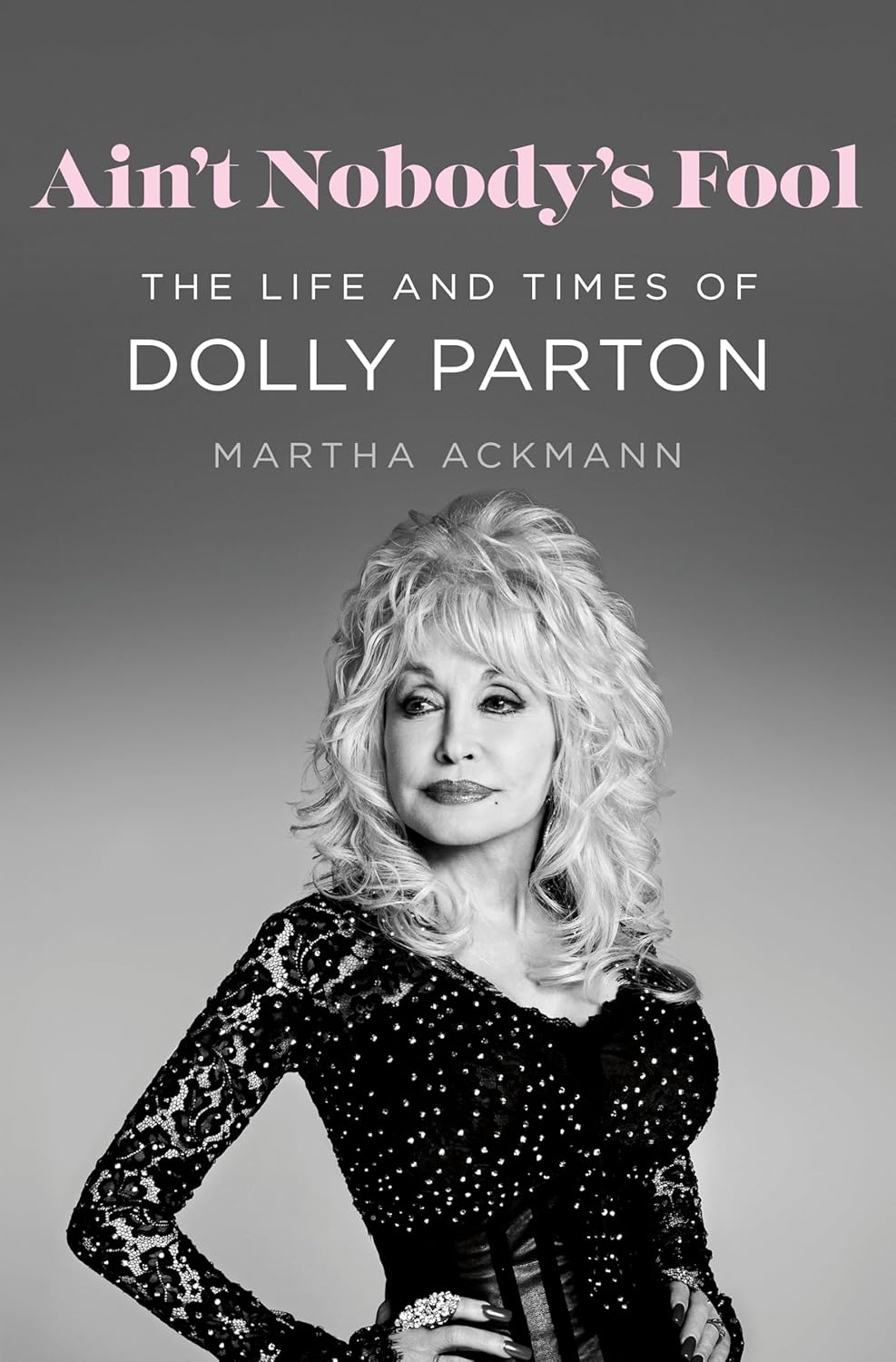
A biography of Dolly Parton ought to cartwheel out of bookstores because if ever there was a life story to celebrate, it’s one about the little girl from the Great Smoky Mountains of Tennessee who grew up as one of 12 children in a tar-paper shack with no indoor plumbing. “We wet the bed sometimes just to keep each other warm,” Dolly would tell audiences, laughing at the memory. Years later, though, she admitted, “The worst thing about poverty is not the actual living of it, but the shame of it.” Today, the singer’s net worth is $650 million, proof of magnificent talent matched to monumental ambition.
Following high-school graduation, Dolly Rebecca Parton grabbed her guitar and headed for Nashville. She heaped big blonde wigs atop her little frame and slipped into 4-inch heels and low-cut dresses spangled with sparkles. Then she sang her way to stardom at the Grand Ole Opry. Within a few years, Dolly was named “the Queen of Country.” Decades later, “the Queen” had produced 50 studio albums and earned 11 Grammy awards, three Emmys, two Academy Award nominations, six Golden Globes, and one Tony. Music historian Robert K. Oermann said if she’d been born in a different era, Dolly would have been Mozart. “She was touched by something.”
Fueled by ambition to showcase her gifts, Dolly took her country music to Hollywood to become a movie star and, in 1980, made her big-screen debut in “9 to 5,” which co-starred Jane Fonda and Lily Tomlin and featured some of Dolly’s songs. Two years later, she starred in “The Best Little Whorehouse in Texas,” followed by “Steel Magnolias.” When lasting movie stardom eluded her, she created Dollywood, an amusement park — complete with a resort and spa — in Pigeon Forge, Tennessee, spanning 160 acres and offering more than 60 rides and slides. “Welcome to my home, my mountains,” reads Dolly’s sign on Dream More Way at the park, which has been described as “a living monument to her life.”
In the fall of 2025, Dolly was set to capstone her 80th birthday with a six-week residency at Caesar’s Palace in Las Vegas. But the appearance was suddenly postponed when she was rushed to a hospital in Knoxville just months after her husband, Carl Dean, died. Her family was frantic. Her sister Freida begged people to pray for Dolly; another sister, Stella, said that her “kidney stones had become infected.” The next day, the star herself tried to assure her fans:
“I just need a little time to get show-ready, as they say…And don’t you worry about me quittin’ the business because God hasn’t said anything about stopping yet. But I believe he is tellin’ me to slow down right now so I can be ready for more big adventures with you all.”
When she then had to cancel even more public appearances, Dolly again tried to reassure her fans, and perhaps herself. “I ain’t dead yet, and I ain’t stopping. I got plenty more to do before God calls me home.”
Now comes Martha Ackmann with Ain’t Nobody’s Fool: The Life and Times of Dolly Parton, which tries to capture the star’s ineffable magic. But without new sources, fresh information, or access to the singer herself, the biographer is hamstrung and forced to fall back on previously published material, including Parton’s 1994 memoir, Dolly: My Life and Other Unfinished Business, plus her three autobiographies: Dolly Parton Songteller: My Life in Lyrics, Behind the Seams: My Life in Rhinestones, and, most recently, Star of the Show: My Life on Stage. Consequently, this work is larded with endnotes, chapter notes, and footnotes on almost every page. Still, Ackmann does praise Dolly’s founding of the Imagination Library, which provides free books to children around the world, and commends the singer’s philanthropy to health organizations, which helped lead to the creation of the Moderna covid-19 vaccine.
Although there will be nothing new to Parton’s fans in this book, it’s moving to read that her most famous song, “Jolene,” reached Nelson Mandela when he was imprisoned on Robben Island for battling South Africa’s apartheid system. Whenever the guards gave Mandela permission to play music over the prison’s loudspeaker, he always chose “Jolene,” which Ackmann movingly describes as “two hundred words of vulnerability and hurt.”
Dolly Parton’s music — the songs she wrote and sang while accompanied by her dulcimer or autoharp or guitar — reverberates with life’s sadness, its joys and triumphs, a kind of magic that’s challenging for any biographer to convey. While readers might wish that Ackmann had given them a more inspiring story, they’ll always have Dolly’s music — as true and everlasting as the Great Smoky Mountains.
Kitty Kelley is the author of seven number-one New York Times bestseller biographies, including Nancy Reagan, Jackie Oh!, and Elizabeth Taylor: The Last Star. She is on the board of the Independent and is a recipient of the PEN Oakland/Gary Webb Anti-Censorship Award. In 2023, she was honored with the Biographers International Organization’s BIO Award, which is given annually to a writer who has made major contributions to the advancement of the art and craft of biography.