All Us Saints: A Novel
- By Katherine Packert Burke
- Bloomsbury Publishing
- 272 pp.
- Reviewed by Marcie Geffner
- June 16, 2026
Traumatized siblings reenact a night of violence.
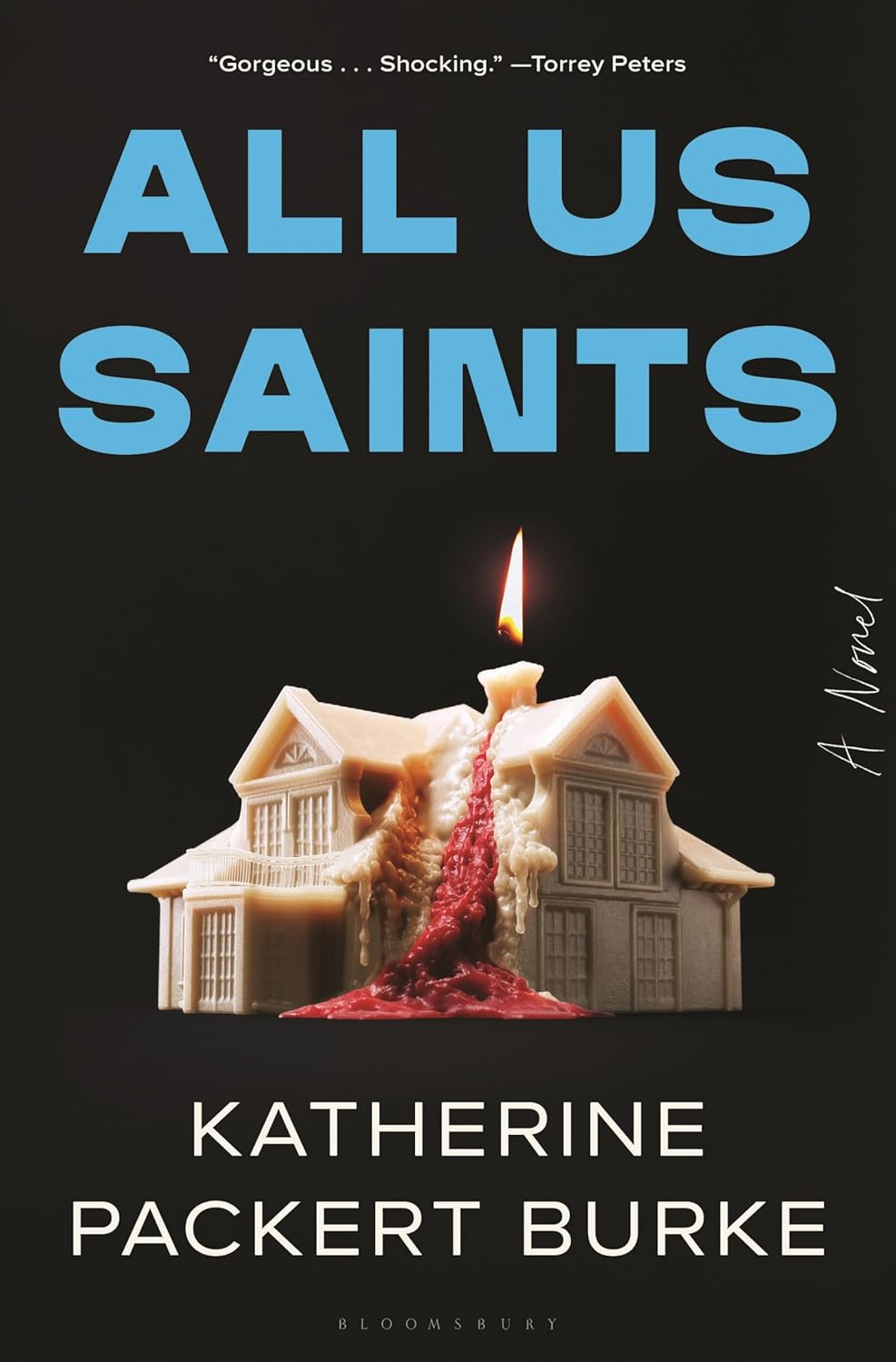
Katherine Packert Burke’s contemporary gothic novel, All Us Saints, portrays the tormented lives of four adult siblings almost two decades after three teenaged girls were killed inside their home. With a large cast of dramatis personae and a minimalistic plot, the author relies on a theatrical, locked-room structure, creepy images, and themes related to gender, sexuality, and violence to hold the story together.
On the evening of May 31, 2011, Calla St. Cloud, a creatively blocked New York playwright, her younger brother, James, a video-store clerk, and James’ girlfriend, Heather, arrive at the St. Cloud home in a small town in Virginia. The place is owned by Calla and James’ elder sister, Edna, a local photographer whose career has stalled. The other occupants are Edna’s husband, Roger, author of Doll Parts: Isolation, Transvestism, and the St. Cloud Family Murders, a true-crime book about the tragedy, and their daughter, Wren.
Shut inside the house, the family extinguishes lit candles one by one while Roger reads a script that reenacts the horrific events that occurred on the same night 19 years earlier. That was when Edna’s twin, Roland, stabbed her friends to death and then turned the knife on her, at which point she extracted it from her chest and stabbed him back:
“When she met Roland at the top of the basement steps, it was like they’d made a trade. He in her makeup, her dress; she with the knife he’d taken from the kitchen. And for a moment she thought: Is this who I am too? Is this the closeness of twinship? But that worry did not keep her from stabbing him. She went to the hospital, he went to the psych ward, and she forgot the feeling.”
Once the evening’s ritual is set in motion, the participants stay awake all night. Edna looks at infamous photos she took of herself and her wounds after the murders. Roger interviews his latest subject (and sexual conquest) about a different crime that occurred in California. Calla teaches Wren how to play a virtual city-building game. And James discusses his confusion about his sexuality with Calla and Heather and rewatches “Dollmaker,” a film inspired by the killings. Nobody enters Roland’s bedroom, which has been bricked up since the massacre.
Thus concludes Act I.
In Act II, the ritual is repeated one year later. The night’s activities are similar, except that Roger is now absent and Calla’s manipulative lover, Sarah, has sneaked into the house without Edna’s knowledge or permission.
Acts I and II are divided by an “Intermission,” in which “The Monster,” via a manifesto, reveals the details of an unhappy childhood and troubled adolescence involving gender dysphoria, mistreatment by a mentor, and emotional abuse and sexual assault by one of Edna’s friends, Beatrice.
“My parents hang my sister’s portraits around the house,” the Monster writes. “When they catch me, some midnight, clumsily scratching out my own face (pen squeaking over the glass; the photo beneath unbothered) they think it mere jealousy. I believe that’s when they know there is something wrong with me. My mother is pregnant with our younger sister a few months later.”
It’s not entirely clear that Roland wrote those words because Roger fabricated quotes from Roland’s diary, which never existed. Still, the confession feels authentic. In a subversive twist, “The Monster” may be the most sympathetic of the four siblings.
Also in the manifesto, Beatrice taunts Roland:
You’re pathetic, she says. There’s no world for people like you. There’s nothing for you. At least in Hell you’ll be with your own kind. At least when you’re dead —
There are no words left. No time to tell her that I agree and I long for it. That in death, some divine watchman will tell me whether I was saint or monster. That I will know at last how we all measure up.
There are no words. There is my knife in her eye, pushed back, back, back.
Edna is the novel’s linchpin and may be just as unhinged as her homicidal twin. The ritual, which she tightly controls, is bizarre and gruesome. Her decision to remain in the house where she was both a survivor and the perpetrator of a brutal attack (and where the St. Cloud parents later died in suspicious circumstances) is peculiar at best and deranged at worst.
The final scene, in which Edna shows her true nature, is short, violent, and incomprehensible. What it means, if anything, isn’t explained. Even so, readers captivated by true crime, dysfunctional families, and slow burns may be drawn to this dark domestic drama.
Marcie Geffner is a journalist, essayist, and book reviewer in Ventura, California.