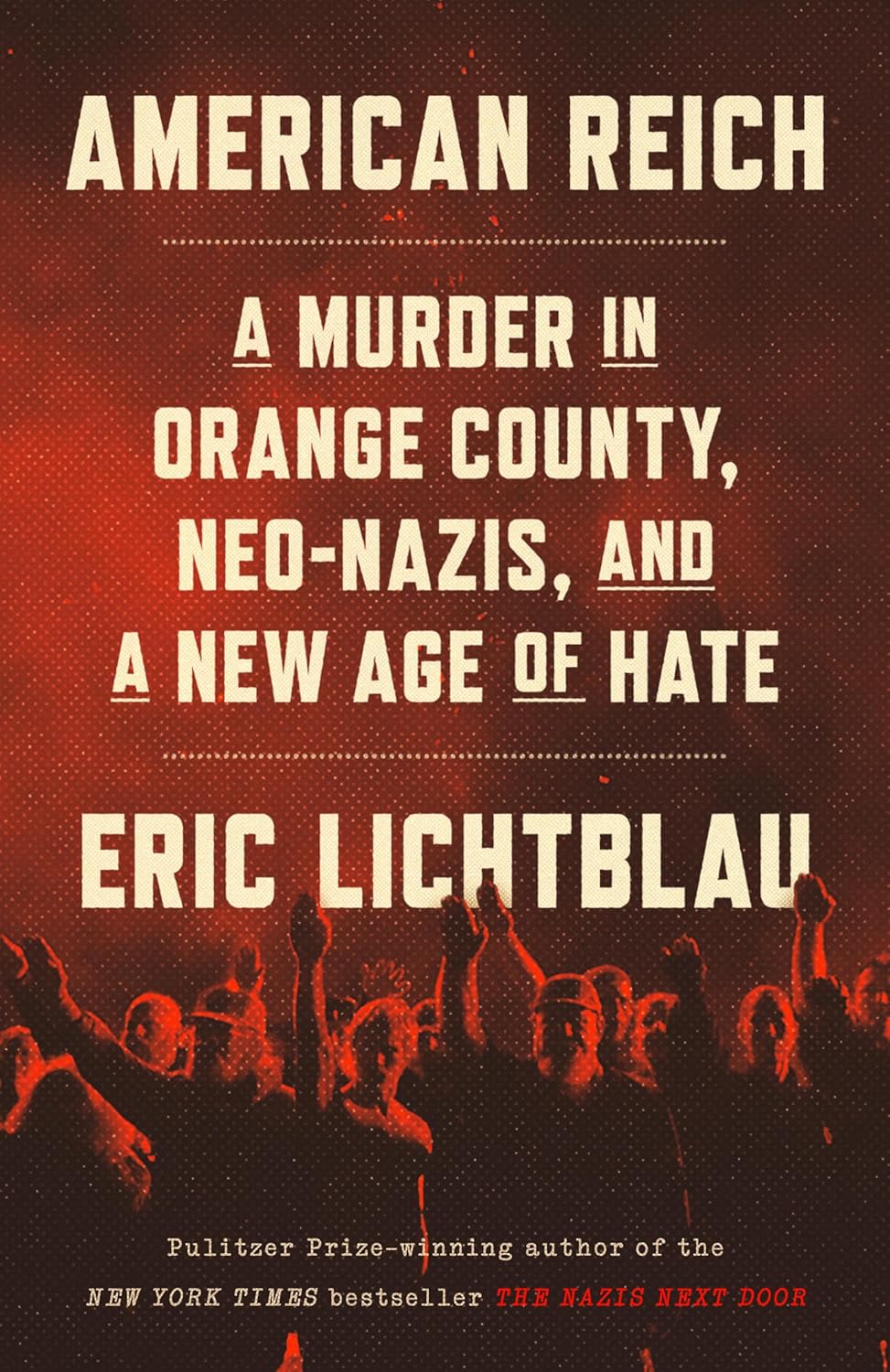
American Reich: A Murder in Orange County, Neo-Nazis, and a New Age of Hate
- By Eric Lichtblau
- Little, Brown and Company
- 352 pp.
- Reviewed by Robert Beauregard
- January 21, 2026
A sobering account of vitriol’s descent into violence.
On the night of January 2, 2018, in a park in Orange County, California, Sam Woodward, 20, stabbed 19-year-old Blaze Bernstein 28 times. Sam alone wielded the knife. He alone targeted Blaze for being gay and Jewish. Yet Sam was not solely responsible for Blaze’s death. His hate was fueled by the white-supremacist rantings he found online, his actions were encouraged by neo-Nazis, and his resolve was strengthened by a climate of anxiety that pervaded Orange County, once almost wholly white and arch-conservative and now racially diverse, more liberal, and with whites in the minority.
In American Reich, Pulitzer Prize-winning journalist Eric Lichtblau puts the country’s hate crimes into cultural and political context, giving singular attention to geography — Orange County being the “epicenter of violent bigotry in America.” At the core of his story is the spread of far-right extremism and the rising temperature of racism, xenophobia, misogyny, and antisemitism, all part of the divisiveness and intolerance at whose center was and continues to be the incendiary rhetoric of the once and current president, Donald Trump.
Woven throughout Lichtblau’s telling of this murder are other hate crimes committed by neo-Nazis and white supremacists. Among the most horrific: Payton Gendron’s 2022 killing of 10 Black shoppers at a Tops grocery store in Buffalo; Robert Bowers’ attack on the Tree of Life Synagogue in Pittsburgh in 2018, which left 11 congregants dead; and Wade Page’s killing of six worshipers at a Sikh temple in a Milwaukee suburb in 2012. The January 6, 2021, insurrection at the U.S. Capitol in Washington, DC, in which neo-Nazis and Orange County were well represented, was a less-deadly manifestation of right-wing extremism and far from a hate crime, but it was hardly nonviolent and hardly out of character.
Lichtblau is intent on assigning responsibility to Trump for the drumbeat of hateful speech and its all-too-familiar consequences. Trump has been unrestrained in his vitriol. He clothed his disdain for Barack Obama in racist rhetoric, characterized immigrants in derogatory terms, stoked the aggrievement of the conservative Tea Party, aligned himself with conservative Evangelicals and Pentecostals, and comforted white supremacists, most tellingly in his comments about the mayhem that descended on Charlottesville, Virginia, in 2017 following a “Unite the Right” rally, when he alleged a moral equivalence between far-right disruptors and peaceful counter-protesters.
Sam Woodward grew up in this environment. Always somewhat of a loner, he was adrift in his life. (Blaze Bernstein, meanwhile, was enrolled at Penn.) At home, he absorbed the homophobia of his father, who was vocal in his animosity toward gays. Sam’s intolerance was exacerbated at the arts high school he initially attended. Culturally diverse, the school was, for him, a desecration of the straight, white Christian world in which he had been raised. (Sam and Blaze attended the school at the same time but had little, if any, contact.)
When Sam discovered far-right online forums, he became even more outspoken about his antipathy toward those unlike himself. Subsequently, he joined and was further radicalized by the neo-Nazi Atomwaffen Division, a far-right extremist cell. He attended the Atomwaffen Division’s training camp to prepare for the coming race war and even made a pilgrimage to visit James Mason, a self-proclaimed Nazi and the author of the neo-Nazi bible Siege.
Trolling and pranking gays online, though, was demeaning for someone who “fantasized about the life of a militant fascist.” Sam wanted more than talk; he wanted action. Chatting online, he convinced Blaze that he might be gay and encouraged Blaze to meet with him. Killing Blaze made Sam a hero among neo-Nazis. Convicted of both first-degree murder and a hate crime, he was sentenced to life in prison without parole.
Lichtblau has written an engrossing and valuable exposé of this dark corner of far-right politics in the U.S. American Reich joins many recent books that reflect on political extremism, the deterioration of civility, and the emergence of authoritarianism at the highest levels of government. While hate groups have surged numerically over the last few decades, so have organized efforts to identify and resist them. Lichtblau mentions a few — e.g., an investigative journalist for ProPublica — but more attention to countermeasures would have tempered the emotional strain of reading about the harassment, assault, and killing of people selected simply because of their race, religion, nationality, or gender.
Lichtblau ends with an anecdote about white supremacists who support pro-Palestinian activists protesting Israel’s military activities in Gaza. When he questioned one of them about their allegiance, the response was, “We’re more anti-Semitic than we are racist!” Hate, it seems, is not without subtleties.
Robert Beauregard is an emeritus professor at Columbia University writing on politics, philosophy, and current events.