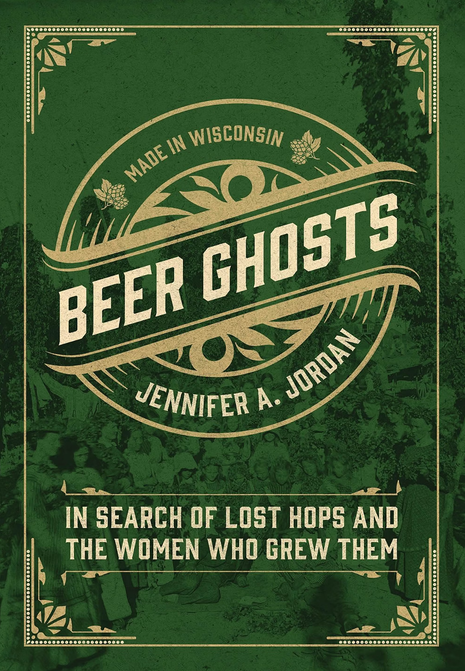
Beer Ghosts: In Search of Lost Hops and the Women Who Grew Them
- By Jennifer A. Jordan
- University of Chicago Press
- 312 pp.
- Reviewed by Rose Rankin
- November 20, 2026
A lively microhistory of a forgotten agricultural boom.
To say that Wisconsin is known for beer is like saying there’s a fork found in the kitchen. Icons such as Miller Brewing and Pabst may be owned or operated by multinational conglomerates today, but the connection between Wisconsin and beer remains strong, as evidenced by everything from scenes in “Wayne’s World” to comedians who post suds-filled stand-up reels on Instagram.
But as obvious as this connection seems now, there are still all sorts of forgotten histories about beer in the heartland, even to those of us born, bred, and steeped (or, perhaps, fermented) in the drinking culture here. Author Jennifer A. Jordan found one of these stories, and while her retelling is often too convoluted, it is revealing of what we can learn from the daily rhythms of life long ago.
Beer Ghosts: In Search of Lost Hops and the Women Who Grew Them is a microhistory of the brief period in the mid-1800s when Wisconsin was a major hop producer. It’s “micro” in that it focuses on a small number of figures, a short time frame, and a relatively defined geography. However, Jordan connects this history to larger socio-economic developments across the U.S. and Europe throughout the 19th century.
The famous breweries opened in Milwaukee on the shores of Lake Michigan, but hop farming flourished farther west in Sauk County, today the location of the ultimate Midwestern tourist trap, Wisconsin Dells. Hops traveled with a few families from Upstate and western New York, where settlers had been growing the crop for years, to Wisconsin as settlers moved westward. What is remarkable is how all traces of hop farming in Wisconsin have since disappeared, invisible even to those of us who’ve traveled I-90 between Chicago and Wisconsin Dells countless times.
It was this little region of south-central Wisconsin that produced millions of pounds of hops between 1865-1868. During those brief boom years, tens of thousands of young white women traveled to the hop farms to harvest the crop — picking hop cones by hand all day for a hectic few weeks as the crop matured in late summer, followed by nightly barn dances and parties while lodging in farmers’ homes.
Jordan meticulously studied agricultural census records, family histories, diaries, newspaper stories, and even headstones in remote cemeteries. From those, she recreates the annual pilgrimage of hop pickers and the laborious preparations by farmers’ wives and daughters to handle all these short-term boarders.
The depth of her research is impressive. The reader learns the intricacies of how hops are grown and harvested; how and when trainloads of young women inundated small towns and farmhouses; the way prices fluctuated season to season and year to year; and the creature comforts that farmers splurged on in the winter of 1867, the peak of the boom, when everyone was flush with cash. Even the Ingalls family of Little House on the Prairie fame makes a cameo, as Jordan tracked down Charles and Caroline’s brief foray into hop farming before the boom years.
Her work reveals that women of all ages were crucial to these cash crops, both as skilled harvesters and as those who fed and hosted them. It also shows that young women could travel independently and make money on their own, which is a far cry from the typical images of that time. As Jordan explains:
“In the nineteenth century, there was no beer without women. The dearth of labor in Wisconsin worked in favor of these young women and their own pursuit of piles of dollar bills and a pleasant excursion.”
As an historical snapshot, the story is fascinating. Yet, the brevity of the actual boom means that the author has a lot of space to fill, and too often she loses the plot. Jumping from New York State to Wisconsin and among different decades muddles the narrative, which is simply redundant at times. The reader quickly understands that the Wisconsin hop market flourished in a short amount of time, but it takes over 100 pages to get a clear statement as to why: failed New York harvests in the mid-1860s.
Despite this, the author brings together important historical perspectives in connecting the Wisconsin hop boom to larger currents. She is highly attuned to the role of race, noting that the annual pickers were almost entirely white women and that their relatively carefree travel was not enjoyed by Black women in the same way. Jordan also discusses Black farmers in Wisconsin at the time, deftly demonstrating that diversity was always a part of the frontier, but that economic opportunities weren’t equal.
Similarly, Indigenous people are key to this story. They lived and farmed alongside white settlers but were driven off the land used to grow hops before, during, and after the boom.
Hops’ environmental impacts aren’t as noticeable as, say, a huge cornfield, but the decimation of forests and wetlands for hop poles — the 20-foot-tall wooden poles that supported the climbing plants — was arguably just as damaging as plowing under the prairie for annual cereal crops. These discussions create a richer, more nuanced understanding of the changes wrought by settlement, agriculture, and economic expansion.
Those economic factors are a final thread that Jordan weaves throughout this history, namely, “that hop growing and other agricultural pursuits were quite often decidedly international and global, even in times and places that many people think of as remote and inaccessible.” Insects in New York State affected buyers in England, which affected the fields of Wisconsin and the lives of thousands of young women in the Midwest.
It’s those larger connections that too often get lost in a local history — which this book most certainly is — but to see them drawn together shows why understanding small moments in time is so valuable.
Rose Rankin is a freelance writer from Chicago. She focuses on history, science, and gender issues, in particular women’s literary history.