Coding Kids: Big Tech’s Battle to Remake Public Schools
- By Natasha Singer
- W.W. Norton & Company
- 352 pp.
- Reviewed by Aran Shetterly
- September 8, 2026
Turns out, Silicon Valley isn’t especially altruistic.
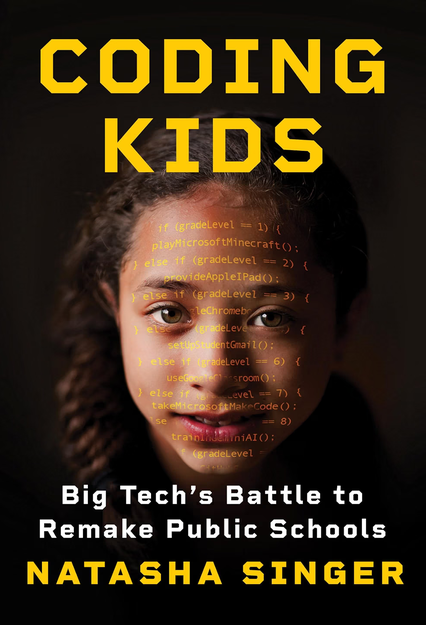
Natasha Singer’s Coding Kids lands in a storm of collective anxiety about how screens (shorthand for all the various computing machines influencing our lives) alter the way we experience the world and each other. “Techno-optimists” claim computing technology will set us on the path to greater individual freedom. The pessimists say it’s draining us of our humanity like an invasion of algorithmic vampires.
On social media and in TED Talks, social psychologists and education influencers snipe at each other. Some argue that artificial intelligence will make us smarter, improving individual educational outcomes. Others insist that social media and AI are rewiring our kids’ brains, allowing hallucinating machines to interrupt the development of their creative and critical abilities by delivering dopamine-spiking jolts of instant gratification and easy answers.
If I can’t stop looking at my smartphone, we all seem to be asking right now, what will this technology do to our children?
Singer does not attempt to resolve these concerns, at least not directly. Rather, Coding Kids homes in on something more fundamental: the financial and political power Big Tech wields to tilt important debates about the physical, cognitive, and emotional effects of social media on children in its favor and to make skeptics feel like they’re fighting from behind, nearly powerless to resist the tsunami of new and untested technologies — and the curricula built around them — that are taking over our public schools.
“I’ve become increasingly fascinated by how some of the world’s richest companies and executives are employing their money and their might to reshape education across the United States and beyond,” Singer writes, begging essential, age-old questions: What’s the proper balance between private industry and government regulation in a democracy? Should education train children for industrial jobs (and to consume Big Tech products) or to be “interrogators of technology,” who, as engaged citizens, help set the governmental policies that regulate Big Tech?
A reporter at the New York Times with a decade of “edtech” experience, Singer reaches back to Thomas Edison, an early proponent of “rich man’s education reform,” as she calls it, to show that technologists and entrepreneurs have long believed that entertaining and “objective” machines could replace expensive and “biased” teachers in the classroom. At the center of her book is the story of the nonprofit Code.org and its charismatic, Harvard-educated leader, Hadi Partovi. Thirteen years ago, Partovi produced a five-minute video called “What Most Schools Don’t Teach.” This “audacious act of Silicon Valley influencer marketing...aimed...at a low-resourced nonprofit sector: public schools serving millions of children,” delivered a worrying message: Kids who didn’t learn to write code would be left behind. And the long-term success of the United States economy depended on training these students to fill a million open tech jobs.
Armies of well-funded lobbyists, greater in number than those promoting gun, healthcare, or reproductive-rights policies, Singer suggests, marched forth with Partovi’s video to “seduce” lawmakers with “tech processes and lingo” and convince them, for the sake of our youth and national economy, to make computer-science classes a requirement in the nation’s public schools. Through the story of Code.org, Singer takes us into the practice of “deep lobbying,” which describes the way powerful corporations stealthily use nonprofits, think tanks, and academics to create a cultural and intellectual context that makes their profit-seeking interests appear altruistic.
In her urgent narrative, Silicon Valley “lingo” comes across as Orwellian. Terms like viralize, disrupt, pivot, nimble, and unicorn make companies with trillion-dollar market capitalizations and their billionaire owners seem cute, exciting, and entertaining, as if we’re watching an episode of “Paw Patrol” rather than a group of power-hungry oligarchs taking over the world. But no word in Coding Kids chills more than “democratize.” “Democratizing” sounds a lot like “democracy,” but the tech-elite byword has nothing to do with a form of government; from the lips of the tech barons, it means enforcing ubiquitous access to their products.
As important as her deep reporting on the tech industry’s ruthlessness are Singer’s profiles of the inspiring cadre of academics, educators, and activists who are documenting and resisting the likes of Google, Microsoft, Apple, Amazon, and Oracle — and now, too, OpenAI and Anthropic — that are “capturing” the government agencies meant to regulate them and turning public schools into workshops where young people’s habits become cemented to their products.
Singer’s timely book and these tireless advocates for an independent education system exhort us to exercise our power as citizens. If we don’t, they warn, we’ll pay for Big Tech’s products not only with our money and attention but also with our children’s education and, eventually, our democracy. Says one educator she interviews, “I have a ten-year-old daughter. I certainly want her to have a job…But I want her to live in a democracy. I want her to flourish as a human being.”
Aran Shetterly is a writer and developmental book editor. He lives in Charlottesville, Virginia, with his wife, son, and dog, Danny. His most recent book is Morningside: The 1979 Greensboro Massacre and the Struggle for an American City’s Soul.