Desire Lines: A Memoir
- By Kristen Millares Young
- Red Hen Press
- 216 pp.
- Reviewed by Yelizaveta P. Renfro
- November 5, 2026
This insightful reflection suffers from its author’s reluctance to share more.
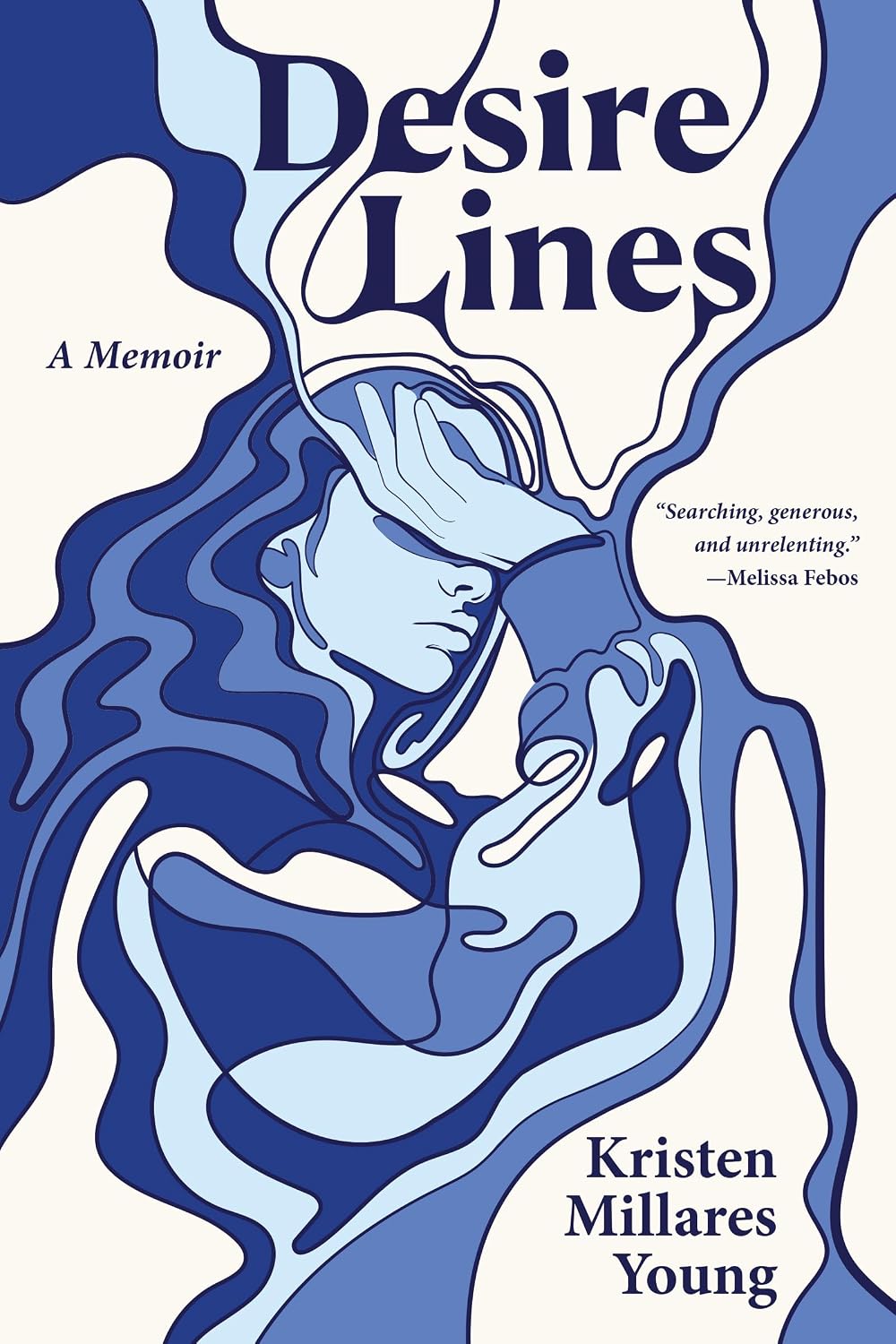
In Desire Lines, a memoir-in-essays, novelist and journalist Kristen Millares Young blends personal experience with family history and research to create a multilayered narrative exploring trauma, belonging, and identity.
Millares Young places the diasporic experiences of her matrilineal line from Spain to Cuba to the United States alongside her research on the ancient goddess Cybele, which she embarks on after making the startling discovery that “God was once a woman.” Her project, as she lays it out in the first essay, “Great Mother,” is “to excavate womanhood, the body, and the sacred.”
Writing candidly about her bout of ovarian cancer at the age of 22, her parents’ multiple cancers, weight and body image, and birth and motherhood, Millares Young doesn’t shy away from exploring corporeal matters. In fact, vesting her female body with power is a large part of her mission. “I spent much of my life accrediting my brain so I would be allowed to rise from this body and be seen for my mind,” she writes. “And yet, as a writer, I’ve learned there is no greater wisdom than that of my womanhood.”
Millares Young also writes of the creative mother’s struggle to make art while caring for her family:
“I ache to create. Without wishing away my sons and husband, I carve tunnels through our time. I climb through these wormholes into worlds of ideas. To control my body is to claim my future.”
In a number of places, we see her simultaneously embracing her role as a mother while striving to make her art. In one noteworthy scene, she is forced to leave her children unattended in a hotel room because they are not permitted to accompany her into the Cabinet des Dessins in the Louvre, where she has come to do research on Cybele. “As I study the mother goddess, I am aware of the gatekeeping that compels me to abandon my maternal obligations to access her,” she writes. “Institutions expel mothers like shrapnel.”
Another central thread Millares Young addresses in the book is the complexity of her identity. She writes:
“I am white and American on my father’s side of my family, and I am Cuban on my mother’s side, darkened by the presence of her father. Those things are not separate in my body. I am Cuban American. That term feels very ’90s. I call myself
LatinaLatinxLatine in solidarity.”
While she devotes essays to both parents and both sets of grandparents, she lingers more on the Cuban side of her family. After her parents divorced, Millares Young was cared for by her maternal grandparents, Abuela and Abuelo. Abuse at the hands of her grandfather casts a long shadow as she strives to process the complex reasons underlying why her parents and Abuela did not do more to protect her. “Is it possible to be both cherished and neglected?” she asks, excavating her childhood. She concludes that it is. Her “specific trauma,” she writes, is “collective disregard”:
“My family’s refusal to confront what happened has affected me more deeply than the abuse itself.”
This disregard for her wellbeing is a central preoccupation of Desire Lines. “I still wrack my brain to find an answer to why my mother assigned her father, whom she knew to be a pedophile, to be my primary caretaker and driver,” she writes. “I try not to think of him, but memories appear. I won’t share them with you.” Over and over, she resists offering more details. “I want to be done with this essay, but I’ve been told that I haven’t shared enough,” she writes, quoting extensively from her editor’s comments. Still, she insists on her “opacity,” arguing:
“With my refusal to provide sordid scenes, I ask readers to trust that my dismay was earned. I decline to recreate the abuse so others can decide whether to mete out condemnation or compassion, nor will I reenact my trauma for titillation.”
While she makes a compelling argument, this position at times feels like a continuation of the “silence” that she claims was “the organizing principle” in her family. They did not speak of the abuse, and neither does she — at least not explicitly.
Millares Young’s style is often oblique and even evasive; it’s as though she’s speaking in circles around the abuse, sometimes deflecting with meta-commentary, sometimes disappearing into the background behind her research. She protects herself, understandably, but the result can be a tone that is detached and emotionally distant, keeping the reader at arm’s length and never quite revealing what is most tender and vulnerable.
There is certainly much of interest in Desire Lines, but there is also much that is held back. Millares Young’s book is a balancing act between what she identifies as “the double blade of writing — the invitation and the veil.” By the end, the veil remains stubbornly present, obstructing the reader’s view of the emotional core at the heart of this otherwise shrewd memoir.
Yelizaveta P. Renfro is the author of the essay collections The Season of Birds and Stones and Xylotheque, and a collection of short stories, A Catalogue of Everything in the World. Her fiction and nonfiction have appeared in Glimmer Train Stories, Creative Nonfiction, North American Review, Colorado Review, Alaska Quarterly Review, South Dakota Review, Witness, Reader’s Digest, and elsewhere. She holds an MFA from George Mason University and a Ph.D. from the University of Nebraska.