Duet for One: A Novel
- By Martha Anne Toll
- Regal House Publishing
- 234 pp.
- Reviewed by Kate Preziosi
- May 21, 2025
Art comes before love in this wise, capable novel.
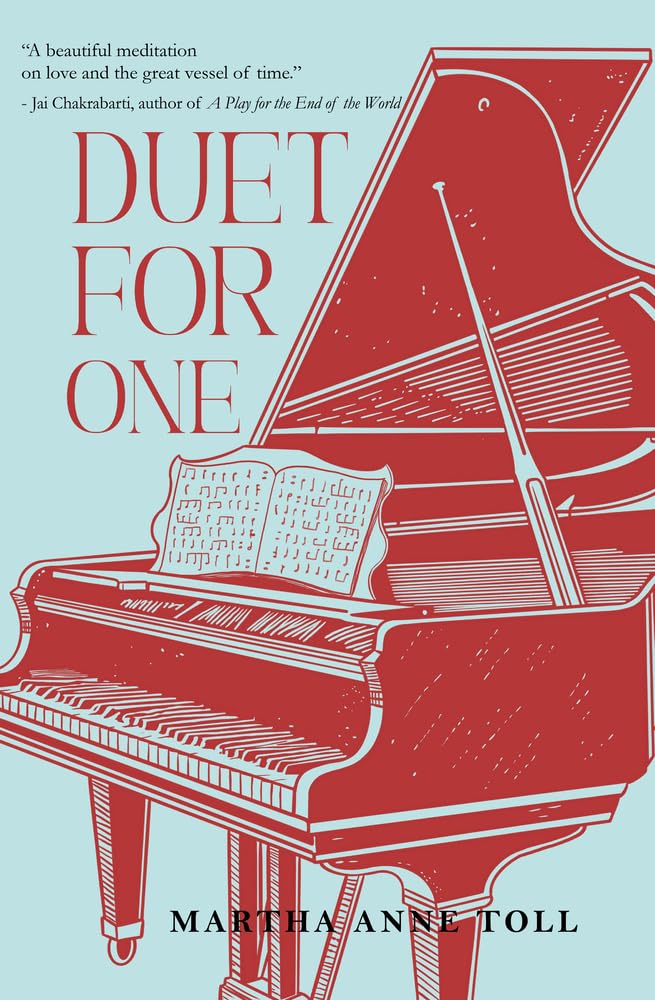
When we meet Victor and Adam Pearl, the father and son at the center of Martha Anne Toll’s latest novel, Duet for One, they’re men out of time. Their wife and mother, Adele Pearl, is dead. She was a renowned classical pianist, playing around the world with Victor as the “Pearl and Pearl” piano duo. She was Adam’s mentor, encouraging his early talent for the violin, pairing him with all the right teachers and agents. In Adele’s wake, Victor is bereft. Adam is simply numb.
Duet for One takes readers behind the velvet curtain into the rarefied world of elite classical musicians, where only those with an alchemy of raw talent, commitment, and ambition may enter. As with her celebrated first novel, Three Muses, Toll writes with authority from her own experience of having trained as a classical violist. The story moves back and forth between the family’s early years and Adam’s relationship with his first love, Dara Kingsley, while following the Pearls and Dara in the present day.
One of the most effective ways that Toll invites non-musical readers into this world is when she’s describing the music itself: “The Pearls’ apartment…had been transformed, piano playing infusing it like incense in a temple.” She establishes who her characters are based on how they play; Victor “sounded sublime –– a confectioner pulling taffy,” while Adele “pulled music out of every note like a famine victim sucking marrow.”
Toll’s lush writing captures what it must feel like to have this kind of transcendent talent. It’s divine. When these characters perform, it’s like they’re leaving the earth entirely and speaking to one another in a secret language that only they can hear. In one scene, Adam and Dara attend a concert featuring his parents, and she observes that Adam is “enraptured; he understood what he was listening to.”
While music is a shared language for those in this world, it also serves to drive them apart. As condolence letters pour in from Adele’s former students and colleagues, Adam doesn’t recognize the “kind,” “wise,” “beloved” woman they write about. He only knew Adele for her relentless, singular focus on her music and for always keeping him at a painful distance. What emerges through flashbacks is a portrait of a parent and child who didn’t know how to reach one other, a common wound that Toll expertly tucks into the insular bubble of her novel.
Music brings Adam and Dara together as teenagers going down the same track. But when Dara chooses to go to college and continue practicing the viola outside of school (rather than attend an elite performing-arts academy), the relationship fractures. Adam indicates that he’d love to study political science or English literature, and she encourages him to pursue other interests. “I’ve never seen anyone make it work,” he says, seeming to forget that Dara is, in fact, trying to make both work. She eventually leaves him because, as both she and Adele believe, “It would be easier for him to be with a musician.”
There’s a musical quality to how Toll marks the passage of time across the narrative. She reinforces the idea that a gifted musician knows how to manipulate time –– to lean into silence as much as to fill it. “Music captures time,” Dara’s instructor tells her, “it molds and bends it. Sound is the passage of time.” After Dara and Adam break up, there’s a long, drawn-out silence of about 20 years between them. When they eventually reconnect, Adam notes that Dara’s conversation “sounded as if she’d picked up with [him] after a day or two apart,” much like a pianist might draw out a silence before playing the final notes of a piece.
The novel would’ve been better served with a lighter touch on this connection between time and music. In the second half, the theme becomes all text and no subtext when Dara, who is an English professor in the novel’s present, teaches a seminar on “Time, Music, and the Twentieth-Century Novel” and hosts a discussion with a famous composer viewed as an “expert on time.”
There’s also the matter of Adam’s characterization. In the two decades he and Dara spend apart, she transforms as a person. She leaves music and makes peace with it. She builds a career in academia, gets married, divorces, and forges an independent life that allows her to see in retrospect that her reasons for leaving Adam were youthful and wrong.
Adam, however, seems stuck in time. As both a teen and an adult, he fixates on his mother and what he sees as her deficiencies. After Dara, he has a “series of unsatisfying liaisons,” all of them with Adele-approved musicians whom he treats poorly. Several times, he declares that he needs to follow his own path, only to continue down the one his parents paved for him. Perhaps most notable is that, despite their years apart, he doesn’t seem to have reflected on what led Dara to leave him — a rupture that was a source of real pain and trauma, and that altered the course of his romantic life.
Adam’s stagnation may be intentional on Toll’s part. At one point, when he finds himself angry at Adele for neglecting him as a child, he considers that, as a man now in his late 30s, he might be “too old for these mental ravings.” Later, he goes deeper, wondering whether he may be “stuck in arrested development, still aching for his mother’s approval –– which would never come –— while wearing the trappings of adulthood.” By the end of the book, it does seem like he’s on the verge of an emotional breakthrough. Still, I can’t help but want better for Dara.
Kate Preziosi is a New York-based writer. Previously, she worked at the Wall Street Journal and theSkimm, where she was a founding team member. She holds an MFA in nonfiction from the New School.