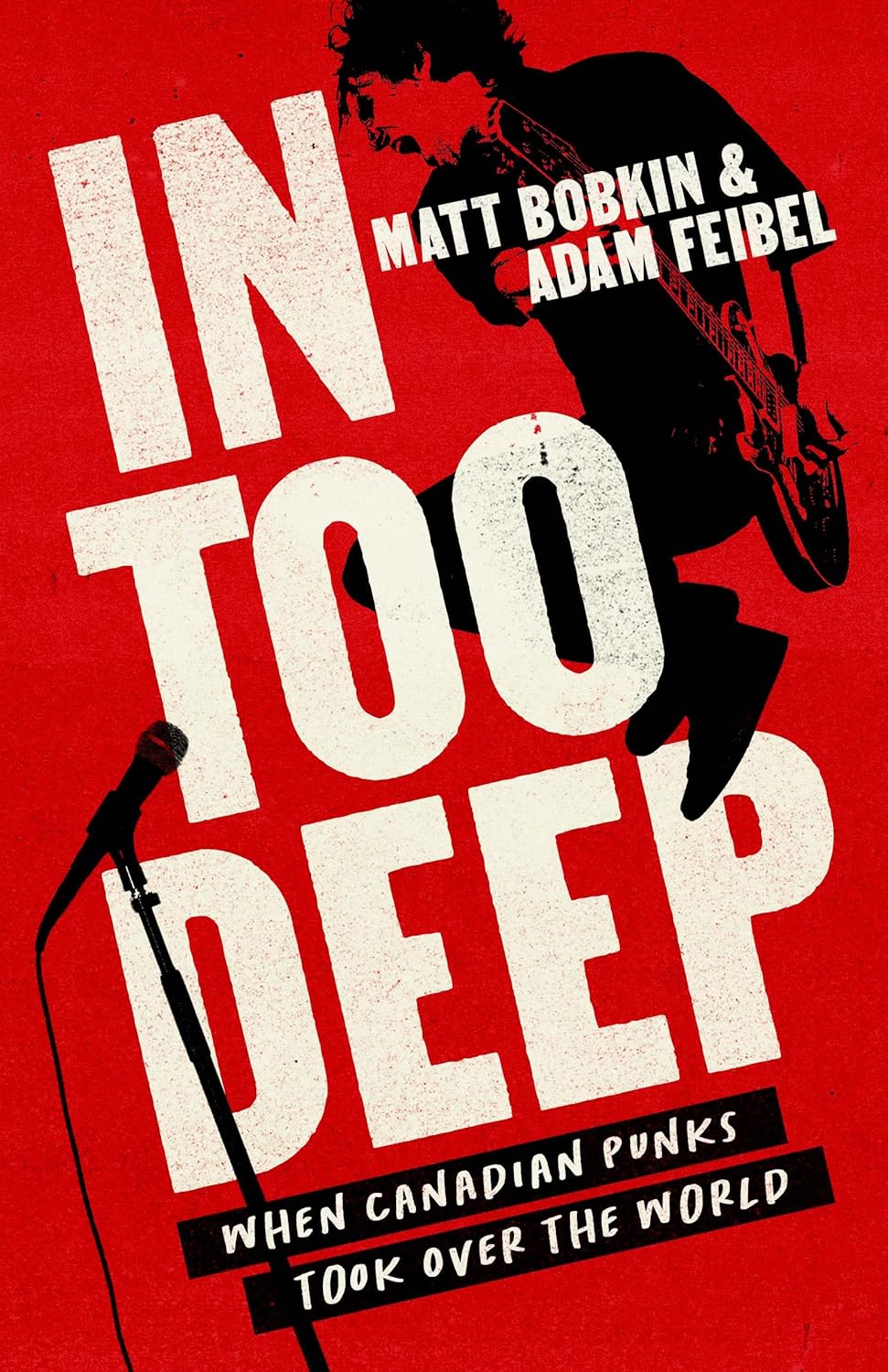
In Too Deep: When Canadian Punks Took Over the World
- By Matt Bobkin and Adam Feibel
- House of Anansi Press
- 344 pp.
- Reviewed by Michael Causey
- September 4, 2025
Our reserved neighbors to the north can rock like badasses, too.
There’s a rarefied level of hyperbole employed in certain arenas: on the campaign trail, in TV ads populated by paid actors hawking wonder drugs, and in the subtitles of nonfiction books clamoring for attention on the crowded shelves at your local Barnes & Noble.
It’s been a few years (okay, 40) since I was a young flunky in a New York City publishing house, but I suspect the latter are still usually chosen by editors rather than authors. So, we probably shouldn’t hold Matt Bobkin and Adam Feibel responsible for In Too Deep’s subtitle; they likely never intended to claim on their book’s cover that 1980s Canadian punks ever took over the world.
Instead, they’re honest when they write that “every Canadian story is an underdog story — that’s just the Canadian way.” The two Toronto-based music journalists, obvious fans of their homegrown punk, are at their best when letting the musicians do the talking in dozens of excellent, insightful interviews about how America’s polite neighbor to the north spawned its “outsize role in pop-punk’s heyday” with acts like Avril Lavigne, Simple Plan, Gob, Sum 41, and a host of others.
The book features well-written narratives chronicling the rise, fall, (sometimes) second rise, (sometimes) second fall, and general roller-coaster ride many of these bands went on as they encountered fickle fans, devious record executives, and the kind of inner turmoil one can only find on an episode of “Real Housewives of (fill in the city)” or in a rock band.
Reading it as an American, I got a clear sense of how Canadians view themselves vis-à-vis their mouthy superpower neighbor. “I think the hardest job in the music business in the entire world is doing A&R [artists and repertoire] in Canada for a major label,” a Canuck record exec laments. “If you sign with an American label or a British label, then the Canadians resent it, and they don’t work your record very strongly in Canada. And yet, the chances of being successful with your records [on a Canadian label] outside of Canada are very small.”
When big-in-Canada punk band Gob stumbles while trying to tap the huge market to the south, “it was like looking through a one-way mirror,” the authors write in what becomes a familiar refrain. “Canada’s reputation as America’s dorky upstairs neighbor was hard to shake.”
After giving readers the lowdown on dozens of performers via engaging anecdotes and sharp observations, Bobkin and Feibel end with a nice epilogue showing how those punks of yesteryear are mostly still doing their thing and being appreciated on nostalgic festival tours. Decades on, thousands of grown-ups are flocking to Las Vegas and elsewhere to relive teenage triumph, ignoring lingering knee and lower-back pain for a few hours as they listen to Lavigne belt out “Sk8er Boi,” Sum 41 crank up “Fat Lip,” and Simple Plan sing without irony, “I’m Just a Kid.”
Finally, there’s something exquisitely Canadian about learning in the small print that the publishing of In Too Deep — this portrait of punkers railing against the Man, capitalism, and other evils — was financially supported by the Canada Council for the Arts, the Ontario Arts Council, and the government of Canada. It doesn’t get much more punk than that.
Michael Causey is a frequent contributor to the Independent and just wrapped up a nine-year gig as a DJ on WOWD 94.4 FM Takoma Park, MD.