It Could Be Otherwise: Science in the Age of Uncertainty
- By Stuart Firestein
- Basic Books
- 288 pp.
- Reviewed by Raima Larter
- September 30, 2026
Research shows there’s no substitute for research.
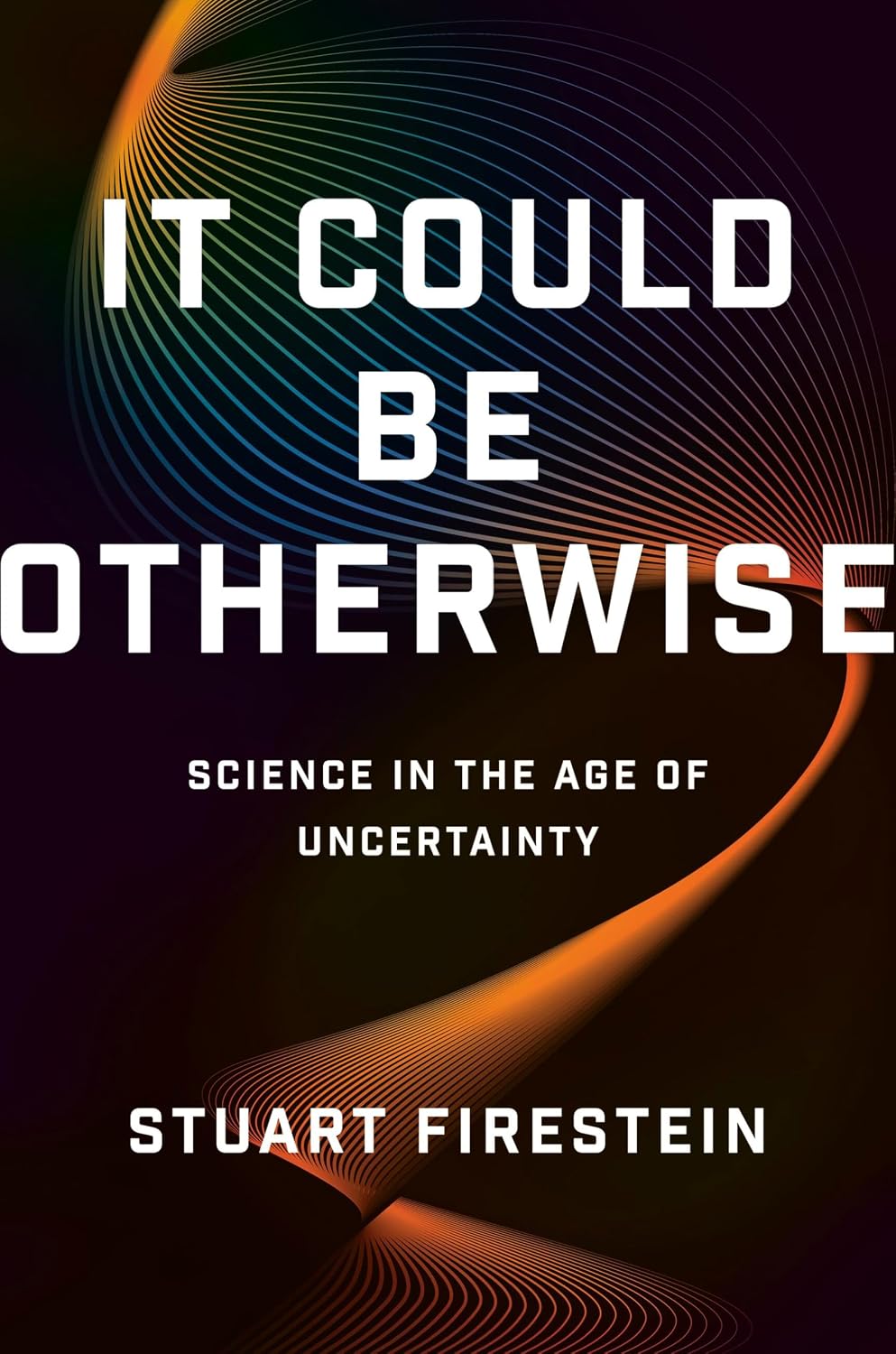
Stuart Firestein, a neuroscience professor at Columbia, begins It Could Be Otherwise with the phrase, “This is a book about optimism.” His thesis is that science and the scientific enterprise are inherently optimistic, even though he believes most members of the public don’t know or appreciate that.
And, in what seems to be an oxymoron at first glance, he also suggests that failure in science is the driving force behind this optimism. After all, why go to all the trouble of doing an experiment unless you’re trying to figure out why the last one failed? You have to be either a masochist or an optimist to keep looking failure in the face like that.
Or, you have to be a scientist.
He quotes Isaac Asimov (both a sci-fi author and a real-life scientist) as claiming that the words a scientist wants to hear when going over new data is not, “Eureka!” but “Hmmmm, that’s strange…”
It’s the unexplained that really gets a scientist going. We thrive on things that are not understood — hence, the book’s subtitle: Science in the Age of Uncertainty. Of course, all ages have been uncertain, but Firestein argues that it’s really only in the modern era that this uncertainty has been recognized as a good thing.
The book is a wide-ranging exploration of topics covering the history of science, from the origin of the term scientist (an amalgamation of “artist” and “science”) to developments in the newer science of complex systems. Firestein offers several new ways of thinking about the scientific method, which he suggests is widely misunderstood. As a scientist myself, I can confirm that his five cognitive tools, or “cogs,” as he calls them, are pretty much the way science is (and always has been) done.
The first cog is “Renunciation of Authority,” which might seem strange to a layperson, but it is necessary to reject any statement of truth coming from above if you want to find the real truth. The second, “Experiments,” is, obviously, how science is done — try something, see what happens, and then develop a theory or mechanism that explains it.
The third cog, “Failure,” might be the most surprising, but it’s more the norm than success is. Failure is also the reason science continues; a failed experiment generates more questions to investigate. The fourth, “Provisional Belief,” might be surprising to those who think ultimate truth begins with the phrase, “Science has shown…” Anything science has “shown” comes with a number of caveats, as any scientist can confirm. We determine the truth, but only within certain limits dictated by the experiments carried out.
The final cog, “The Power of Counterintuitive Thinking,” demonstrates just how crucial creativity is to doing science. As Firestein puts it:
“Right there at the very beginning of modern science was one of the most counterintuitive thoughts in all of history. What could be more counterintuitive than thinking the Earth is rotating and the sun is standing still?”
The book goes on to consider uncertainty, specifically the type arising in complex systems in which phenomena such as chaos can occur. One chapter reviews concepts related to uncertainty — including bifurcations, chaotic behavior, and nonlinearity — but as the author gets many things wrong here, it’s clear he’s not an expert in this field. I could say the same about some of his explanations of thermodynamics. He seems to shy away from, if not outright dismiss, anything requiring math or physics for an accurate explanation. (In other words, don’t use this book for good explanations of complexity theory; there are better sources for that, a few of which are listed in the bibliography.)
I felt more confident in his discussions of matters involving the brain, but since his area of expertise is neuroscience, this is not a surprise. There are also many interesting anecdotes from working scientists, along with funny quips and side comments from the author himself. His writing style is engaging and easy to read, and he’s avoided the trap that so many scientists-turned-authors fall into of losing your audience before you get to the point.
Firestein makes clear that his motivation for writing the book is to spread the word that even in the face of uncertainty, or because of it, science is the way to go:
“It is the very knowledge of how little we know when we look up into the endless night sky, or at a thousand-year-old tree branching in complex patterns, or at a line of ants marching around to support a hidden city of millions that makes us humble…It is awe and wonder — words that we have allowed, to our considerable loss, to become childish — that lie at the heart of science.”
In the end, this book, despite its flaws, is an eloquent and impassioned defense of the noble pursuit of science, one that’s especially welcome now, in this most uncertain of times.
Before moving to Colorado, Raima Larter was a chemistry professor who secretly wrote fiction and poetry and tucked it away in drawers. She has published four novels, a nonfiction book, and numerous short stories. Her most recent book, Silver Rush, is the first in a series of historical novels and novellas. Read more at raimalarter.com.