Judy Blume: A Life
- By Mark Oppenheimer
- G.P. Putnam’s Sons
- 480 pp.
- Reviewed by Kitty Kelley
- February 24, 2026
An adoring ode to the beloved author.
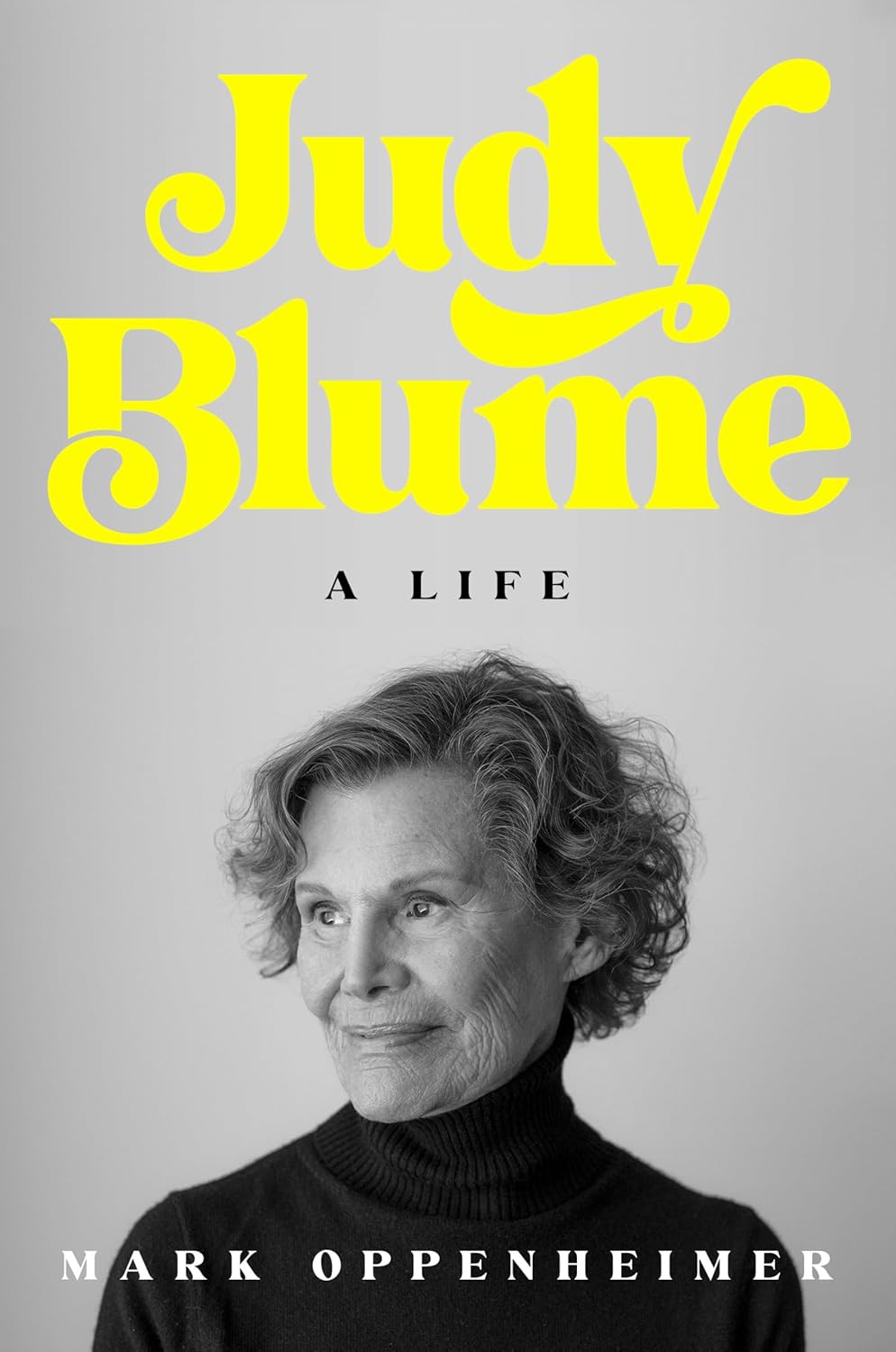
All the little girls — now mothers and grandmothers — who grew up reading Judy Blume will celebrate this biography of the beloved author. Great-grandmothers will applaud the cover photo of the 88-year-old writer who still looks great. (Yes, she follows the Katharine Hepburn rule for women of a certain age: Wear turtlenecks.)
Judy Blume is a coronation of sorts. Mark Oppenheimer grew up reading and re-reading Blume’s books. His essay “Why Judy Blume Endures,” which ran on November 16, 1997, in the New York Times Book Review, extolled Blume as the professor of puberty: popular with children but lacking adult acclaim.
“I was assigned [Scott] O’Dell’s Island of the Blue Dolphins three times and was made to read each volume of [Madeleine] L’Engle’s Time trilogy,” he wrote. “No teacher ever assigned Judy Blume.” Oppenheimer, who holds a Ph.D. in religious studies from Yale, chose to read Blume because of her books’ realism: They dared to address subjects like birth control, religion, and even class.
An unabashed fan, he decided to honor his idol with his first biography, for which Blume gave him full access. She sat “for hours of interviews, in person and on the telephone.” She answered “hundreds of questions by email” and offered access to her husband, her children, her assistants, her friends. Oppenheimer sent her his first draft, and she responded with dozens of pages of corrections and additions. Not since Boswell has a biographer bagged such a bonanza.
In his chatty narrative, Oppenheimer states that Blume had “three great assets” as a writer:
- She was productive. “[F]rom the beginning of 1967 through the summer of 1968, she generated multiple books of various lengths, comprising hundreds of pages of text and drawings.”
- She was hungry for criticism. She wanted to improve and looked for people to help her.
- She knew when to take the criticism and when to leave it.
It may be reassuring for aspiring writers to read of Blume’s many rejections before she finally got published and the immense fortitude she developed to keep on plugging away, which suggests that success is persistence in disguise.
Judy Blume began life in 1938 as Judith Marcia Sussman in Elizabeth, New Jersey, a “scrawny, chronically underweight” girl in a mostly secular Jewish family. Her father was a dentist; her mother kept house for Judy and her older brother, David. After graduating from Battin High School — a “large comprehensive high school with a student body that was diverse, if not by sex or race (all female, about 90 percent white), then by interest,” writes Oppenheimer — Blume briefly attended Boston University before enrolling at New York University, where she earned a B.A. in education.
“I married at twenty-one, had two children, and at twenty-eight, with a five-year-old daughter and a three-year-old son, realized I needed something else in my life,” she recalled. “A creative person with no outlet is in real danger of falling apart.” So, she made felt wall-hangings that she sold to Bloomingdale’s. She tried songwriting. Then, she took a night course on creative writing and decided to compose stories for children, with a “dream of becoming the next Dr. Seuss.”
Feeling suffocated, Blume left her first marriage after more than 15 years and immediately rebounded to a second husband but left him, too. In 1987, she married George Cooper, and they remain together to this day.
I grew up with Winnie-the-Pooh, the Bobbsey Twins, and Nancy Drew, so I missed the bounty of Blume’s books, but what a feast she’s served. Of her 30-plus titles for children, teens, and adults, the most popular were published in the 1970s, her most productive decade, and include Tales of a Fourth-Grade Nothing (1972), which recounts an elder brother’s envy of his younger sibling; Deenie (1973), which explains scoliosis and masturbation; Blubber (1974), which chronicles an overweight girl’s adolescence; and Forever… (1975), which deals frankly with teenage sexuality and features a penis named “Ralph.”
That latter book has been a target of censorship for 50 years. Blume explained on her website that she wrote it because her daughter “asked for a story about two nice kids who have sex without either of them having to die.” National Public Radio lists Forever… as one of the “100 Best-Ever Teen Novels.” Yet, to this day, it remains banned in Florida, the number-one state for book banning. (Ironically, Blume has a home in Key West, where she co-owns a bookstore in which no books are banned.)
One of the author’s most famous books is the 1970 tale of a little girl who shares her intimate secrets with God, Are You There God? It’s Me, Margaret, which has sold millions of copies. More than five decades after its publication, the middle-grade novel is still banned in some schools because it addresses menstruation. By the 1990s, multiple Blume books were on the American Library Association’s list of the 100 most-banned books in America — again because, in them, she addresses topics such as sexuality, fat-shaming, divorce, and bullying.
Throughout her career, Blume has fought hard to protect her work. She challenged school boards on their bans, testified in court, disputed religious groups that denounced her, and always cheered the librarians and booksellers who supported her. At times, the criticism was ferocious. On an episode of the TV show “Crossfire” in 1984, conservative commentator Pat Buchanan asked her, “What is this preoccupation with sex in books for 10-year-old children?” Blume smiled. “Are you hung up on masturbation?” she retorted.
When Blume wasn’t writing, she bought houses in New Mexico, Martha’s Vineyard, London, Florida, and New York. Then she redecorated them. “The truth is, I’m a houseaholic,” she told Architectural Digest in 2013. “I love to create a new nest.”
Now that Blume has retired, she’s been blessed with an adoring biographer who is also a longtime believer in her work. While Judy Blume will never rival Boswell’s tome on Samuel Johnson, it’s a 480-page paean that should earn Oppenheimer a front-row seat in “Blume-world.”
[Editor’s note: Due to editorial errors, a prior version of this review contained misattributed quotes and mistakenly stated that Ms. Blume was raised an Orthodox Jew.]
Kitty Kelley is the author of seven number-one New York Times bestseller biographies, including Nancy Reagan, Jackie Oh!, and Elizabeth Taylor: The Last Star. She is on the board of the Independent and is a recipient of the PEN Oakland/Gary Webb Anti-Censorship Award. In 2023, she was honored with the Biographers International Organization’s BIO Award, which is given annually to a writer who has made major contributions to the advancement of the art and craft of biography.