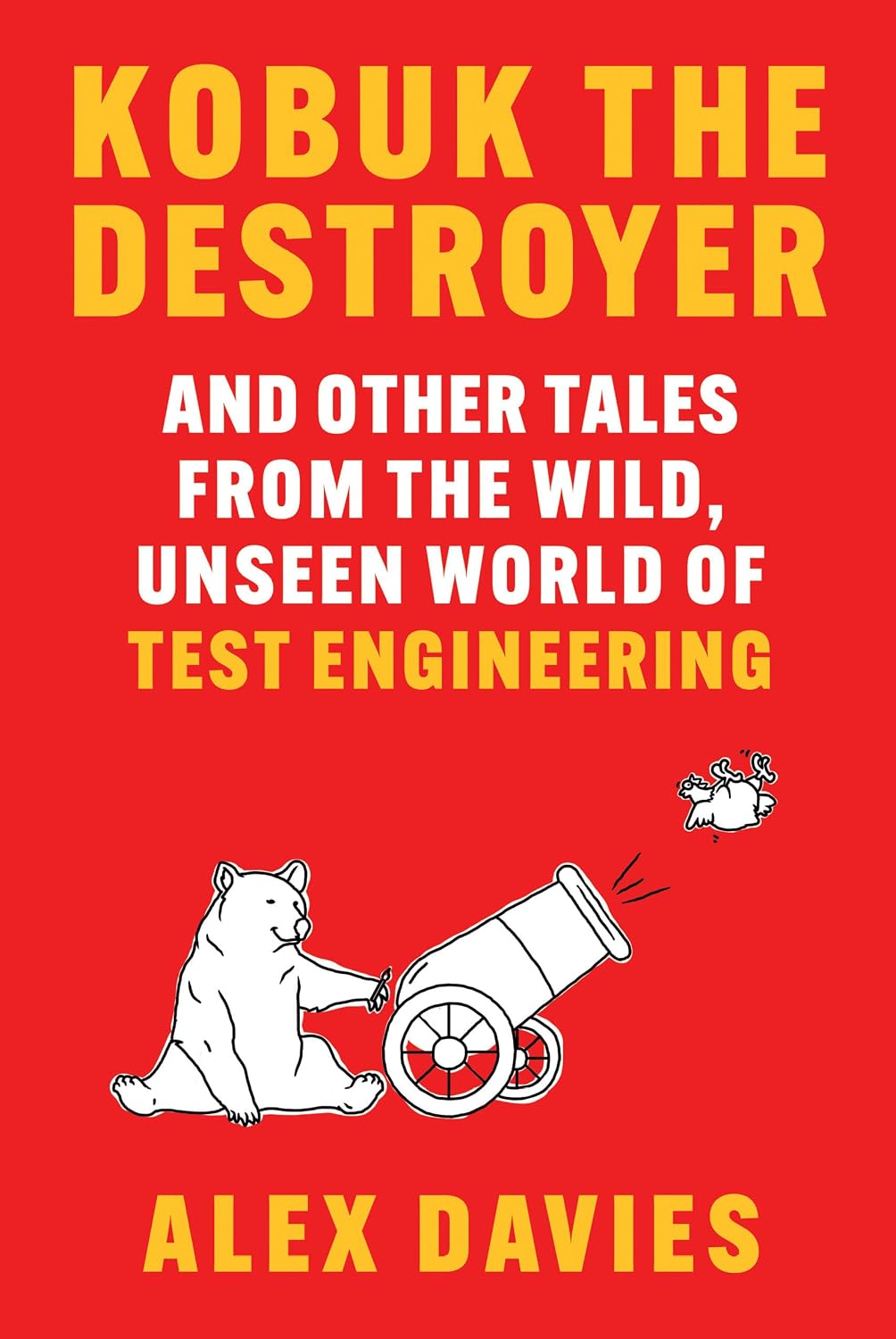
Kobuk the Destroyer: And Other Tales from the Wild, Unseen World of Test Engineering
- By Alex Davies
- W.W. Norton & Company
- 272 pp.
- Reviewed by Randy Cepuch
- August 31, 2026
Angry bears and fake derrieres help keep us safe.
It’s hard to pick a favorite “Calvin and Hobbes” cartoon, but mine features the rambunctious and precocious 6-year-old boy asking his father how weight limits on bridges are set. Dad cheerfully pulls his son’s leg, explaining that they keep driving heavier trucks over the bridge until it collapses, then they weigh the last truck and rebuild.
Cartoonist Bill Watterson may or may not have known it, but in the 1870s, the Eads Bridge in St. Louis — then the world’s largest arch bridge, more than a mile long — was tested in more or less that very way. As Alex Davies explains in Kobuk the Destroyer and Other Tales from the Wild, Unseen World of Test Engineering, for several weeks, 14 locomotives of steadily increasing weight were run over the span, far exceeding what they expected the bridge to hold. (No rebuilding was needed.)
If, like Calvin, you’ve ever wondered how “they” figure out what’s safe, you’re sure to love this book. It’s an engaging and entertaining celebration of the people — and the animals, like the titular Kobuk, a grizzly who establishes what items can be considered bear-resistant — who try to protect us from dangerous products and our own stupidity:
“The test engineer gets little attention in a world that lionizes inventors, and that’s a shame not just because their work involves chicken cannons, flamethrowers, and mischievous grizzly bears, and not just because they rely on the same ingenuity, foresight, and creativity that fit the inventor stereotype. It’s a shame because they are the ultimate fixers, the people who turn inventions into products by earning and rewarding the public’s trust.”
Their work takes into account all sorts of variables — the effects of temperature, moisture, and a determined baby’s teeth, to list just a few. How a product survives repetitive use is often crucial, so, at GE’s lab, there’s a room full of refrigerators whose doors are opened and closed all day long. Meanwhile, IKEA’s testing includes lots of wooden “rumpas” being pressed into chairs over and over again, and at Boeing, a 200-pound mechanical butt is lowered onto airplane toilet seats “thousands of times.”
While engineers try to predict everything that can go wrong, surprises are inevitable. Ever wondered where the term “Murphy’s Law” came from? It seems that, in 1949, an aircraft-deceleration test failed because the sensors were installed backward, and Air Force test technician Edward A. Murphy observed, “Whatever can go wrong, will go wrong.” (Elon Musk surely agreed when he proudly introduced the Tesla Cybertruck’s armored glass option by having an assistant throw steel balls at the windshield. It shattered.)
Humans being human, making anything completely safe is an impossible dream because nothing gets used in just one way. Screwdrivers are designed to tighten or loosen screws, a task for which they’re tested, but they’re also often used to pry the lids off paint cans, a task for which they’re not. Of course, there are limits to foreseeable uses. It’s hard to imagine anyone would use a screwdriver as an ear cleaner, but you never know. (No wonder plastic bags have labels warning they’re not toys.)
Intentional compromises are often necessary. Child-resistant caps, for example, are meant to keep most kids out while letting most adults in. The design breakthrough came from watching children try to open things with their teeth rather than their hands.
Trade-offs for economic reasons happen, too, when the risks are considered reasonable. We can all understand why from our own experiences:
“Say you’re at the grocery store, and the checkout clerk asks if you want single or double bags. You’re debating a safety factor of 1 versus 2, and your answer comes from a speedy consideration of a few factors: whether the bags are paper or plastic, whether you’re buying cereal or milk, whether you’re walking five blocks home or 50 feet to the car, whether you mind paying 10 cents per bag, whether you’re running late and want to get out of there as quickly as possible.”
Sometimes, testers discover that previous efforts to make things safer lead to new problems. Mercedes engineers, for instance, found that when airbags are triggered during collisions, the noise they make is loud enough to cause deafness. So, in newer models, airbag activations are accompanied by an artificial sound created specifically to contract ear muscles and lessen that risk.
But safety’s not all that testers consider. In many cases, they ensure products live up to a company’s reputation for quality, even when doing so requires extraordinary patience:
“Zildjian, which has been making musical instruments since its founding four hundred years ago in Constantinople and is now based outside Boston, has an employee who tests the sound quality of every cymbal it makes — up to 4,000 a day — with three taps of a drumstick before giving his approval.”
While Kobuk is packed with such fascinating bits of trivia, it also offers News You Can Use. Considering recent headlines about the dangers of cyclospora from unclean produce, readers may want to take to heart what a food-safety expert told Davies about packaged salads:
“The more complex the system becomes, the greater the need for multiple control points. If I’m buying a head of lettuce versus a bag of lettuce that has been made in a factory, the latter’s a more complicated system, so there are more places where errors can come into the system. You’re creating opportunities for something to go wrong. I just buy a head of lettuce.”
In some ways, product testing is what we do here at the Independent. After rigorous (okay, leisurely) study, this researcher concluded that Kobuk the Destroyer can be safely enjoyed by readers. It opens and closes easily, is unlikely to spontaneously combust, and is virtually impossible to stick in your ear. Probably best not to let a grizzly bear borrow it, though.
Randy Cepuch is a member of the Independent’s board of directors and a frequent reviewer.
.png)