Mad as Hell: How 60 Minutes Took on the Powerful and Made Television History
- By Harry Moses
- Prospecta Press
- 256 pp.
- Reviewed by Kitty Kelley
- September 15, 2026
Recalling a once-vaunted newsroom and its big-headed anchors.
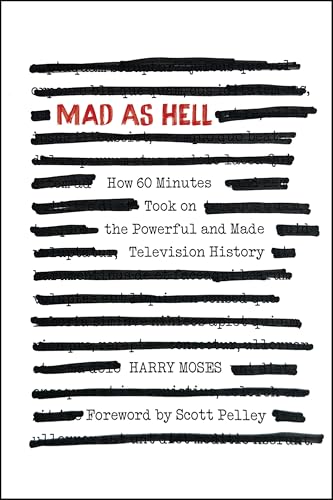
Right up front in his prologue, the author tells readers he’s not a team player. “I root for the little guy, hold most Republicans suspect, and believe that large corporations are by habit and desire, corrupt,” states Harry Moses, who, at the age of 90, has published his first memoir, Mad as Hell: How 60 Minutes Took on the Powerful and Made Television History.
Moses grabs his title from the 1976 movie “Network,” in which Peter Finch, playing an angry prophet of the airwaves, instructs his viewers to rebel: “I want you to get up now. I want all of you to get up out of your chairs…and go to the window, open it, and stick your head out and yell, ‘I’m as mad as hell, and I’m not going to take this anymore!’”
Like Don Quixote tilting at windmills, Moses seemed to gallop toward exposé journalism, determined to wallop bad guys and canonize good ones. He best illustrates this in his chapters on the crew from “60 Minutes,” where he was once a lead producer for Mike Wallace, Dan Rather, Ed Bradley, Diane Sawyer, and Lesley Stahl, none of whom fare well in these pages. The adage “No man is a hero to his valet” seems particularly applicable to this lot.
Having worked together for five “frantic years,” Moses gives Wallace, who specialized in “the ambush interview,” his own chapter. “It was exhilarating and emotionally exhausting,” he writes. “I ended up with an ulcer I named Myron (Mike’s given name).” He later reveals:
“I confess that I found many of Mike’s shticks amusing…Less amusing was the way Mike treated women on the staff. Each morning, he strode briskly down the hall, snapping the bra straps and pinching the bottoms of any female unfortunate enough to be in his path. Today, he’d be sacked.”
Moses recollects Rather giving new definition to the term prima donna, but he fires more damaging salvos at Sawyer, who, during an interview with Calvin Klein, insisted on peppering the designer with rumors that he was gay and had had every drop of his HIV-contaminated blood drained and replaced with healthy plasma. “I thought the tale was as absurd as it was impractical,” Moses writes, noting that he tried to explain to Sawyer that the story was about the billion-dollar fashion business Klein had built from scratch, not a take-down of the man’s sex life.
“He’s never acknowledged that he’s gay,” Sawyer insisted. “Doesn’t matter,” Moses shot back. She continued pushing the issue and finally asked Klein about his sexuality. Moses later excised the exchange from the tape, and nothing more was said about the matter.
The producer encountered a rougher go-around working with Stahl, who seemed to personify the blinding high beams of an egotist. When beginning work on their first segment together, he explained to her that the cameras and lighting needed to be positioned a certain way to minimize the interviewee’s cleft lip. “In order for your shot to match his shot,” Moses told Stahl, “I had to do the same with you.” But when Stahl saw the image on the monitor, she balked. “Change the camera angle. Change the lighting. Make it the way I like it,” she ordered.
Moses’ descriptions of Stahl as “imperious” might make readers cringe, as they imagine a witch on a broomstick. When he gave her the copy he’d written that introduced the piece, she rewrote it. Don Hewitt, the show’s executive producer, didn’t like her rewrite and told Moses to go back to the original. He did, and she flew into a rant. “I don’t care what he wants,” Stahl said, referring to Hewitt. “I won’t read it.”
At this point, Moses’ ulcer from Mike Wallace looks like a badge of honor alongside others he received, including an Emmy, a Peabody, an award from the Directors Guild of America, and a lifetime achievement award from the National Academy of Television Arts and Sciences.
Readers might wonder why the highly paid correspondents at “60 Minutes” (Stahl purportedly now makes $8 million a year) didn’t embrace with drooling gratitude producers like Moses, whose sole responsibility was to cast them as gifted journalists and compelling storytellers. Producers are like Iditarod dogs, pulling the correspondents’ sleds through miles of rugged, frozen terrain.
Of course, “No man is a hero to his valet” certainly also applies to Moses. “At CBS, the knock on me — accurate enough, as it turned out — was not my ability but that I was deficient in ‘people skills,’” he acknowledges. Fragile egos and demanding personalities aren’t unique to the newsroom, though. Moses recounts flabbergasting encounters with Woody Allen, Neil Simon, Arthur Miller, Samuel L. Jackson, and Sam Waterston, too.
By the end of his memoir, Moses admits he grew “weary of working with correspondents who asked the questions I had written, didn’t know the story as well as I did, and failed to get the best out of the interview subjects.” Blessed (or cursed) with a ripe ego and rippling self-confidence, he concludes:
“At the age of ninety, I am presently fit, disease free, and can function well enough without the aid of Prevagen.”
The odds for continued success are definitely in Moses’ favor — and it’s intriguing to wonder what his last act will be. Given his commitment to the little guy and his belief that most Republicans are suspect and corporations corrupt, one wonders if Harry Moses might make a Hail Mary pass at writing a presidential biography. One can only hope.
Kitty Kelley is the author of seven number-one New York Times bestseller biographies, including Nancy Reagan, Jackie Oh!, and Elizabeth Taylor: The Last Star. She is on the board of the Independent and is a recipient of the PEN Oakland/Gary Webb Anti-Censorship Award. In 2023, she was honored with the Biographers International Organization’s BIO Award, which is given annually to a writer who has made major contributions to the advancement of the art and craft of biography.