Man, F*ck This House (And Other Disasters)
- By Brian Asman
- Blackstone Publishing
- 374 pp.
- Reviewed by Mariko Hewer
- December 26, 2025
This collection of scary stories is heavy on heart and gore.
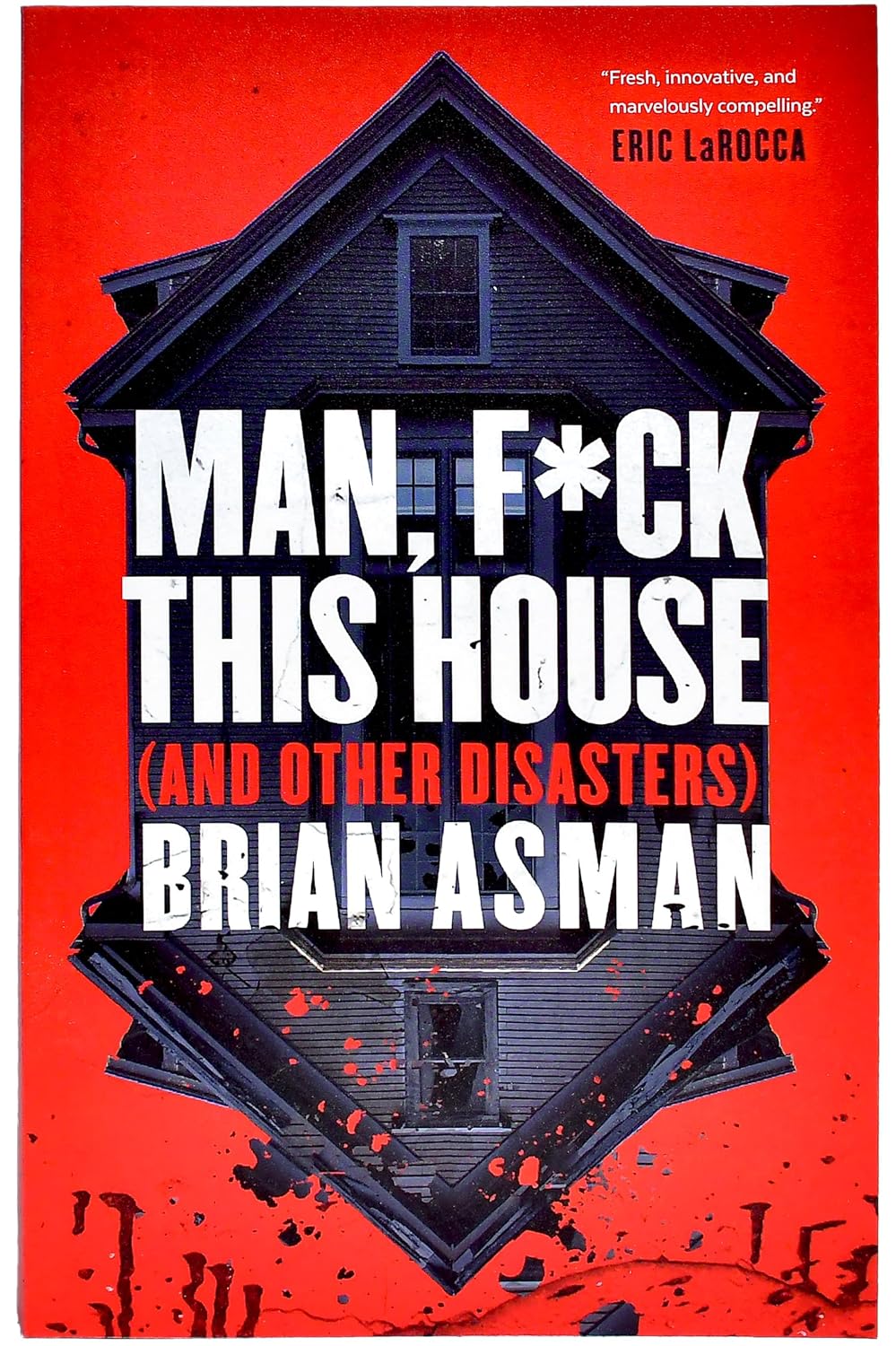
The most effective horror stories often feature external threats (zombies, aliens, serial killers) as well as internal challenges (broken relationships, personal tragedies, unresolved traumas). In Man, F*ck This House (And Other Disasters), Brian Asman employs both, with limited success.
Asman’s title story, “Man, Fuck This House,” the collection’s longest, is kaleidoscopic in scope, if a bit muddied by its characters’ inconsistencies. After the Haskins family moves into what they believe is their dream home, strange things start happening — but not the kind you expect in a scary story. Instead, the lonely house acts as a helpmeet to its lonely new housewife:
“Sabrina went to the sink — the plate gleamed in the dish rack. The spooks hadn’t only made coffee, apparently. She wasn’t sure whether to be grateful or afraid or angry. A strange admixture of all three boiled in her veins. Maybe THAT was worst of all — she never quite knew how to feel.”
While the saga of a house evolving to feel emotions and kinship is compelling, the tale’s other human protagonist, Sabrina’s son, Damien, comes across as contradictory. Believing (correctly) that his mother is frightened of him because he absorbed his twin in utero, the 10-year-old throws himself into his creepiness, though he considers himself “a perilously normal child, albeit an extraordinarily intelligent one.” Yet, when Damien sets out to play a terrifying prank on his mom, and his sister refuses to take part, he reflects:
“Either way, her histrionics changed nothing. Her participation in the plan had always been optional. Just like her continued existence.”
This last, eerily homicidal remark doesn’t feel particularly “normal,” even by feuding-sibling standards.
The story’s peripheral characters also sometimes strain credulity, such as when drivers encountering a rogue runaway house simply honk their horns at the renegade structure. Would somebody driving headlong into such a reality-bending event really have the presence of mind to honk? And what would they hope to accomplish by doing so?
Later in the tale, a man claiming his evil doppelganger committed the crime for which he is blamed tells a listener, “I never left the party. Remember I had about 200 witnesses? None of that mattered because they had me on video, kicking open my car door and running off while Hazel Eden clutched her chest and collapsed to the floor.” This, after he (or his lookalike) drove through the front window of a gas station.
In an era where images and video are all too easy to fake, it’s unlikely the police wouldn’t have done at least a little investigating into the incident.
The story “In the Rushes,” on the other hand, portrays a satisfyingly nuanced and emotionally complex parent-child relationship between Carol, a divorced mom, and her adopted daughter, Becca. While dragging the surly teen on an early-morning bike ride, Carol worries:
“Without shared DNA, can feelings be real? Or are they just going through the motions? Did Becca love-love her, or was she just conditioned by millions of years of evolution to act like that?”
But when she briefly loses sight of the girl around the next bend and finds her abandoned bike upended, tire spinning, a minute later, all such philosophical questions disappear. Carol springs into action:
“An irrational voice told her she only had until that tire stopped. Then Becca would be truly gone.”
Anyone in the grip of panic knows the incoherent calculations that are made in the moment, and Asman’s writing here feels true to life (minus the soon-to-appear sewer monster, of course).
Another distinct talent of the author’s is his blending of the mundane and the tragic, the sardonic and nostalgic, such as in “Line of Sight,” where a coroner’s report includes what “amounted to a spirited what the fuck, albeit one expressed with a mess of six-dollar words.” And in “The Tire Swing,” the mourning narrator recalls talking to his older brother the summer everything went wrong:
“That was the moment I should’ve told him everything. But I didn’t…Instead of telling him the things that might’ve saved us, I said, ‘Wanna play some PlayStation?’”
On the whole, Man, F*uck This House’s emotional punches outnumber its credulity-straining instances, making it well worth a read.
Mariko Hewer is a freelance editor and writer, as well as a nursery-school teacher. She is passionate about good books, good food, and good company.