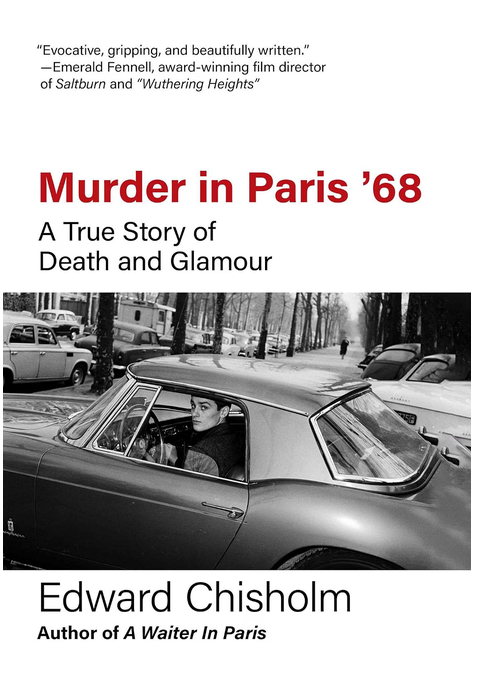
Murder in Paris ’68: A True Story of Death and Glamour
- By Edward Chisholm
- Pegasus Crime
- 416 pp.
- Reviewed by Dennis Drabelle
- November 16, 2026
An absorbing real-life whodunit set in the City of Light.
The French movie star Alain Delon was no better than a great beauty should be. He exuded narcissism, arrogance, and entitlement while following his hunch that masculine reserve wins more hearts than effusiveness can. All the same, Delon submitted to anyone who could help him become a cinematic contender — notably the directors René Clément and Jean-Pierre Melville — and courted gangsters, whose risk-filled lives enthralled him.
Hence, the credibility of his signature roles, the conniving nobody Tom Ripley in Clément’s “Purple Noon” (1959) and the closed-mouthed hitman Jef Costello in Melville’s “Le Samourai” (1967), which together made Delon the emblematic figure of late-stage film noir as it went global and discarded the “noir” in favor of a full-color palette in the 1960s.
How Delon’s haughty passivity may have contributed to the killing of his personal assistant is the subject of Edward Chisholm’s absorbing new book, Murder in Paris ’68.
The victim was Stevan Markovic, 21 years old in 1958 when he emigrated from his native Yugoslavia, “tall, broad, good-looking in a blunt, virile sort of way,” in Chisholm’s words. “Behind him: a life of petty crime, street fighting, card hustling and womanizing. Ahead: the future. Paris.” A decade later, Stevan was found dead in the village of Elancourt, near Versailles, his badly beaten corpse wrapped in a plastic sheet and stuffed into a sack.
At the time, Chisholm explains, the City of Light was movie-mad, but as the New Wave came into its own, Delon stood a bit apart — none of the movement’s signature directors, François Truffaut, Jean-Luc Godard, or Claude Chabrol, ever worked with him. Yet Delon’s homme-fatale handsomeness made him “a living embodiment of the new, global, aspirational post-war France, where wealth was acquired fast and pleasure pursued hard.”
Stevan was introduced to Delon by Milos Milosevic, a friend from Stevan’s Yugoslavian days who had roomed for a time with the actor’s makeup artist. Able to carry out orders without appearing servile, Stevan was a good fit for the boss’ entourage, which skewed toward “drifters, bruisers, [and] criminals.” The thugs’ acceptance of Delon let him persuade himself that he wasn’t selling out to respectability — a fantasy that didn’t fool his wife, Nathalie. Yet she warmed to Stevan because he was good with the Delons’ young son.
Stevan tried to make himself indispensable to the Delons, but from time to time, they proved he wasn’t by decamping from one of their houses to another and neither taking him along nor leaving him money to live on while house-sitting for them. What could he do but revert to the criminality that had kept him afloat in his home country? The Delons also kept Stevan off balance by repeatedly breaking their word to help him obtain the French equivalent of a green card. His was an existence that vacillated between luxury and neglect.
He made big mistakes, too, such as shacking up with Nathalie when she and Delon were in the throes of their divorce and exploiting Delon’s connections with gangsters for his own benefit. Not surprisingly, Stevan found himself out of his depth in their milieu.
Chisholm’s analysis of Milos’ relationship with Delon during the latter’s less-than-successful campaign to export his stardom to Hollywood in the early 1960s could just as well apply to Stevan:
“To live in the shadow of someone you see not as a star, but as a fraud. To witness the gap between the image and the man — the tantrums, the affairs, the fragility…To hold the secret that the young god is, in fact, just a man. That kind of knowledge can rot you.”
It can also destroy you, as it did Milos, who, in 1966, was shot and killed in actor Mickey Rooney’s house, as was Rooney’s wife. Stevan failed to draw the right conclusion from his old friend’s death: You worm your way into a movie star’s life at your peril.
Because the principal figures in the story are all gone — Delon himself outlived the others, dying two years ago at age 88 — Chisholm had to rely almost exclusively on the historical record, which he seems to have combed with doggedness and élan. If you are expecting unassailable answers to the question of who killed Stevan Markovic and why, you will be disappointed. But if you were engrossed, as I was, by Patrick Radden Keefe’s London Falling, you’re likely to have a similar experience with Murder in Paris ’68. Both books pull off the difficult trick of telling a true-crime story in a way that captures the spirit of a great city in one of its tawdrier phases.
Dennis Drabelle is a former mysteries editor of the defunct Washington Post Book World.