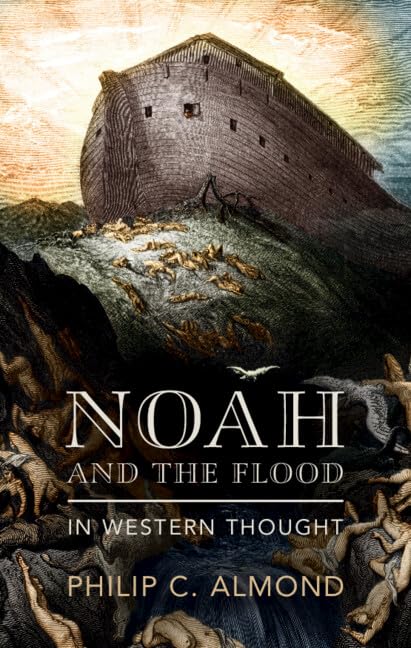
Noah and the Flood in Western Thought
- By Philip C. Almond
- Cambridge University Press
- 396 pp.
- Reviewed by Teddy Duncan Jr.
- July 23, 2025
How the deluge tale morphed from historical to mythical.
Religious ideas, like all ideas, undergo an inexorable transmutation over time — but a religion, as an assertion of metaphysical truths, must maintain a fundamental sense of ahistorical permanence. Religion requires an unchanging kernel of doctrine, not subject to culture or temporality, acting as the necessary theological grounding to cohere the faith. There is no Christianity without the bodily resurrection of Jesus and a belief in monotheism; there is no Buddhism without the Four Noble Truths and the Eightfold Path. But circling these cardinal, faith-defining doctrines are lesser, non-doctrinal matters that are susceptible to varying interpretations across the fractured denominations and sub-schools of a religion.
In contradistinction to the view that all religious ideas have a neat transmission from antiquity to modernity, Philip C. Almond illustrates in Noah and the Flood in Western Thought the discursivity of that transmission passed down, somewhat precariously, through time.
Almond, a professor at the University of Queensland, is a prolific scholar of religious history: Over the past five years, he has written four academic books on subjects such as the Buddha, Mary Magdalene, and the Anti-Christ. In his newest work, he delineates the Noahic narrative and its interpretive reception by commentators over centuries, forcefully evincing the primacy of the “universal deluge” in the intellectual and religious development of the Western world.
The chapters in Noah and the Flood, in both substance and structure, almost resemble a literature review, consisting of numerous quotes with minimal authorial intervention. Although the book can be criticized for a certain tediousness or banality, it effectively leverages its triviality to index the discursive granularity between scholars (e.g., contending claims on the physical dimensions of the ark).
The story of Noah, with its mysteries and narratological deviations, has been central — until recently — to Christian historical legitimacy and remains an essential scene in the biblical narrative. As Almond writes, “the universality of the flood and the re-population of the earth from the survivors of it were crucial to the credibility of Christianity.” Similarly, the Noahic narrative is essential to Judaism and Islam.
Almond elucidates these competing Abrahamic interpretations, replete with their own added details, names, and moral assumptions. For instance, due to Noah’s wife being unnamed in the New Testament, Almond says that, across all the different traditions, “the wife of Noah has been given one hundred and three different names.” In the Judaic tradition, some referred to her as “Naamah”; in Islamic texts, she remains either unnamed or is called “Amorah.”
Other details of Noah’s life became highly contested sites of theological significance. In Genesis, Noah is described as the first to plant grapes and subsequently ferment them to produce wine — and shortly after, he becomes the first to experience inebriation. While drunk, Noah takes off his clothing, and one of his three sons, Ham, sees his nakedness and derisively tells his brothers, who come and clothe their father. Noah curses not Ham but Ham’s son Canaan (Noah’s own grandchild), saying, “Cursed be Canaan! The lowest of slaves he will be to his brothers.”
In the Islamic tradition, which considers Noah a near-perfect prophet and forbids the consumption of alcohol, this scene is diminished. Conversely, rabbis historically confronted the scene, leading to their view of Noah as morally compromised and imperfect.
Noah’s curse of Canaan, as Almond explicates, also has speculative extra-theological implications: It became a biblical justification for the enslavement of Black people since Ham’s descendants were assumed to have occupied the African continent and to have been subjected to slavery by God through the proxy of Noah. Almond even identifies the narrative of Noah as the originary seed of race science, dating back to the 18th century. Because of the dispersal of humanity to different continents, and Noah’s curse on Canaan, there emerged the false idea of substantive, immutable racial differences rather than national or geographic differences.
The book’s most insightful moments are those that invoke the Noahic narrative’s genuine radicality. Noah is considered the second Adam, a prophet-hero who secured the re-propagation of all earthly beings. Almond cites a 17th-century scholar, Thomas Burnet, who aptly refers to the ark as “A Ship, whose Cargo was not less than the Whole World.”
After relaying these various religious perspectives, the book moves onto the “scientific” view of the flood story: The biblical flood, as an event that overtook the world and reset the population of the planet, is shown to inform early scientific thought, which attempted to reconcile the flood and science. Almond later traces the shift of the flood from an object of science to one of mythology.
Excluding its epilogue on personal environmental responsibility, which has the non-relevant abruptness of a non sequitur, the book ends by discussing a replica of the ark in Kentucky called the “Ark Encounter,” a Creationist organization’s conception of the ship’s literal, material embodiment. The exhibit aptly illuminates the biblical flood’s position in the Western mind: somewhere between myth and science, antiquity’s parables and modernity’s knowledge, supernatural divinity and ordinary nature. Almond affirms, through the Ark Encounter, that the Noah story remains, as ever, subject to non-definitive, speculative interpretation.
Teddy Duncan Jr.’s freelance writing has appeared in publications such as Observer, Document Journal, Fad Magazine, Creative Loafing (Tampa), and Document Journal; his scholarly work is in Latin American Literary Review, the International Review of Zizek Studies, the Midwest Quarterly, and Between the Species. His new book is Interpreting Meat: Theorizing the Commodification and Consumption of Animals. He can be reached at [email protected].
_2.png)