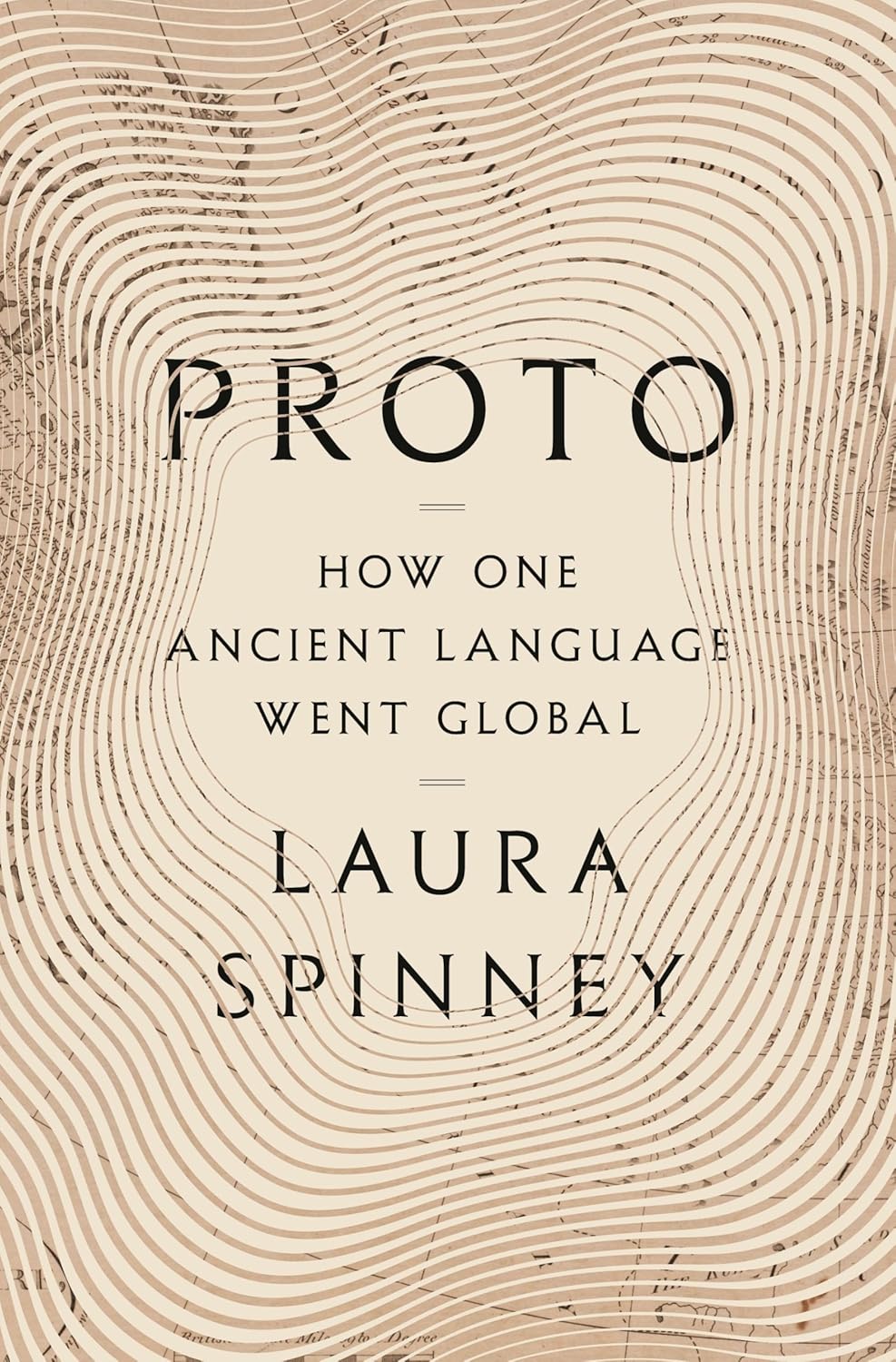
Proto: How One Ancient Language Went Global
- By Laura Spinney
- Bloomsbury Publishing
- 352 pp.
- Reviewed by William Rice
- June 9, 2025
The fascinating, epic journey of a tenacious tongue.
It’s amazing how much we can learn about language from a bunch of old bones. Recent advances in genetics have allowed archeologists to figure out, for instance, which ancient bodies in prehistoric tombs are related to others nearby and which are newcomers — and what direction those strangers came from. These and other anthropological clues can, in turn, help linguists, armed with the knowledge of predictable sound progressions in human speech, determine whether a given language is the parent, child, or sibling of another tongue.
Laura Spinney’s Proto: How One Ancient Language Went Global describes how these techniques have been used to identify the progenitor of the Indo-European language family — the original dialect that eventually spawned modern languages spoken in countries from Iceland to Bangladesh, including this one. Spinney speculates that “fewer than a hundred people may have [originally] spoken” that proto version of the language group now used by almost half the world’s population.
Apparently, our language forebears were a tribe of nomads called the Yamnaya, who started out from the Eurasian steppe north of the Black Sea about 5,000 years ago. It’s so common to think of the Mideast as the “cradle of Western civilization” that it feels odd to designate a spot some 1,500 miles away from it as the origin of that civilization’s language.
In fact, one of the intriguing ideas indirectly highlighted by the book is that Eurasia — due west of the Ural Mountains — wasn’t always the wild wasteland later described by disdainful chroniclers from Greece and Rome. Spinney describes bustling trade routes and huge mining operations spanning the area thousands of years before our current era, albeit intermittently disrupted by ecological disasters.
As befits a book about language, Spinney’s is always crisp and clear, sometimes sly and playful. She notes that among the powers to which writing can be put is “seducing and defrauding people over long distances.” She asks, in a concluding section on the modern-day lingua franca that’s elbowing out local languages yet being transformed every day, “[I]s English killing, or is it dying, or is it somehow doing both at once?”
Spinney’s done a deep dive into her subject, as evidenced by a 21-page bibliography and descriptions of field research in remote and often dangerous areas. (The center of Indo-European studies has been a war zone since Russia invaded Ukraine.) Ironically, her immersion in the material may have been too intense for a work intended for generalists. Until I checked her brief bio on the back cover, I incorrectly assumed she was a linguist herself, given the detail she offers about academic disputes within that discipline. Whether thousands of years ago a certain early language came south over the Caucasus or east through Anatolia doesn’t carry the import for outsiders that it does for the scholars invested in contesting the point.
Much more interesting than narrow academic debates are the broader political dimensions of language. We get the weighted word “barbarian” from Greeks who applied it to anyone who didn’t speak their tongue (all they heard coming from these foreigners’ mouths was a meaningless “bar, bar, bar”). Especially since the consolidation of the modern nation-state in 17th-century Europe, linguistic majorities have tried to suppress minority languages. English overlords aimed to stamp out Gaelic in Ireland, while German speakers in Austria attempted to root out the Czech and Italian used on the empire’s borders. In the New World, both Canada and the United States have shameful legacies of trying to obliterate native languages.
But the origin of languages can have political implications as well. One of the scholarly disputes Spinney describes is over the direction of travel of Indo-European into or out of the Indian Subcontinent. She notes that Hindu nationalists have joined the otherwise obscure fray; the notion of India being the linguistic supplier rather than the supplied has been made part of their jingoistic ideology.
Observations like that one, which connect the ancient to the present, sparked more interest in this nonexpert reader than did the detailed descriptions of cultures long dead. The author reports, for example, “The makeup of [Ireland’s] population has barely changed since the Bronze Age, meaning modern Irish people trace almost all of their ancestry back” to a civilization that spread across Europe 4,000 years ago.
Other fascinating nuggets:
- Even after urban elites in Gaul had shifted to Latin, the pre-Roman Gaulish language “survived in the countryside and it left its imprint on French,” including the word for 80 (quatre-vingt, or “four twenty”), based on the locals’ base-20 counting method.
- England was the “only significant territorial gain” for the Germanic branch of Indo-European “after the fall of Rome.” (But perhaps the most important, given what’s happened since.)
- Among the few Celtic words to survive that Anglo-Saxon invasion were “ass” and “hog.”
- “Greek is remarkable among Indo-European languages in that it has remained a single language for the more than three thousand years of its recorded existence…”
Spinney calls language “humanity’s oldest tool.” Given the hundreds of thousands of years homo sapiens has been around, it’s enlightening and somewhat humbling to realize how new that tool is.
William Rice is a writer for political and policy-advocacy organizations.
.png)