Pure Men: A Novel
- By Mohamed Mbougar Sarr; translated by Lara Vergnaud
- Other Press
- 208 pp.
- Reviewed by Susi Wyss
- July 8, 2026
A Senegalese professor confronts his country’s homophobia.
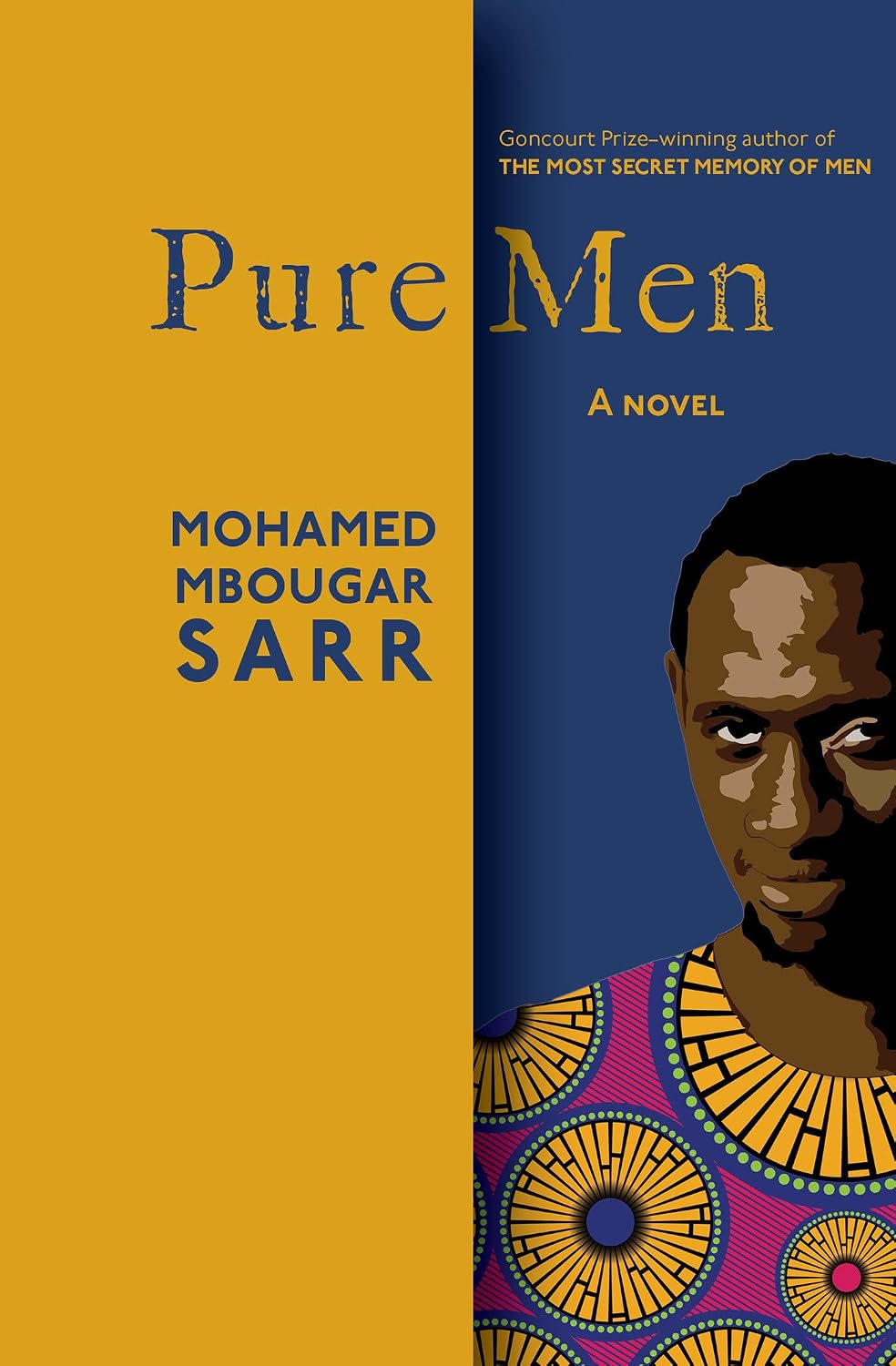
Mohamed Mbougar Sarr’s third novel, Pure Men, opens with a gruesome act that sets the stage for one man’s journey through his, and his country’s, conscience. Ndéné Gueye, a young professor of literature at a university in Dakar, has become disillusioned by the university’s bureaucracy and his “disinterested, lazy, and mediocre students.” One night, his girlfriend, Rama, shows him a choppy amateur video of a mob heading to a cemetery, where two men dig up a shrouded corpse from its grave, drag it out, and toss it away.
Ndéné isn’t sure how to process what he has seen, other than noting the deceased man was likely a góor-jigéen, the Wolof term (literally, woman-man) for any queer identity. Even as he is dismissive of what he’s just witnessed — “After all, he was just a góor-jigéen” — Ndéné is disturbed by his own “exaggerated…coldness, fearful perhaps that the eye of my society would catch me in the act of showing weakness.”
As other events occur on the sidelines, demonstrating that this one act of violence in not an anomaly and that the persecution of homosexuals is ongoing in Senegal, Ndéné develops a self-proclaimed “perverse fascination” with the video. He sets out to learn more about the man whose body was desecrated, how he lived and how he died.
In his search, Ndéné encounters a cast of characters, each with their own views on queerness. The imam at his mosque declares that homosexuality was imported by the West, the góor-jigéen must be removed from society, and any Muslims who defend them will go to hell. Ndéné’s father, in line to become the next imam, is slightly more tolerant: Even as he tells his son that homosexuality is a choice and he would disown any child of his who chose it, when he fills in for the imam, he calls upon the people to pray for mercy for the disinterred man’s soul.
On the other end of the spectrum are Rama’s bisexual lover, Angela, who says queerness is not a choice and that anthropologic research shows it has always existed in Africa; Samba Awa Niang, a self-proclaimed transvestite who is assumed (incorrectly) to be gay but who hasn’t been targeted because he’s a highly successful drag entertainer; and an older gay friend who blames “vulgar homosexuals” for the wave of homophobia in Senegal because, inspired by the white world, they became too overt with their sexuality. Finally, there’s the mother of Amadou, the dead man, who answers Ndéné’s questions about her son’s life, death, and final burial spot.
Over time, as Ndéné seeks to understand Amadou’s world, his focus turns inward, questioning what his culture has made him into and peeling back the layers to better understand himself. It’s a dangerous process, as he risks losing his teaching job, being rejected by his father, and becoming a figure of scorn. But none of these possible outcomes, it turns out, is as grave as not finding the clarity he seeks about himself.
Sarr’s writing style — poetic, flowery, effusive — perfectly captures the voice of his literary-professor narrator. However, the dialogue sometimes feels heavy-handed, making the characters seem like mere vehicles for providing readers with differing schools of thoughts on homosexuality. And the extreme points-of-view are less poignant than the more nuanced ones, like those of Amadou’s mother and the older gay friend. Still, Pure Men is a powerful reflection on hypocrisy and hate, with the evolution of Ndéné’s inner thoughts and beliefs providing the heart of the novel.
While the specifics of the opening event are fictional, Sarr has stated that it was inspired by an actual case of disinterment. In Senegal, homosexuality is still a crime punishable by five years in prison, though jail may be preferrable, in some cases, to vigilante justice. Not surprisingly, when Pure Men was published in 2018, it was not sold in Senegal. However, it started to receive attention there after 2021, when Sarr became the first African to win France’s prestigious Prix Goncourt for his fourth novel, The Most Secret Memory of Men. As Pure Men became the subject of increasing controversy in his home country, Sarr was asked for a final word on the book. His reply was that everything he had to say was in its pages. Fortunately, the novel is nuanced enough, and digs deep enough, to speak for itself.
The juxtaposition of the beauty of Sarr’s language against the ugliness of homophobia and its destruction of human beings is jarring but serves a larger purpose. As the novel makes a case for people to be recognized for their humanity rather than their sexual identity, it also condemns religious extremism, which Angela points out is one step away from totalitarianism. Ultimately, Pure Men isn’t just a warning about the threat of totalitarianism in Senegal but in any country — including this one.
Susi Wyss is author of The Civilized World, a novel-in-stories set across Africa that was largely inspired by her 20-year career in international health. In addition to receiving the Maria Thomas Fiction Award, The Civilized World was named a “Book to Pick Up Now” by O, the Oprah Magazine.