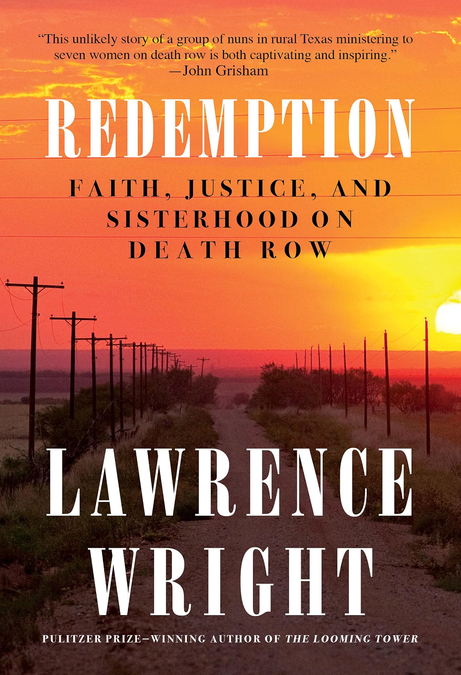
Redemption: Faith, Justice, and Sisterhood on Death Row
- By Lawrence Wright
- Knopf
- 272 pp.
- Reviewed by Kitty Kelley
- November 11, 2026
The Pulitzer-winning author argues for an end to capital punishment.
This book’s description reads like a tabloid exposé: A group of nuns sworn to poverty, chastity, and silence leave the cloistered confines of their convent one day to enter prison gates and befriend seven condemned women. The setting is Texas, the so-called “capital of capital punishment,” which has executed more people than any other state in the Union. The premise sounds preposterous: Saintly sisters making friends with murderers?
Yet the story is true.
Lawrence Wright unites these two disparate groups in the foreword to Redemption: Faith, Justice, and Sisterhood on Death Row and makes a humane appeal to our conscience. Their legal pleas exhausted, the women have been living for years in cramped, fetid cells, waiting to be summoned to the death chamber. Some are grandmothers who’ve spent their entire adult lives behind bars, decades and decades. In that time, many inmates, once considered godless killers, have traveled the long “road to redemption,” prompting Wright to question whether they still deserve to die.
“Typically, the prisoner who is being led to the gurney has already served most of what would have been a life sentence,” he writes. The question, then, is should we bother with the lethal injection at all? Wright answers it at the end of the book:
“Most of these women, I believe, have been sufficiently transformed that they can be spared the punishment that society has imposed. But that is not likely to happen. The question that remains is whether society itself can be redeemed.”
Wright begins his story with prison clergyman Ronnie Lastovica admitting he cannot establish rapport with the snarling inmates. “They were like feral cats,” he told Wright, who describes his characters with verve. He portrays the Catholic deacon as “a cattleman. Slender and swaybacked, his face is pinched and narrow, mottled from the Texas sun, with a strong jaw and a small mouth marked by a crooked smile. He wears silver wire-rim glasses, although he’s blind in his left eye, because of a detached retina, which is only detectable by the slightly larger pupil.”
His strong jaw set, Deacon Ronnie heads for the Sisters of Mary Morning Star in Gatesville, a few miles outside Waco, with an outrageous proposition. He feels that the hardened women on death row might be more receptive to the unworldly nuns than they have been to him. So, he makes his case to the Sisters, who won’t agree without permission from their Mother Superior. She grants it, with a caveat: The young nuns can make one visit to the prison, and one visit only. Fortunately, that single trip becomes many as the sheltered Sisters find camaraderie with the hardened convicts. Their rapport is not illogical, explains the author, because both groups share the same sense of isolation from the outside world.
With incisive intelligence and sublime prose, the 79-year-old Pulitzer Prize winner appeals to readers professionally and personally. As a journalist, he writes in the third person, reporting with precision. In the first person, he writes with passion as a humanitarian. He asks why society shouldn’t travel the same redemptive path as the doomed women. Having followed the prisoners for two years, he no longer believes they’re inhuman or that their crimes are unforgivable.
Wright, who lives in Austin, admits he’s “lost faith in the presumption that Texas, or any state, has a system of justice that is sufficiently reliable, fair, or just to assume the power to take a life.” Still, he acknowledges that — when there’s absolutely no doubt about guilt in certain horrendous acts — justice often requires capital punishment for capital crimes. He adds, however, that the “same system can be subverted by crooked prosecutors, incompetent attorneys, or racial prejudice,” all of which he illustrates in this riveting book.
The author tells readers about growing up in the First United Methodist Church in Dallas, a city that hosts 800 different houses of worship. Wright was a teenager when President John F. Kennedy was assassinated there on November 22, 1963:
“I could see how religious piety fed political extremism. I had warmed myself on the coals of a temperate belief, only to see it rage into flames, culminating in a dramatically inevitable assassination.”
Years later, he’s trying to understand why the majority of people in death-penalty states identify as Christians. Without their immense support, there would be no death penalty in America.
Wright has written 15 books over the course of his career, many of which reviewers have praised as “moving,” “inspiring,” “highly readable,” and “meticulously researched.” Redemption deserves similar accolades — as well as grateful thanks from readers for its poignant reminder of what it means to be human.
Kitty Kelley is the author of seven number-one New York Times bestseller biographies, including Nancy Reagan, Jackie Oh!, and Elizabeth Taylor: The Last Star. She is on the board of the Independent and is a recipient of the PEN Oakland/Gary Webb Anti-Censorship Award. In 2023, she was honored with the Biographers International Organization’s BIO Award, which is given annually to a writer who has made major contributions to the advancement of the art and craft of biography.