Simple Stories
- By Lyonel Trouillot; translated by Willard Wood
- Other Press
- 112 pp.
- Reviewed by Susi Wyss
- September 10, 2026
This sage collection renders a lively, complicated Haiti.
While the 22 tales in Haitian writer Lyonel Trouillot’s Simple Stories are quite short — mostly between two and four pages, with the longest at eight — there is nothing “simple” about them. Many of them cover decades, if not the entirety, of a character’s life, what might have been a novel condensed into a few thousand words. No easy feat for any writer, but Trouillot, who is also a poet, Chevalier des Arts et des Lettres, and winner of multiple literary awards, has given us stories that are charming, funny, or sorrowful — in some cases, all three at once.
Originally published in French in 2024, Simple Stories is set across multiple time periods, from the Duvalier era through present-day Haiti. What ties the many characters together is that they all live in the Port-au-Prince neighborhood of Saint Antoine, where, over time, in a sort of reverse gentrification, “the poor peasants moved in, driving the old inhabitants into less crowed, less decrepit parts of the city.”
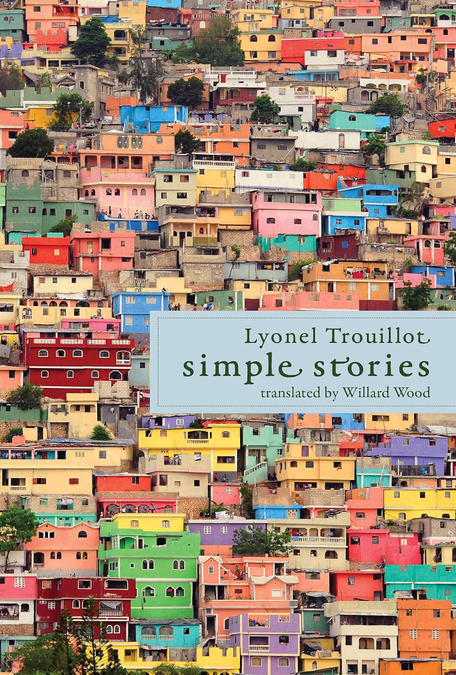
Despite sometimes remaining unnamed, Trouillot’s characters are complex, varied, and as colorful as the crowded homes on the book’s cover. They include the trans mistress of a colonel “with no taste for violence,” a maid in dangerously obsessive love with her master’s son, and a poet who calls himself James Bond. Writers, poets, and artists figure prominently, as do controlling mothers and ne’er-do-well men.
“Casa Blanca,” which includes the first instance I’m aware of in which “Baudelaire” is used as a verb, tells the story of a small, meek teacher and Yolanda, a Dominican prostitute. Instead of taking her to bed, the teacher reads poetry to her — until one fateful night when a much bigger man competes for her attention.
“Family Spirit” starts out as a run-of-the-mill tale of a passionate love that fizzles out over the years and then morphs into a disturbing story about the lengths women sometimes must go to in a male-dominated society. As if to underscore the fact that this story could belong to any woman, Trouillot leaves the three main characters unnamed.
And in one of the most affecting stories of the collection, “The Promise,” wealthy industrialist Pierre Bonhomme, a self-made man who has reached an advanced age, is described by Trouillot as follows:
“He’d sold off his car collection and stopped listening to his favorite operas. You can be rich and still be hard of hearing. And the music that had once brought him peace and calm now seemed lugubrious, a portent of future evil.”
Notwithstanding his fear of death, Bonhomme takes off on a dangerous mission for reasons that become clear in the final paragraphs.
What provides extra depth to these and the other tales in Simple Stories is the way Trouillot sometimes switches the point of view to provide the reader with a fuller perspective than what any one individual character sees and understands. In “The Prodigal Child,” for instance, we meet a thirtysomething man who spent two years studying in Europe and is working on a “treatise on the negation and invention of self.” He has nothing but disdain for his mother’s “coarse country manners…her peasant blouse and her stupid sayings.”
Only when the POV switches to his mother’s do we learn that he’s living in an asylum and what is happening to the manuscript he’s working on. Similarly, in “The Trigger Event,” the anecdote an author tells the world about himself and how he became a writer is shattered by a letter from a woman who knew him way back when. Other times, the point of view is a communal “we,” as in the story “Sad Guitar,” the tale of a young musician who is sent by his family to make something of himself in the United States.
Collectively, the stories paint a complex and vibrant Haiti. Recurring themes include jealousy and revenge, ghosts and vodou, charm potions and witches, prostitution, family ties, and migration in search of opportunities — all set against the political backdrop of corrupt and ineffective governments that sometimes break even those not in the direct crosshairs of despots, bandits, and kingpins. But Trouillot’s Haiti is also a world of art and literature and love in its many forms, and in spite of the sometimes-heavy themes, he relates his stories in a cozy, almost chatty fashion. Even in translation, ably executed by Willard Wood, the reader feels as though they’re listening to the narrator as he regales a group of friends at a corner café.
In his prologue, Trouillot “dedicate[s] this book to the wounded and the outcast, who have a right to revenge and sometimes take it, if only in words.” By the end of the book, his not-so-simple stories have given a voice to those who don’t ordinarily have one — and remind us just how sweet revenge can be.
Susi Wyss is author of The Civilized World, a novel-in-stories set across Africa that was largely inspired by her 20-year career in international health. In addition to receiving the Maria Thomas Fiction Award, The Civilized World was named a “Book to Pick Up Now” by O, the Oprah Magazine.