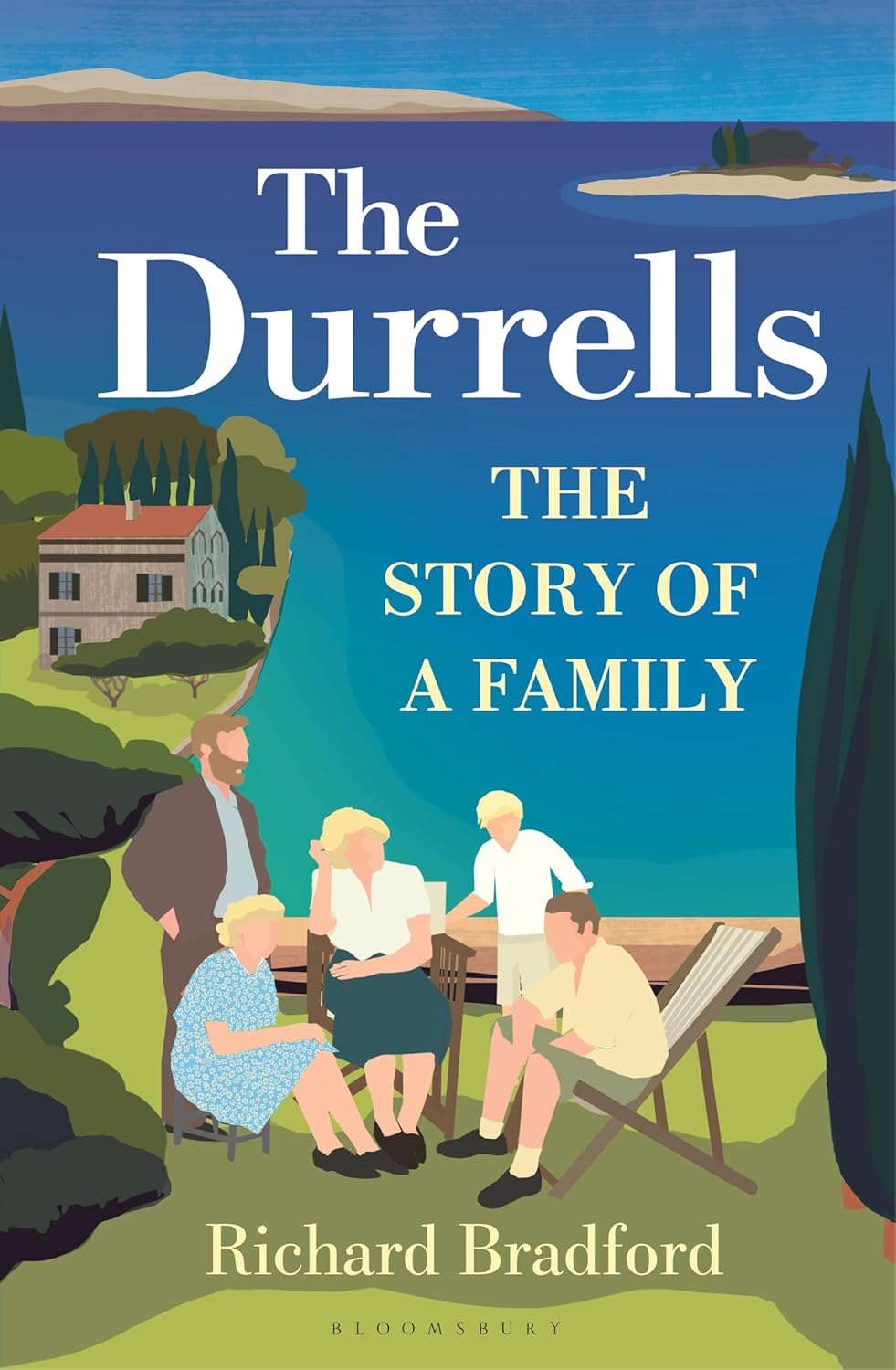
The Durrells: The Story of a Family
- By Richard Bradford
- Bloomsbury Caravel
- 384 pp.
- Reviewed by Ananya Bhattacharyya
- October 17, 2025
The beloved authors/brothers weren’t quite so charming in real life.
Remember the saying, “If you like a book, don’t meet the author”? Reading certain biographies about authors can have a similar effect; readers may come to know more than they wanted to about their favorite writers.
Richard Bradford’s The Durrells: The Story of a Family is one such work. Despite its title, the book is mainly about the famous literary Durrell brothers, Lawrence and Gerald — or, as we come to think of them, Larry and Gerry. (I will refer to them by these names, just like Bradford does, to differentiate between the two.) The larger family story feels both out of place and cursory.
Larry wrote several literary novels, the most famous of which are a set of four complex and experimental narratives collectively called The Alexandria Quartet. Gerry, on the other hand, wrote much-loved humorous memoirs, including My Family and Other Animals, which are about the wild creatures he was obsessed with since childhood, as well as his friends and relatives.
Readers like me who are drawn to The Durrells, then, probably have some combination of love and admiration for one or both brothers’ writing. So, the contempt Bradford feels for the siblings, which is palpable right off the bat, might make one wonder whether he’s being fair.
Initially, at least.
Bradford wastes no time in establishing that the family wasn’t really delightfully quirky, as depicted in My Family and Other Animals. Louisa, the mother, was an alcoholic, Bradford says, “who buried her despair in drunkenness from breakfast-time onwards.” The gun-toting, non-writer brother, Leslie, he adds, had an affair with the family’s Corfiot maid, Maria. When she became pregnant, the entire clan conspired to first trick and then abandon her.
And then, of course, there are the other two brothers — the foci of the biographer’s lens. Bradford spends many pages describing Larry’s treatment of the women in his life, which can be described in one word: appalling. From clutching random women’s breasts at parties to committing multiple infidelities to beating his wife, Larry seems to have excelled at misogyny, narcissism, and abuse even more than he excelled at creating high-culture literature.
Gerry, on the other hand, didn’t have a high opinion of humans in general, and people of color in particular. After establishing Gerry’s racism, Bradford poses this question:
“Anthropomorphism is, for some, idiosyncratic, even charming — but when the delight in animals replaces respect for other humans, what can one feel but unease? Especially when the degraded humans are Black.”
Readers of this book will be confronted by an ethical question plaguing society more and more in the past few decades: Can we — or should we — separate the artist from the art and still enjoy the latter? Though some recent works, such as Claire Dederer’s Monsters: A Fan’s Dilemma, seek to unpack this thorny issue, the truth is that each individual must decide whether to read, listen to, or watch artists who also happen to be repellent people.
As Bradford details the brothers’ character flaws, his disdain becomes more and more understandable. But he relishes disparaging Larry’s writing a tad too much. Regarding one of his early novels, The Black Book, Bradford states:
“With surrealist visual art shapes, faces and figures speak to each other in a warped yet sometimes beguiling conversation. In literature the correspondent result can come close to unadulterated incoherence, and this is what we find in The Black Book. There is some sexual grotesquery, with a nod towards [Henry] Miller, but at least the latter’s book is painfully readable.”
(Miller and Lawrence were close friends, and Lawrence appears to have been especially swayed by Miller’s writing.)
To me, the criticism of Larry’s work seemed unnecessary. Why even bother to write a biography if you think your subject’s art is unworthy?
Within the morass of this takedown, I found one insight interesting: Bradford’s look into the brothers’ professional lives. Early in the book, a Durrell family friend in Corfu, Theodore Stephanides (who was made famous in My Family and Other Animals), writes about Larry, “Sometimes I would wake up at two or three in the morning and hear the faint, distant early click of his typewriter in his room.” His dedication to his art was absolute, and he held jobs in order to subsist while pursuing it.
Gerry, on the other hand, seemed not to particularly enjoy writing but became an author anyway, Bradford explains, because of his wife, Jacquie, who understood and encouraged his natural talent for storytelling. Writing about animals was a way both to make a living and to spend time with them. According to Bradford, Gerry’s first book, The Overloaded Ark, was actually a joint effort between husband and wife. They worked for six weeks, trying to craft a tale that would interest a publisher. The 65,000 words they ultimately produced were picked up by London-based Faber, after which Gerry became a literary sensation who went on to pen a number of bestsellers.
Upon finishing The Durrells, readers may walk away with contradictory feelings: admiration for the hard work both brothers put into their art and discomfort over their many personal flaws. Whichever sentiment dominates will likely shape any relationship with the authors going forward.
Ananya Bhattacharyya is a Washington-based editor and writer. Her work has been published in the New York Times, Guardian, Lit Hub, Baltimore Sun, Al Jazeera America, Reuters, Vice, Washingtonian, and other publications.