The Ego Trip: Psychedelic Toads, a Trail of Deaths, and the Guru Who Peddled Transcendence
- By Kimon de Greef
- Doubleday
- 336 pp.
- Reviewed by Lilia Marie Ellis
- August 12, 2026
Meet a self-styled “shaman” who got high on his own supply.
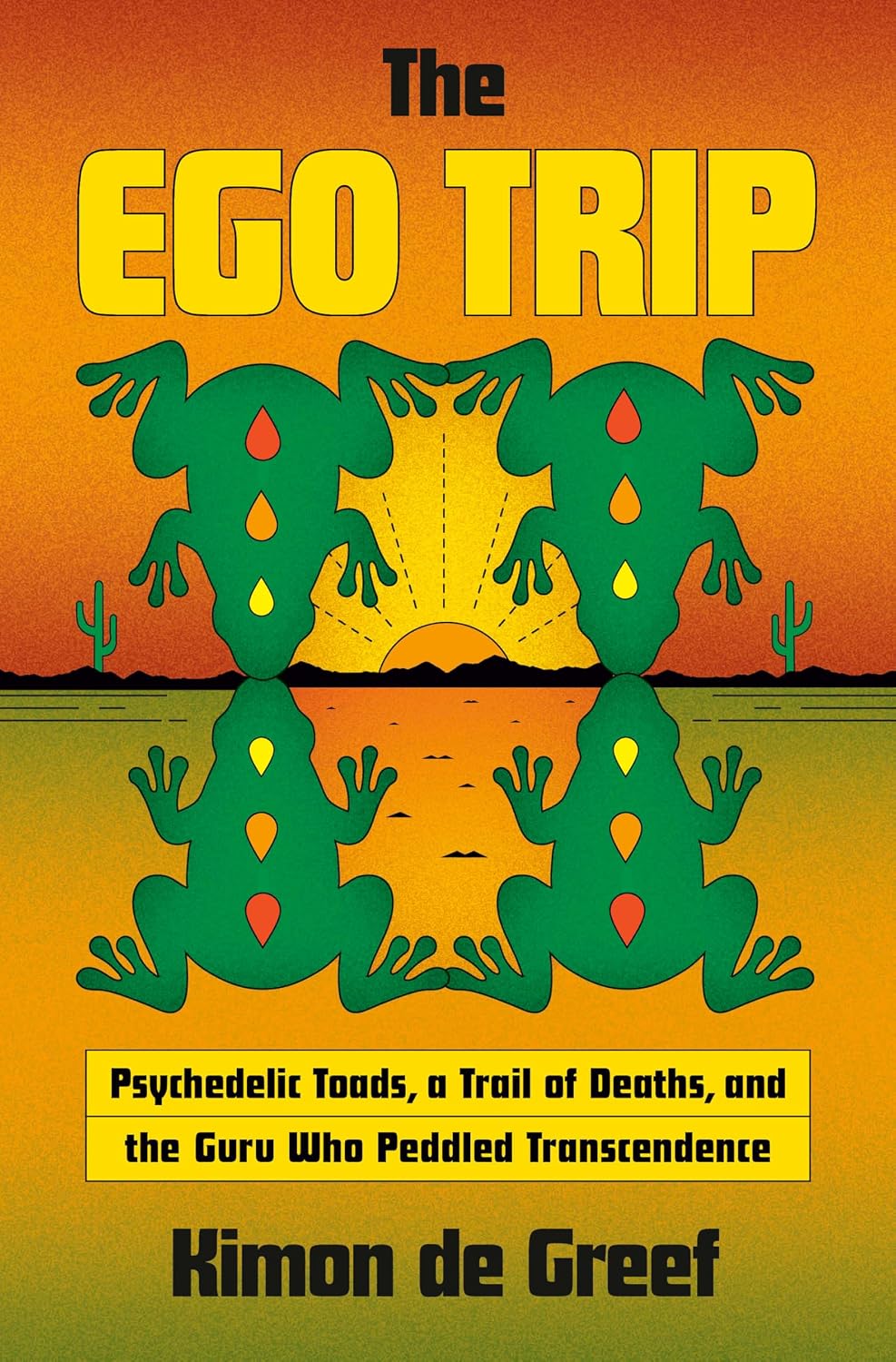
In the age of social media, sometimes nothing is more outlandish than the truth. Journalist Kimon de Greef’s new book, The Ego Trip, profiles a powerful psychedelic drug derived from toads and the controversial doctor who made it famous. De Greef follows Dr. Octavio Rettig Hinojosa’s history with “toad medicine,” from his early attempts to market “smoking toad” as an indigenous practice, to the intense devotion he would later achieve from his followers. What results is a thrilling, bizarre tale that shines a light into the business of medicine and spirituality in our strange cultural moment.
Looming large over The Ego Trip is 5-MeO-DMT, the so-called “God molecule” found naturally in the toxins of the Sonoran Desert toad. While the toad’s secretions are dangerous when consumed directly, they can be vaporized and smoked safely, yielding a dramatic half-hour psychedelic trip. Practitioners say the experience of smoking toad dissolves the sense of boundary between self and other, giving a transcendent sense of union with reality. They view 5-MeO-DMT with an almost religious awe.
Although currently illegal in the U.S., 5-MeO-DMT shows particular promise as a cure for treatment-resistant depression and addiction. LSD and other psychedelics have some medicinal promise, but their trips can last half a day; in contrast, a provider could administer a complete dose of toad within a short session. The science behind 5-MeO-DMT is new and constantly evolving, but de Greef’s clear prose cuts through the hype and fog alike to explain what’s at stake. He keeps the focus on the human side of things — the patients and profiteers behind the burgeoning industry — making the book legible and compelling throughout.
Toad smoking’s biggest advocate is the charismatic Hinojosa, a Mexican physician whose energy and complexity jump off the page. Once an addict, Octavio (de Greef refers to him by his first name) found healing through smoking toad in the early 2000s, and has now positioned himself somewhere between doctor, mogul, and guru. As de Greef explains, Octavio, ever the brilliant salesman, “drew selectively” on the traditions of the local Seri people to market toad smoking as an indigenous practice. There is no evidence that Seri people ever smoked toad, yet Octavio (who is not Seri) insists he has “rediscovered” a lost pre-colonial ritual.
During toad-smoking sessions, Octavio dresses as a shaman and chants Seri songs despite not knowing the language. His obsessive internet followers — a mix of New-Agers and psychedelic devotees — have meanwhile turned the Sonoran Desert into a toad-smoking tourist hotspot. For their part, many Seri people have distanced themselves from Octavio and lament the dubious toad-smoking lore he’s selling. The Ego Trip avoids too much editorializing, instead wisely letting its thorough research and interviews speak for themselves. It’s a disturbing cautionary tale of how easily the truth (and a people’s livelihood and culture) can be twisted in service of commerce and online fame.
The book also offers a disconcerting glimpse into the double-edged sword of psychedelic substances. Octavio has administered toad to thousands of people, many of whom swear that he cured their mental illness or saved them from addiction to hard drugs. Yet others have been scarred by their experience; some have even died. Octavio’s rapid-fire sessions — in which he might administer toad medicine to dozens of people in a row, without measuring out dosages or screening anyone’s medical history — might be efficient and profitable, but they put patients’ well-being last. Caught on the biggest ego trip of all, Octavio shows little remorse for the lives he has destroyed.
Yet as de Greef is keen to stress, the problem is not just one eccentric doctor; the pharmaceutical companies currently racing to monetize 5-MeO-DMT are making the same mistakes. Several start-ups are running high-dose clinical trials whose patients are utterly unprepared for the jarring experience of psychedelic drugs. “I was prepared for a skipping rope. You handed me a bungee jump,” one memorably said. The Ego Trip stalls slightly in these sections (without a strong personality like Octavio as an anchor, the pacing feels slower and the writing drier), yet overall, de Greef succeeds in illustrating that commercialized psychedelics are not the miracle drug many hoped for.
Business, spirituality, and medicine have never been separate, but in the age of Instagram and TikTok, they blur together in increasingly disturbing ways. The Ego Trip is a glimpse into a particularly strange example, yet Octavio’s cult-like business impulses are not so different from figures like Elon Musk who dominate today’s headlines. This makes de Greef’s work an entertaining, eye-opening tale — and the humble Sonoran Desert toad an unlikely symbol of the times.
Lilia Marie Ellis is a poet, essayist, and Ph.D. student at the University of Chicago.