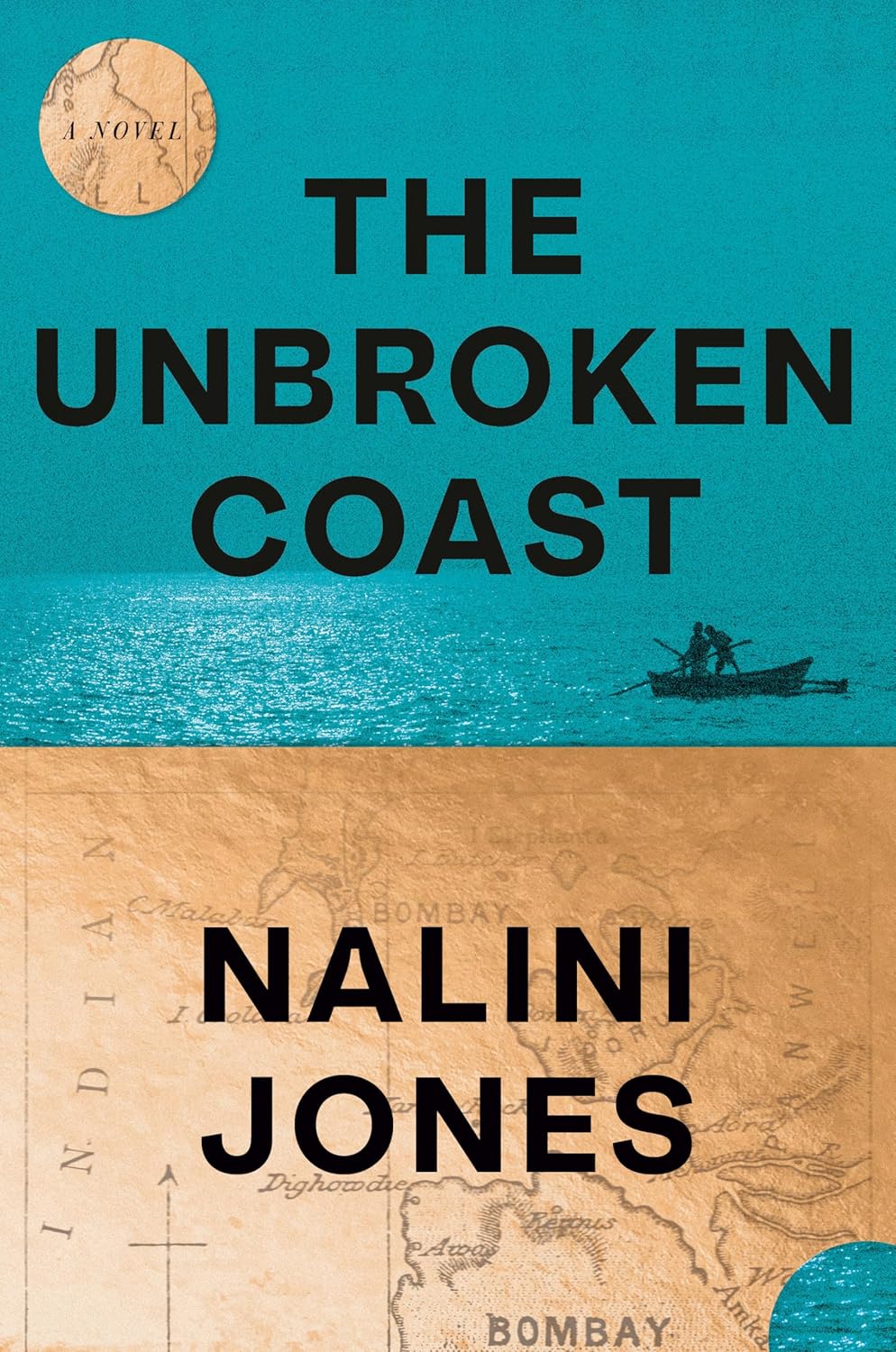
The Unbroken Coast: A Novel
- By Nalini Jones
- Knopf
- 480 pp.
- Reviewed by Bruce J. Krajewski
- October 3, 2025
Faith sustains generations of Mumbai families plagued by misfortune.
The Unbroken Coast is an exemplum of the butterfly effect — the idea from chaos theory that if a bird flaps its wings in Australia, the ripples might cause a hurricane in Cuba. It’s a well-crafted, emotional metaphor for our unexpected interconnectedness over long distances.
Nalini Jones’ narrative, focusing on Bombay’s poor, spans 1640 to 2005, years linked by a statue of Jesus’ mother, Mary, being pulled up from a 17th-century sea floor by a boy fishing with his father. A similar statue is a constant feature in the home of Essie, this Catholic-centric novel’s self-described “avenging angel,” who plans a garden shrine with the sculpture. Not that Essie waits around for the Virgin’s intervention. Her competence and reliability mean she often rights other people’s listing ships on her own.
Most of the book’s action takes place between 1978 and 2005, the period encompassing Bombay’s transition to Mumbai, the Bombay riots of the 1990s, and India’s struggle with AIDS. The first character we meet in the modern timeline is Essie’s husband, Francis, a professor of history. His story shows how people from two different families — haves and have-nots — intersect. Instead of a bird flapping its wings Down Under, the catalyst for their interconnectedness is a bicycle accident.
Young Celia, part of the aboriginal Koli fishing people of Bombay, distraught over a pair of shoes she knows her family cannot afford to replace, is fleeing from school and runs into the professor’s bicycle, causing both of them to spill on the ground. “They were both down in a heap, Celia splayed over the front tire and the cyclist’s leg caught beneath the frame.” No call to a personal-injury lawyer here. Instead, the accident forges a bond between Celia’s family and Essie’s after Francis insists on treating Celia’s wounds at his house:
“He carried her the way Jesus carried the lost sheep.”
(A case can be made that Celia is more the Christ figure, the one subjected to indignities and brutalization similar to the stations of the cross.)
For Celia’s family, “fishing was the center of everything.” Her father, Dominic, starts off a fisherman, and though her brother Jerome hates the work, it was assumed he would continue in the livelihood. However, the father sustains his family by taking on debt from a moneylender, Mr. Pujari. Dominic only escapes Mr. Pujari’s grasp by selling his fishing boat.
The characters read life’s vacillations in two basic ways: one religious, and the other linked to divination, with a character commenting at one point that another’s good luck means more good luck is on the way. When Dominic benefits from sets of prayer beads found in a lost shipping container, he wonders, “Had the container been a sign.” Flora, Celia’s mother, interprets the beads’ appearance as a “sign that Mary was watching over their family even after they had abandoned the sea.” This brings Flora comfort and leads Dominic to start a new business named the Holy Rosary Tea Stall.
But is divine intervention really at work? Are prayers answered? Or do characters flourish due to their own cleverness and drive?
Francis and Essie’s generosity toward Celia makes the girl’s success seem dependent on charity. At Celia’s low point later in the novel, after a stillbirth and abandonment by her husband, Anthony, who leaves to seek treatment for AIDS, it is Essie who steps in to retrieve Celia’s property from Anthony’s family’s house, where Celia had been living before being thrown out and blamed falsely for his infection. In the book’s acknowledgments, Jones reveals that a prior nonfiction project gave her access to firsthand accounts of India’s 1980s AIDS crisis, one that mirrored America’s — complete with fear, scapegoating, misinformation, and exploitative alternative “therapies.”
Given the Catholic Church’s fraught history vis-à-vis AIDS, the novel’s apparent devotion to the religion — one that forbids any kind of critical perspective — is puzzling. Readers are left to wonder to what extent the characters’ circumstances have been programmed by their own religiosity and class stratification. (For contrast, think of the nuanced presentation of poor children in Ali Smith’s dystopian Gliff.)
The Unbroken Coast’s final image relates to how “the world widened,” possibly suggesting a general benefit of interconnectedness. But is interconnectedness really foundational to a good life? It’s unclear whether that’s the point the author is making. Still, it’s difficult to imagine readers won’t be moved by this novel, which is as rich in pathos as any of Dickens’ working-class tales.
Bruce J. Krajewski has written commentary for the Ancillary Review of Books, the Guardian, the Los Angeles Review of Books, LitHub, the Dublin Review of Books, and other publications.