The Very Heart of It: New York Diaries, 1983-1994
- By Thomas Mallon
- Knopf
- 592 pp.
- Reviewed by Nick Havey
- July 18, 2025
While candid, this chronicle of the author’s life is surprisingly tone-deaf.
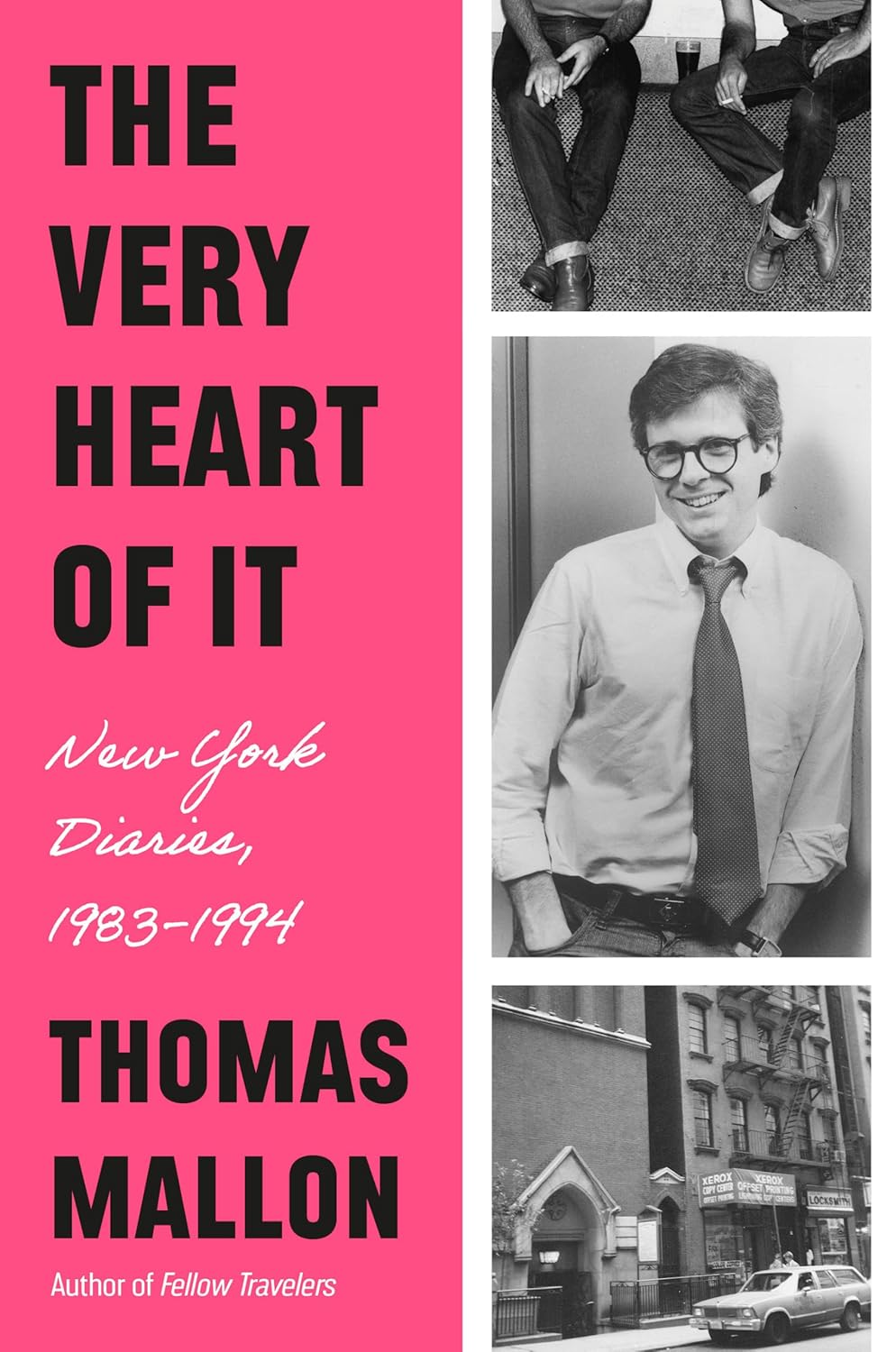
Thomas Mallon, perhaps best known for his novel-turned-Showtime-series Fellow Travelers, found early success with his first work, A Book of One’s Own. An ode to the diary as an exceedingly inclusive form — anybody can keep one — the book presented the diary as a cultural mainstay that allowed writers to document the daily minutiae of their lives. So, in the twilight of his career, it makes sense that he would get to “the very heart of” his own life by publishing as a memoir more than a decade’s worth of excerpts from his meticulously kept diaries.
The Very Heart of It chronicles Mallon’s life from 1983-1994 and emphasizes his experiences as a gay man in New York and as a writer struggling with the competing responsibilities and benefits of an academic career versus one in traditional publishing (he chooses the latter). Ironically, much of The Very Heart of It would’ve benefited from peer review; it is overwrought, overly long, and might’ve been more successful as a memoir if there had been a stronger effort at curation and reflection.
At Vassar, young Mallon is an early archetype of the disillusioned conservative faculty member who, today, might demand affirmative action for white men. Far to the right of both his peers and his students, Mallon distances himself from the very environment — academia — he’s actively benefiting from as a diversity hire while positioning himself as a token in traditional publishing: He’s a gay conservative and he’s going to benefit from his marginality, goddammit. (He later gets an incredible offer to ghostwrite Dan Quayle’s memoir, and it’s clear from Mallon’s own diary entries that this is a result of his identities.)
As an instructor, he’s “sick of these emotional spectacles of the overprivileged,” as he describes a student whining about a poor mark; he spends an inordinate amount of time recounting the inner workings of the department for someone with one foot already out the door; and he decries what he likely would now define as the “woke” hiring practices of his colleagues.
Recalling one such colleague’s dismissal of a faculty candidate as a “gung-ho boy,” he reports that he “let her have it” and “told her to consider why it was OK to use that term for the now universally despised white male, and what would happen if someone in the room used its female equivalent.” This doesn’t stop him, in entries dated from the same week, from recording all the ways in which editors and book reviewers have slighted his work, all the while reminding himself that he deserves better.
Later, while describing a meeting at GQ, Mallon remarks, “Art [Cooper, the magazine’s longtime editor] ran a meeting in ten minutes this morning that would have taken 2 hours at Vassar. There’s no rhetorical posturing and no compulsion to make every issue a moral issue.” What he doesn’t do is acknowledge the reality that when everyone in the room is a white man — and the only gay one is trying his damnedest to preserve the privilege that comes with straight-passing — there are no “moral” dilemmas of the kind that might arise amid a more diverse group.
This reality is wickedly evident in the way he writes about the women he perceives as threats or is simply jealous of professionally (Susan Sontag and Anna Wintour) or within the political sphere (Hillary Clinton, Margaret Thatcher, and Madeleine Albright). With stereotypical gay-man disdain, he seems capable only of valuing a woman when she is clearly his better (like Mary McCarthy or his own mother) or a diva at the center of the zeitgeist (Barbra Streisand, Tina Turner, or Madonna). This does little to endear him to the 21st-century reader (even if his insider look at the world of publishing in the 1980s and 90s is interesting). And while adoration shouldn’t be the express goal of a diary — a point Mallon hammers home in A Book of One’s Own — it’s incredibly bold to publish long-ago diaries as a memoir but offer no hindsight-fueled introspection or contextualization.
Luckily, Mallon’s entries about his personal life are less cringeworthy than those about his academic career. Much of the early ones center on Tommy, a partner who died of AIDS. Mallon is a passionate and sentimental lover but doesn’t shy away from hornier entries that emphasize that he is, after all, a man. But these entries, too, reveal his somewhat pervasive sense of entitlement. He deserves a bigger book advance, he deserves more acclaim, he deserves a better boyfriend. Such dispassionate petulance makes it challenging to wade through these 500-plus pages.
Reading about the AIDS crisis via contemporaneous entries was engaging, but Mallon’s self-centered commentary on the tragedy — “A report on ABC News tonight says AIDS may kill 50 million people in Africa. I went into one of my panics-not, of course, for the 50 million Africans, but for myself” — and refusal to get tested for HIV for more than six years after exposure felt like an embodiment of privilege that maybe shouldn’t have been shared with the world (especially absent any updated thoughts).
As Mallon reminds us in A Book of One’s Own, it is tremendously egotistical to write a diary with the assumption that it’ll interest future generations; to assume that there is an audience. His writing is appealing and incisive, but The Very Heart of It lacks a clear thesis other than the preservation of Mallon’s life on the page.
A diary can be a wonderful receptacle for candor and honesty — and although Mallon would say a diarist becomes a liar once the pen hits the page, this book’s greatest strength is its honesty — but this self-indulgent one perhaps should’ve remained a book of Mallon’s own.
Nick Havey is a thriller and mystery writer and a lover of all fiction. His work has appeared in the Compulsive Reader, Lambda Literary, and a number of peer-reviewed journals.