White Elephant: A Novel
- By Jeyamohan; translated by Priyamvada Ramkumar
- FSG Originals
- 336 pp.
- Reviewed by Emily Hall
- September 1, 2026
An Irishman in India confronts the ugliness of the Raj.
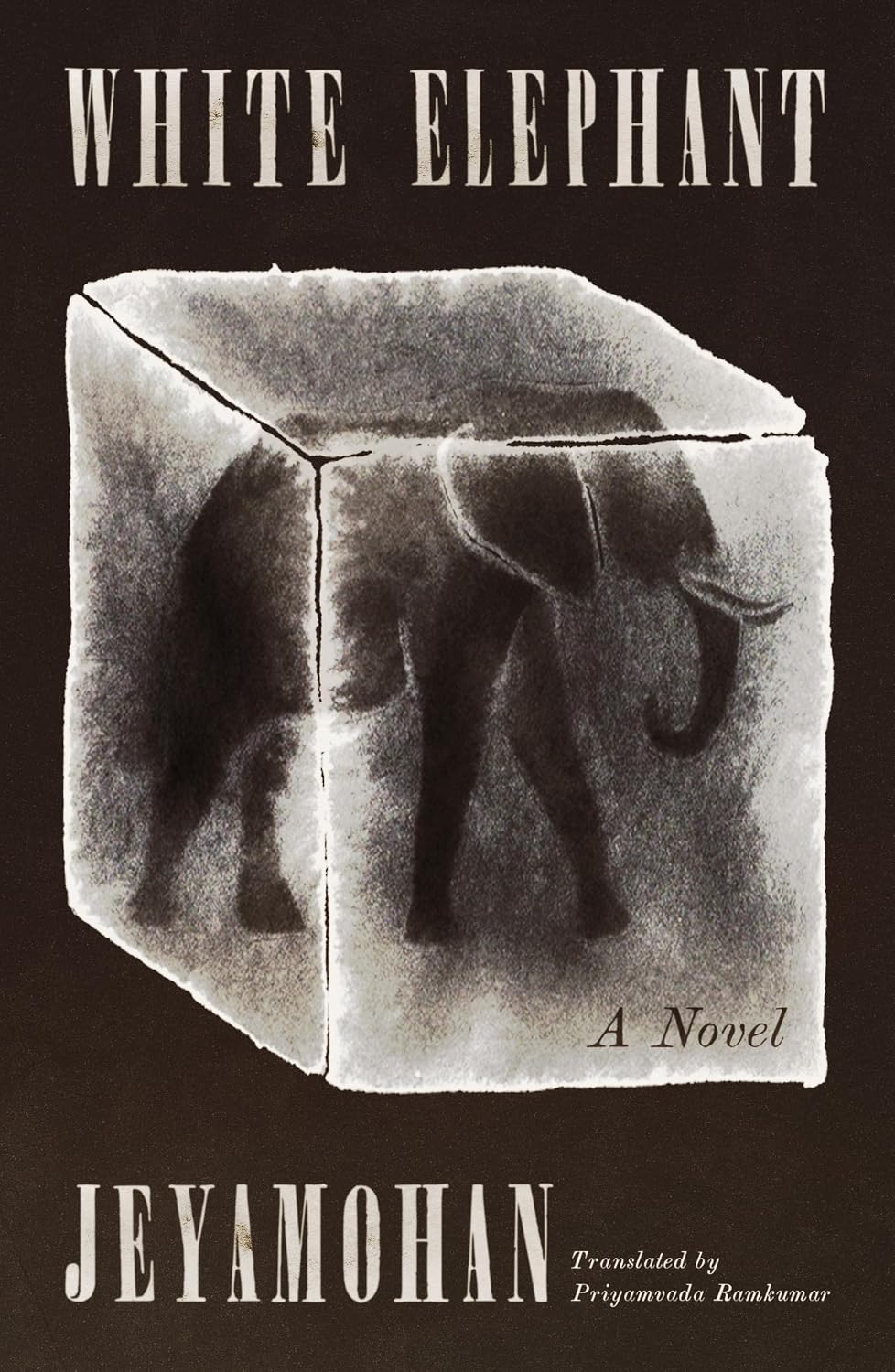
Jeyamohan’s historical novel White Elephant is a visceral exploration of Britain’s colonization of India. The story, translated from the Tamil by Priyamvada Ramkumar, is set in 1878, during the Great Indian Famine, and follows Aiden Byrne, an Irish police officer in the British army. While Aiden initially comes to the city of Madraspatnam with romantic (if not jingoistic) notions of colonial efforts, he eventually realizes that he’s complicit in human-rights abuses, especially against the “untouchables,” who are dying in great numbers. Rather than fully address the tragedy, he tries to suppress this knowledge, which causes him to unravel.
The plot of White Elephant is a vehicle for exploring the various failures of the Raj. When the story begins, Aiden sees two “thin and skeletal” people being whipped at the Ice House, a place where mammoth ice blocks are processed so the Brits can enjoy chilled beverages. While Aiden is shocked by the violence and insists that “the Crown’s laws make no allowance for Her Majesty’s subjects to flog their workers,” the foreman refuses to believe it, let alone help the couple; they’re untouchables, those at the bottom of India’s caste system.
Later, when the pair goes missing, Aiden appeals to the higher-ups, convinced he can help the workers find justice. What he doesn’t realize is that the authorities don’t want to engage with, let alone confront, systemic and institutionalized suffering. Furthermore, many Indians, too, are indifferent to the untouchables’ plight. Aiden finally starts to grasp the magnitude of the issue when he meets Kathavarayan, a young untouchable whose family serves as butlers for British soldiers.
Incisive and blunt, Kathavarayan is Aiden’s foil, believing the famine will provide an opportunity for untouchables to reclaim some rights. For Aiden, this is jarring, given that so many Indians have already died at the hands of their colonizers. But, as Kathavarayan observes, contact with the British “opened a door” to the world, one that restored a sense of dignity to the untouchables, who, because of the famine, have been allowed to move more freely than before.
White Elephant thus presents an admirably complex dilemma: How does anyone change a system when so many benefit from it? While the answers are intriguing, the novel is unfortunately weighed down by description. Nearly every conflict and entanglement is conveyed through lengthy conversations between characters, leaving almost nothing to the reader’s imagination. And many characters seem to exist solely to tell Aiden what he needs to know about the circumstances of his surroundings.
Where the narrative shines, however, is in its depiction of Aiden. Notably, he refuses to participate in certain aspects of the system — such as when he eschews adding ice to his drinks — but he’s never quite outside it. Even though he’s Irish, he “gradually melted and reshaped himself,” buying into the British ideology that allows him to escape his parents’ poverty. As he performs his job, he learns to compartmentalize the atrocities around him. After witnessing starving people being torn apart by dogs, for instance, he returns to his office, where the “cacophony…lost its intensity, and transformed into little more than an incident he had read in some novel.”
Despite his conflicting feelings, Aiden seeks justice for the untouchables, pursuing the matter all the way up to a duke in a scene that shows what compartmentalization looks like when taken to extremes. While Aiden argues for the rights of the untouchables, the duke and his wife sit amidst ivory fans and “curtains [that] undulated against the big teak-wood windows like serene dancers.” Juxtaposed against the many chapters describing squalor and graphic violence, this level of luxury is sickening.
The duke’s indifference to the famine further damages Aiden’s already frail mental state. Soon, when faced with a mob of untouchable workers who try to strike, he threatens to use force against them. Aware that he’s become exactly what he hates, he laments that he’s “a weapon…shaped and whetted by the drill of army.”
But he has little time to reflect on this before he’s promoted and moved to a less volatile district, where the reward for his work is a life surrounded by elites who raise glasses topped with ice so they can toast the empire that’s made them rich. What, if anything, he does to push back this time is for readers to discover.
Emily Hall is a freelance writer whose reviews have appeared in places such as Portland Review, Ancillary Review of Books, Necessary Fiction, and MER. Her creative prose appears in places such as Passages North, 100 Word Story, Gooseberry Pie Lit, FlashFlood Journal, Blood Orange Review, and Cherry Tree. She’s a prose editor for Pictura Journal, has a Ph.D. in English from the University of North Carolina at Greensboro, and lives in North Carolina with her husband.