Yuppies: The Bankers, Lawyers, Joggers, and Gourmands Who Conquered New York
- By Dylan Gottlieb
- Harvard University Press
- 352 pp.
- Reviewed by William Rice
- June 9, 2026
Did those ambitious whippersnappers really ruin everything?
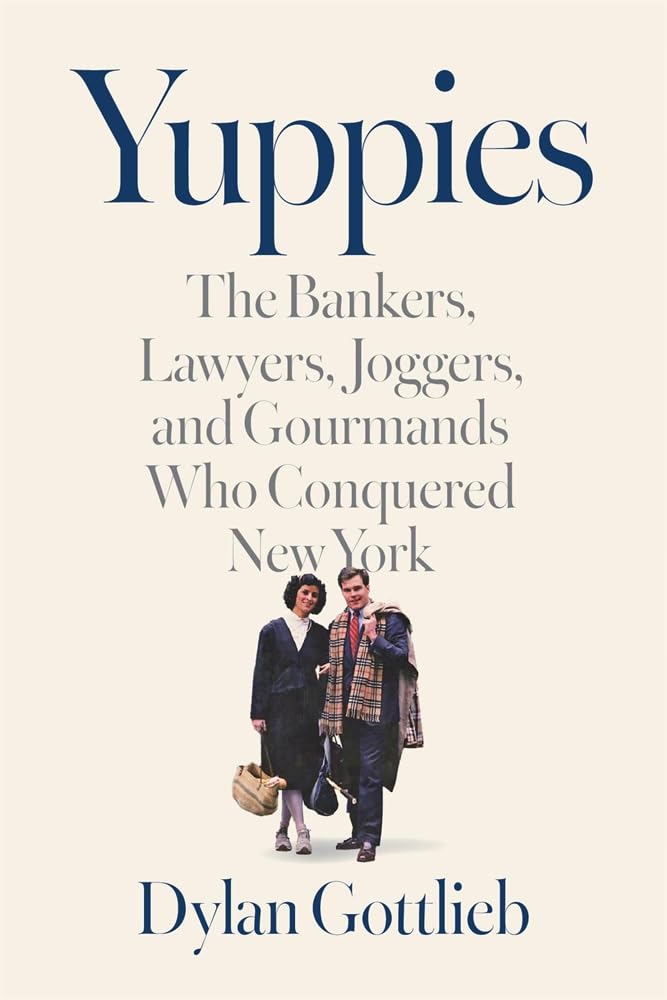
Dylan Gottlieb really hates yuppies. According to the author of this new book about them, young urban professionals of the 1980s were “foot soldiers” in the disastrous financialization of the American economy, “the direct agents and beneficiaries of the plunder of working-class communities,” “consummate entrepreneurs of the self” and, most alarming, “anxieties about affluence made flesh.”
As the title indicates, Yuppies: The Bankers, Lawyers, Joggers, and Gourmands Who Conquered New York is geographically restricted in its scope, even though to those of us who lived through the ‘80s, yuppies seemed to pop up in every city, certainly including Washington, DC. Gottlieb acknowledges there were copycats elsewhere but focuses on Manhattan as the original yuppie incubator because it is the headquarters of the finance industry that he so closely associates with the sociological phenomenon.
Readers seeking lighthearted nostalgia about shoulder pads and suspenders should look elsewhere. This book is an indictment, and the charges include murder: Deadly fires were used to dislodge working-class, usually Black or Latino families from rent-controlled buildings that could be rented or sold at market rates to yuppies. The author chillingly reports that between 1978 and 1983, in nearby Hoboken, New Jersey — just across the Hudson River from Midtown Manhattan — arson “killed fifty-six people and left more than eight thousand homeless.”
Alongside his antipathy toward his subjects, Gottlieb expresses some sympathy. Though well paid, the rookie bankers and law-firm associates who made up the core of the yuppie class worked exhausting hours, often at menial tasks. He compares the “dynamic” of overworking and underchallenging associates to “the deskilling that industrial workers faced on factory floors.”
The text closely examines several totems of yuppiehood, including the Silver Palate gourmet take-out shop (and accompanying cookbook), the New York City Marathon, and Gary Hart’s 1984 presidential campaign. The book is well researched and stern in tone; some ideas — such as the link between career-ladder climbing and competitive running — are needlessly repeated.
Even though Gottlieb blames today’s destabilizing economic inequality on the rise of the yuppie, he acknowledges that the phenomenon was also democratizing: Displacing the male WASP establishment, yuppies came in both genders and a variety of races and ethnicities, including “white ethnics.” Yet this new class became exclusionary in its own way, barring access to those without the proper educational and professional credentials.
By the mid-1970s, cities — most prominently, New York — had fallen on hard times and into bad repute. Years of white flight to the suburbs had left whole urban neighborhoods abandoned, drying up municipal-tax bases and leaving city budgets busted. Baseball fans watching the second game of the 1977 World Series were offered scenes of an out-of-control fire in the South Bronx emblematic of that borough’s decline.
Left behind, albeit in tarnished condition, were handsome 19th-century homes and convenient transit options. Baby Boomers who’d grown up in the sterile suburbs began to rediscover the charms of city living, rehabilitating rowhouses, forgoing cars, and creating a toehold on the urban frontier. What began as a DIY movement accelerated as landlords began catering to the young professionals looking for their piece of city living. The result was a doubling of rental costs between the middle of the 1970s and the middle of the 1980s.
Gottlieb provides some startling statistics on the Ivy League-to-Wall Street pipeline, informing us that, in 1979, only about 3 percent of University of Pennsylvania graduates took jobs in finance, whereas by 1987, about one-third did. Almost half of Yale’s 1985 graduating class applied for jobs at a single investment bank.
Big demographic changes heralded the coming of the yuppie, including women delaying marriage and childbearing to pursue careers. Gottlieb tells us that the birthrate in Manhattan in 1980 was less than half that of 1950.
By the author’s reckoning, yuppie influence over the decades has been so intense that it’s now embedded in the mainstream culture. Judging by the specialty coffees in supermarkets and the yoga classes in strip malls, we are all yuppies now. (Presumably, Gottlieb, a young-looking professor in the Boston area, is too.)
Or, at least, half of us are. The other half is just as mad as Gottlieb at yuppiehood for some of the same reasons. They agree that the financialization of the economy represented and facilitated by yuppies has had a punishing effect on working-class communities: shut-down factories, emptied Main Street storefronts, and broken dreams. (Where they probably disagree is on the merit of the cultural changes wrought by the new yuppie class.) That unhappy half is what in the author’s estimation explains Donald Trump and the rise of conservative populism.
Gottlieb reserves for one short, concluding paragraph his proposed solutions to the yuppification of America. He thinks we can reimagine our economy and society so that finance is not the center of it all, neighborhoods remain affordable for everyone, and “we shun internecine competition for dominance and distinction.” Certainly, a rebalancing of the economy would be a smart move, and quality housing should be available to everyone. But ending the eternal inclination of intelligent, ambitious young people to try to better themselves — and best others in the process — seems like a tall order.
William Rice is a writer for political and policy-advocacy organizations.