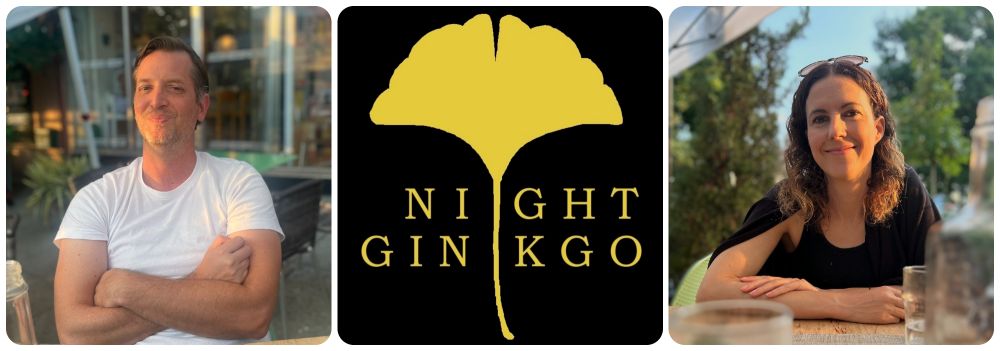
Meet the powerhouse literary couple behind Night Ginkgo Press.
As an undergraduate at Syracuse University, I was introduced to poetry and short fiction written by literary couple Tess Gallagher and Raymond Carver. I thought I’d grow up to be like them — they would be my model — sharing drafts with a partner, urging one another to write more, intertwining and nourishing each other. At one point, somewhat romantically in my undergrad mind, they even switched genres — with Ray writing poetry and Tess writing short stories. I took workshops with both of them and, on occasion, spent time with them outside of the classroom.
However, my literary-couple fantasy was not meant to be (though I just celebrated 40 years of a fun marriage to the non-writer guy I met the first day of sophomore year). Still, I’ve remained fascinated by literary pairs all these years. This is one reason I was eager to interview Andrew Bertaina and Lauren Woods, the literary “it” couple of the moment in the DC area, who are deeply involved with their monthly house-party readings, 804 Lit Salon, the launch of Night Ginkgo Press, and LitBox.
Andrew, tell me about Night Ginkgo Press. Why launch a new press in Washington, DC, at this very divided moment in our nation’s capital? You are starting with an anthology, but do you have any additional calls for submissions coming up?
We are launching a press to help fill some of the needs we see in the literary community. It’s still hard to find places for short-story collections or experimental writing in the literary landscape. We’d like to help be a part of filling what I consider to be a gap. Increasingly, large presses aren’t looking for the type of literary or experimental writing that I find most interesting. We’ll have an additional call for full manuscripts later in the year, and we’re really excited about acquiring and promoting new work soon. The anthology will be coming out at the end of October.
Community seems to be at the center of your literary world. You’ve made quite a splash with your monthly reading series, 804 Lit Salon. Why open your house every month — and how does one get in on it?
The reading series arose out of a small community of writer friends that we had, so it seemed like a natural outgrowth of that group. I also wanted to facilitate something that was a bit more dialectical between the readers and the audience. As a young writer, I always found it so intimidating to talk to a writer after a reading, so I never did! The series tries to cut that distance away. Folks can just email me at [email protected].
Switching gears, Lauren, LitBox is now at Western Market. In this digital age, it’s wonderfully retro. It must startle people (in a good way) when they come upon it and see that they can buy books from a vending machine like they do snacks. What made you bring this to DC?
Thank you, I love that description. It really does feel retro at this point to have a physical book, but I think it’s so important to keep modes of reading where you’re not tempted to toggle to something else. There were multiple sources of inspiration for this project. One is a lack of visibility for local and smaller-press authors, who are often put in the backs of bookstores, and then people are surprised when they don’t sell as well. I wanted a small, equitable space with bigger and smaller presses there together, all outward facing. I also saw a picture of a book-vending machine in a European train station and thought we should have that here! I specifically wanted to bring books to an unusual space, and this one does it because it’s in a food court. If you buy a book in a bookstore, you probably set out to do it. But if you buy a book in a food court, you probably just came across the vending machine and bought a book on a whim that you otherwise wouldn’t have bought. That feels extra special to me.
How do DMV writers get their books in LitBox? Has the general public been using it?
As for how to get in books, I have a Google Form on the website where authors can submit their books for consideration. We can only take 23 a month, so I know I’m missing a lot of wonderful books, but I’m getting to as many as I can, even if it takes a long time. I’m also relying on other writers and literary organizations for recommendations, so it’s not all on me to decide. As for sales, in the first two weeks, we sold 50 books, and hopefully more as people find out about it. (I hope they continue to sell well! I’d love to expand at some point, but there were a lot of up-front costs between shipping and installation, and we have to make a profit first.) What is also amazing is that people are buying these books pretty evenly across the board. A smaller-press book in LitBox is just as likely to sell as a bigger one, which proves to me that if you market books equally, they mostly sell equally.
As I mentioned, I’m fascinated by literary couples — do you have any insights on making it work?
(Andrew): I think the easiest part about this life is that it’s a shared interest. I’m not sure how different it is than any other shared interest for a couple. It makes things a bit easier to have a literary partner. I mean, last year, I read this incredible biography on Tolstoy, and my wife didn’t mind hearing all about how wild he was! I think it’s pretty ideal as long as you’re not competing with your spouse.
(Lauren): We don’t spend as much time thinking or talking about literary topics as you might think. Most of our lives revolve around our kids and the logistics of the week, and beyond that, maybe what we’re watching or reading. Of course, we talk about the writing process because we’re both writers. Andrew is also very giving. Besides the literary stuff, he coached flag football and soccer this year and did a lot of school pickups. We both have busy jobs and stay busy on weekends. It’s tough to find time to write, but I think we find a lot of happiness in remembering that while literature and the literary community are wonderful, it isn’t a substitute for being out there and living our lives.
Back to you, Andrew. I attended the Barrelhouse “Conversations and Connections” gathering at American University this past spring, and you shared how writing your latest collection, Ethan Hawke & Me: The Before Trilogy, was a different experience for you. Can you elaborate on that? And did you send a copy to Ethan Hawke and/or Julie Delpy?
This particular piece of writing was different because it was more of a developmental process. I’d write a draft of the book and then get some feedback from the editor. Most of the feedback focused on adding more scenes or clarifying the perspective of the movie. I write in an associative style, so I think the scaffolding of the movies and the editorial feedback kept it more directed. As for a small press, it’s really that collaborative process that makes the experience unique. The press and writer are united in wanting to sell as many books as possible, which is a good thing! Last, I’d love to send a copy to both of them. If any readers have a suggestion…
*****
And on that book, Ethan Hawke & Me, just out in May from the pop-culture dynamo of a literary organization, Barrelhouse: First, it’s an extended essay or meditation organized into five sections, giving it a cinematic structure to frame the narrative. It uses the film “Before Sunrise,” starring Hawke and Delpy, as a jumping-off point to explore life and the heart’s most basic desire for connection from a thoughtful white male perspective that seems to have receded amid the bombast of podcasts in our Trumped-up political sphere. A recent “Modern Love” column in the New York Times even laments, “Men, Where Have You Gone? Please Come Back.”
The men, or at least one of them, have surfaced in Bertaina’s gentle book, which eases you in with this beautiful opening:
“Love. I hoped it would happen on a train sometime during my early 20s as the countryside rolled past — cows lowing in the fields, clothes dancing on lines, a murmuration of starlings patterning the sky.”
We are given the image of a young man reading and scribbling in a spiral-bound notebook, and then we’re on our way into one of the most heart-rending, immersive reads I’ve experienced in a long time. I read it straight through. It’s about love, but it’s as much about courage. It takes courage to leave a small valley town in Northern California and a religious upbringing to recognize and take responsibility for a failed first marriage, and to seek, at 40, love again with an open heart and questioning mind. I only wish I had Ethan Hawke & Me while I was on a train.
Caroline Bock writes stories — from micros to novels. She is the author of the novel The Other Beautiful People, forthcoming from Regal House Publishing in summer 2026. A graduate of Syracuse University, she studied creative writing with Raymond Carver and poetry with Jack Gilbert and Tess Gallagher. In 2011, after a 20-year career as a cable television executive, she earned an MFA in fiction from the City College of New York. She has short fiction forthcoming in the Hopkins Review. She is the co-president and prose editor at the Washington Writers’ Publishing House. She lives in Maryland with her family.