Strange Violin Editions has its roots in Mormonism.
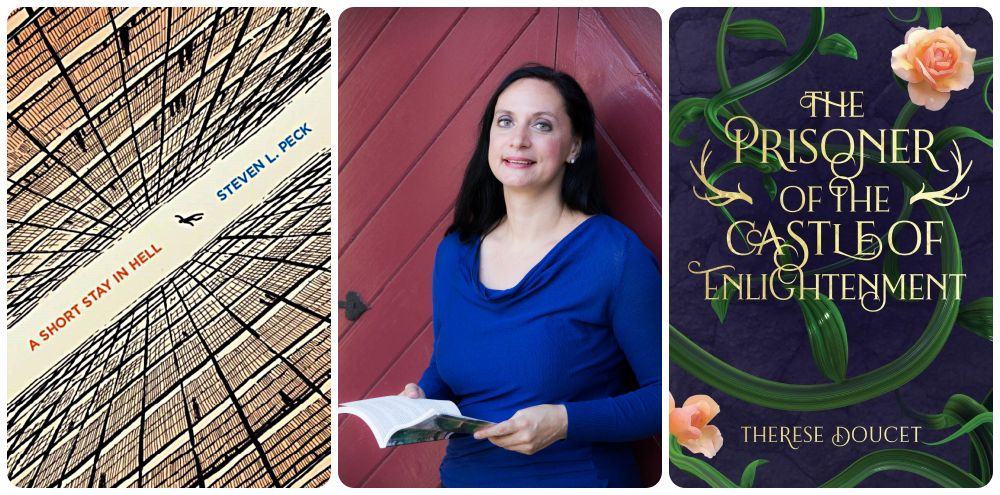
I’ve known Therese Doucet for a long time as part of a writer’s group that has met monthly for over a dozen years. In that time, we’ve discussed at length our manuscripts and our daughters but almost never the independent press she launched in 2011, the DC-based micro-publisher Strange Violin Editions. I am sure this is about me, about how I silo friendships into specific subheadings — writing friends, book-club friends, work friends — filing the latter neatly under the jobs I’ve had over the years. Therese is one of the most intensely interesting and multi-talented people I have ever met; she doesn’t belong in any silo.
On your website, you discuss founding the press “after researching ways to publish your own novel and realizing that there was a dearth of publishing options for Mormonism-related books that fell outside the parameters of LDS orthodoxy.” Can you expand on why you founded Strange Violin Editions?
My goal with founding the press was to serve a very niche group of readers — current and former Mormons, as well as readers with an interest in the culture of Mormonism, with an openness to reading unorthodox fiction and nonfiction. (Note that official Church policy discourages referring to members of the Church of Jesus Christ of Latter-Day Saints as “Mormons,” but I use the traditional nickname for brevity.) Currently, however, my interests have shifted to publishing more general fiction and nonfiction. I’m especially interested in fiction with elements of magical realism.
Your writing, and the works from Strange Violin Editions, notably Steven L. Peck’s breakout A Short Stay in Hell, seem to intersect deep literary and meta-philosophical roots with more mainstream genres of fantasy and horror. What draws you as a writer and publisher to these idea-driven, genre-infused kinds of literary novels?
I was a philosophy major in college, so I’ve always loved thinky, challenging books. I also love a good immersive plot that transports you to somewhere new in your imagination, so combining those two loves is my ideal for both writing and publishing fiction.
You have roots in the LDS faith, as does Steven L. Peck (whose main character in A Short Stay in Hell, Soren Johansson, is a faithful member of the LDS Church). In the larger literary world, Stephenie Meyer, author of Twilight, also in many ways a genre-breaking series, is one of the faith’s most famous literary members. What is your sense of the connection between the faith and fiction?
I’m a great admirer of Stephenie Meyer! Shannon Hale also deserves a mention in this context. Mormonism very much has its own version of the Protestant work ethic, and education was highly valued in Mormon culture when I was growing up, so even though I’m no longer a believer, I think the faith can really nurture the combination of hard work, idealism, and creativity that goes into writing wonderful novels.
Published in 2012, A Short Stay in Hell is truly a testament to you as an editor/publisher believing in a work for the long haul. You’ve recently received international interest in it and attended the Frankfurt Book Fair in October, one of the top book-trade fairs in the world, to pursue a partner to help you manage that interest. How did you find that experience? Do you think it’s worthwhile for writers and/or small presses to attend Frankfurt?
Yes! Frankfurt was fascinating and intense. It’s just huge, and small and indie presses can easily feel lost in the crowd there. I think medium-sized and larger presses would tend to get the most out of it, but a number of organizations partner with small presses and indie authors to display their books at the fair, such as the Independent Book Publishers Association (IBPA), so that’s always an option. I also found the industry talks and data presentations to be fascinating and feel that I learned a lot about international publishing trends.
A Short Stay in Hell is available in print, ebook, and as an audiobook. Can you share some of the process of turning the print book into an audiobook? And has it been successful?
Speaking of trends, audiobooks are one of the fastest-growing categories in worldwide publishing currently. The process of producing an audiobook edition was a lot of fun. I was able to audition narrators on a platform called ACX and eventually hired an NYC-based narrator named Sergei Burbank to complete the audiobook, who did an awesome job. I was able to do quality-control checks throughout the production process via the platform, which I think is a key step that sometimes gets overlooked. The audiobook version of A Short Stay in Hell has been wildly successful and typically accounts for around 20-25 percent of our sales each month. ACX has been a great platform, but it may not be the best choice for those who want distribution beyond Audible.
Your own novel — the haunting, sexy historical fantasy novel set in mid-18th-century Savoy, The Prisoner of the Castle of Enlightenment, was originally published in 2020 by an independent press, DX Varos Publishing, run by Dan Varos, who unexpectedly passed away in 2023, shocking many writers and resulting in the press’ shutdown. This hasn’t been the first independent press to abruptly shut down. As of this October, your novel is now available as an ebook distributed by Strange Violin Editions. Are there any red flags you learned from this experience that you could share for writers looking to be published by an independent press?
I definitely learned the importance of contingency planning and succession planning for small presses, which is a topic that I noticed is going to be on the program for IBPA’s Publishing University conference in 2026. So, this is an issue of broad concern to indie publishing generally. For writers, consider incorporating this consideration into your vetting of offers from small publishers — try to determine whether the press has a backup plan for if the head of operations is incapacitated or the company has to shut down for other reasons.
On The Prisoner of the Castle of Enlightenment — are you going to distribute a new print version?
Yes, I am indeed going to put out a new print version, as well as a new audio version, since the rights reverted to me when the publisher passed away.
Strange Violin Editions has published five books in its short history. Are you going to open for submissions in the future? If so, how do people submit?
I do plan to open for submissions, but the timeline is TBD. In the past, I worked through a submission-portal service and would probably reopen the portal, since that was helpful for evaluating submissions in the past.
*****
Now, onto A Short Stay in Hell, by Steven L. Peck, an evolutionary ecologist and professor of the philosophy of biology at Brigham Young University. At 104 pages, it can be read in one sitting, but you’ll want to savor this existential vision of eternity. There are many literary and religious references here, from Mickey Spillane to Zoroastrianism to a Hell based on the short story by Jorge Luis Borges, “The Library of Babel,” and even more so to numerology, which, as I’m “only” an agnostic English major, eluded me — and fascinated me.
The main character, a 45-year-old Mormon who has died from cancer, believes strongly in the hereafter but not in what the hereafter has in store for him. Most of all, books and ideas rip through this Hell, and I wanted to stay longer, to linger. I can see why readers from around the world want to dissect this thinking-man’s version of what’s next for us all.
Now, onward to my own personal hell (and heaven) of writing and publishing — and to a 2026 for us all filled with good books!
Caroline Bock writes stories — from micros to novels. She is the author of the novel The Other Beautiful People, forthcoming from Regal House Publishing in summer 2026. A graduate of Syracuse University, she studied creative writing with Raymond Carver and poetry with Jack Gilbert and Tess Gallagher. In 2011, after a 20-year career as a cable television executive, she earned an MFA in fiction from the City College of New York. She has short fiction forthcoming in the Hopkins Review. She is the co-president and prose editor at the Washington Writers’ Publishing House. She lives in Maryland with her family.