How akinoga press elevates the art of bookbinding.
I spent this past Saturday at the Frederick Book Arts Center in Frederick, Maryland, where I worked with ink and paper, rolling the early 20th-century letterpresses, cutting the paper, folding it, and feeling renewed. The tactile, muscle-bound experience of making literary art — in this case, poetry broadsides and posters — for the Washington Writers’ Publishing House reminded me why I love beautifully made books, especially handmade ones.
Which brings me to the Baltimore-based akinoga press. Over the years, I’ve bought several books from akinoga. In the last year, I was drawn to their table at the Baltimore Book Festival and the CityLit Festival. I wasn’t able to not touch their books, to not want to play with the pages and read the words that played on them.
First, an explanation about their curiously distinctive name from their website:
“akinoga press (pronounced ah-kee-noh-gah; Japanese for autumn moth) is a Baltimore-based micro-press that specializes in hand-bound chapbooks of a spacious/minimalist nature and is dedicated to publishing work that’s small, quiet, odd, easily-missed, and 100% needs to be read.”
I’ll take odds with odd and easily missed since I found their works compelling and hard to put down. I wanted to spend time with these books, so much so that I decided to talk more with akinoga’s founder, Mychael Zulauf.
I’m intrigued by your short bio: “Mychael Zulauf, founder, editor, designer, binder.” Binder?
Yep! If a manuscript/book is short enough, and if the writer is on board, I will bind all copies by hand instead of getting them perfect bound by the printer I use. I’m limited right now to shorter books, though I have been experimenting to see if I can add more to the binding form I use (modified double-pamphlet stitch) and have it still be time- and resource-efficient.
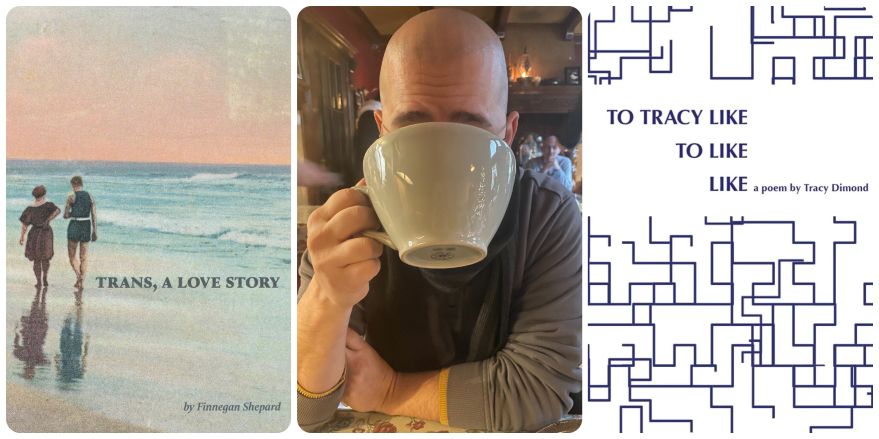
Hand-binding books also gives me a good bit of freedom to explore the form and function of a book (like TO TRACY LIKE by Tracy Dimond or double exposure by Maria C. Goodson), which is always an enjoyable and rewarding challenge. Plus, there’s an added intimacy and uniqueness that I think readers pick up on when reading a hand-bound book. I’d like to think they can intuit the added time and attention that each copy carries with it and thus creates for them, in that way, an enhanced reading experience.
The press is essentially you, but you have “cohorts” who support you. How does akinoga work with those cohorts?
I would like to think we support each other! But publishing as cohorts, for me, is just a way to break down my workload into something resembling a manageable process. It allows me to have very intentional open consideration/submission periods that I then don’t have to think about until I’m almost through the (at the time) current cohort. It also gives me a loose idea of what my publishing schedule will be for the next however many years. I try to publish four books a year (one per season), so if, let’s say, after an open-submission period, I decided to publish 10 of those submissions, I know essentially what the next two-and-a-half years will look like, and those 10 writers are that publishing cycle’s cohort. And inevitably, connections and echoes begin to manifest between the works of the cohort, which is very gratifying for me and hopefully more serendipity than merely pattern-making (on my part).
I run the press as a more or less traditional press, i.e., I take on all of the financial burden of production, as well as give my writers (in lieu of royalties, and within reason) essentially unlimited access to free copies that they can do whatever they want with. But, inside that model, I endeavor to work as collaboratively with my writers as possible. The editing/revision process is a multi-draft, workshop process, and I get their input at each major stage of the layout/design process. Some writers have a clear vision that I do my best to execute; others have more of a loose idea that we flesh out together as part of the overall process. But, ultimately, my job is to facilitate what we both feel is the very best version of their work and then send it out into the world.
The Association of Writers and Writing Programs’ (AWP) annual conference will be in Baltimore next March. But you’re already right in the middle of the incredibly vibrant Baltimore-area literary scene — what is it about Baltimore, books, and writers?
A LOT of credit is due to the numerous amazing creative-writing MFA and Ph.D. programs in Baltimore. The city attracts a tremendous amount of incredibly talented, creative people and then has a tendency to hold onto them. I mean, just look at how many reading series there are, how many small presses that are actively publishing very disparate but all really amazing books. Baltimore has two separate annual literary/book festivals. TWO! I feel like a city would be lucky to have even just one!
Baltimore seems to have a way of making people care about it and the communities it’s comprised of. And, I think, in turn, those communities and the city at large reflect a good amount of that care back on us. What’s the saying: A rising tide lifts all boats? I think that’s Baltimore in general, and all the creative communities specifically: Seeing, and being a part of, the passion and encouragement and creativity of your peers buoys everyone.
I was excited to read your sneak preview of Trans, A Love Story, a novella by Finnegan Shepard. What’s the next project for akinoga press?
The next two books up for release are novellas, one a corporate horror, the other a sort of blend of magical realism and noir. And then 2026 is all poetry, all the time! I have a couple of debut collections and even my first returning writer, environmental sculptor Stephanie Garon.
*****
Established in 2015 with the launch of its first publication, Go to the Ant, O Sluggard by Tonee Mae Moll, akinoga press will have published 28 books by the end of 2025. Submissions will open in October/November 2026.
I highly recommend Trans, A Love Story for those who are looking for an indie-movie-style love story. It’s set in Manhattan and is the story of two 20-somethings, Amy and Lucas, meeting cute, falling in love, and finding out what really matters about trans love — and love for all. I was drawn to the story the same way I was drawn to akinoga’s other works: I wanted to hang out with these characters — preferably at brunch or a downtown bar. I wanted to spend time with them.
Caroline Bock writes stories — from micros to novels. She is the author of the novel The Other Beautiful People, forthcoming from Regal House Publishing in summer 2026. A graduate of Syracuse University, she studied creative writing with Raymond Carver and poetry with Jack Gilbert and Tess Gallagher. In 2011, after a 20-year career as a cable television executive, she earned an MFA in fiction from the City College of New York. She has short fiction forthcoming in the Hopkins Review. She is the co-president and prose editor at the Washington Writers’ Publishing House. She lives in Maryland with her family.