The writer talks love, the DC punk scene, and their debut novel, which concerns both.
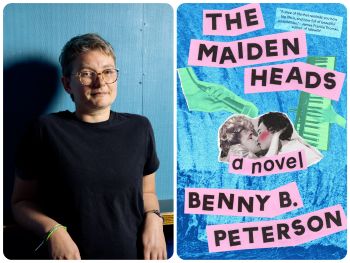
The Maidenheads, Benny B. Peterson’s debut novel, is about love every which way it happens. In it, Peterson (they/them), a writer and editor living outside Washington, DC, covers the playlist of love: lust, manipulation, obsession, consolation, and, finally, self-love. The backdrop is the punk-music scene in DC over several decades, with our heroine, Jamie, working to unite past and present as she contends with becoming herself in all her glory.
Let’s start with DC music lore, particularly punk nostalgia. Your novel takes place in the early 2000s and then again a decade later. Way back in the 1980s, my boyfriend and I prowled the streets around the 9:30 Club photographing stencil graffiti, much of it the work of bands like Urban Verbs and Tiny Desk Unit. So I enjoyed Jamie’s nostalgia for DC’s enduring punk scene, as well as the band names and lyrics you invented! Can you talk about music as your inspiration?
Oh, wow, I love that you were situated in such a real way within the imaginary space of the book! I moved to DC as an adult and learned much later on about the punk scene my characters come up in as teenagers. So part of the novel, for me, was an excavation of a history I find fascinating in a city I’ve come to love as an outsider (I’ve been here for 20 years, but you’re kind of always an outsider here if you’re not a native). I learned about DC punk history from friends who’d lived it, and it felt like a thematically fertile and, to me, very engaging backdrop for a novel. I love the music myself, too, and it was a pleasure to listen and to watch old shows on YouTube, always imagining how my characters would’ve listened and watched.
I love your line, “I remembered how close to joy rage could feel,” where punk is both a primal scream and an ecstatic anthem.
Yeah, I think about punk as a music and scene that balances such tenderness with such ferocity. And both of those poles were important for me to explore in my characters and in my novel.
I haven’t read enough novels about gender fluidity, and I welcomed witnessing Jamie’s evolving self. She was like a marble in a maze, trying different paths until settling into the right groove: Jamie, James, Jim. Rather than a coming-of-age novel, this feels like a coming-of-gender novel. Talk to us about that.
I love that metaphor for Jamie and for all of us in that maze! I think for queer people, there can be many nonlinear comings-of-age, and we can often feel stuck in different phases of life until we figure out who we need to become in order to move forward. Jamie is very much stuck at the outset of the novel, and we gradually intuit that part of her stuckness is around her gender identity. I knew I wasn’t interested in writing a traditional coming-out narrative, and, in fact, Jamie never describes her own identity or changes her pronouns within the book. But she does make some big changes by the end that allow her, at last, to sink into the right groove, as you put it.
If you’re comfortable, I’d love to hear how your own journey inspired the novel.
Sure! I started the novel 10 years ago thinking I was a mostly straight woman and ended it as a very queer trans guy. I always feel like I have to reassure people that the book is not autobiographical and I’m far less messy than Jamie, but to be fair, there was messiness along the way for me as well, and certainly some of that twinned chaos and self-discovery entered the book. I wouldn’t call it a direct inspiration, though, more kind of an emotional shading.
There is plenty of gutsy sex in this novel! After one memorable night, Jamie says, “I was gelatinous from sex.” The last time OK Go played the 9:30 Club, they kept shooting off a confetti cannon, and the lead singer said when they review a show, their only note to themselves is: More confetti! Did you write the passion with zeal, or did you reread a scene and decide: More confetti!?
Wow, taking up “more confetti” as a writing mantra! Love that. I think I’m always pushing myself in any scene to go farther, bigger, weirder, even if sometimes it means I need to scale back later. Sex scenes, specifically, I find incredibly important in terms of exploring character and how people relate to each other — sex can be joyful and shameful, terrifying and liberating, tedious and consciousness-enlarging, sometimes all at once, and I never want to skimp on making those scenes do all the powerful work I know they’re capable of. Plus, I love writing them, even when (especially when?) the sex itself is bad.
Jamie imagines that everyone thinks less of her than they actually do, certainly less than the reader does. That paralleled the storyline of her finding her voice. She is never sure she can sing until she opens her mouth to belt out her anthem, which starts, “I’m not gonna be forgotten.”
Yes, Jamie is someone who really doesn’t know herself very well, doesn’t know what she’s capable of or how she projects into the world. I think a lot of us are that way in our 20s, actually, and although Jamie is a little older than I think most protagonists of coming-of-age novels are, it still felt very right for me to approach the story that way.
This is a DC-writer question: How did you decide what to actually name and what to fictionalize?
Great question. Basically, everything with a name is a real place that existed in the DC of the novel’s present-day, with two big exceptions: the two main characters go to a fictionalized version of Jackson-Reed High School, which I call Frederick Douglass High in the novel; and they perform at a concert hall I called the Atrium, which is fairly transparently based on the Anthem. With Douglass High, I wanted a little more space to imagine Mari and Jamie’s high-school experience. I knew if I used the name Wilson (as it was called then), people who went to Wilson would have a really clear vision of the scenes that might not jibe with how I was imagining them, as someone who has never been inside the school building nor was likely to get a tour.
With the Atrium: The Anthem didn’t open until 2017, but I needed something like it for my characters in 2012, so I invented the Atrium. Apart from those two things, though, all the geography of the novel is drawn fairly directly from life, down to the amount of time it takes for the characters to walk a distance, the bus routes, etc., etc. I was really, really careful, because as much as possible, I wanted DC readers to feel safely held by a fiction that felt real.
My favorite review of your book called it a “queercore punk symphony of the human heart and limbs.” I especially like “symphonic” to describe the elements you play as you sound out heartache, divorce, pregnancy, abortion, art, sexuality, and, of course, punk. Can you talk about managing the themes and variations of your novel?
Aw, yes, I loved that description (by Jorge Estupinan of Debutiful), as well. It was really challenging, especially, to place into counterpoint the arc of Jamie deciding what to do about her pregnancy with the arc of Jamie deciding what to do about Mari, and, at times, each arc threatened to overwhelm the other. Then you toss in a bunch of minor characters who have their own strong feelings about how the book should go, and, at times, in the very long revision process, it felt more like a cacophony than a symphony! I did my best to manage it all and learned a lot from my mistakes, at the very least.
[Photo by Farrah Skeiky.]
Mary Kay Zuravleff is the author of four novels, including American Ending, an Oprah Spring Book Pick, and Man Alive!, a Washington Post Notable Book.