The innovator hopes that, one day, our favorite protein will no longer come from animals.
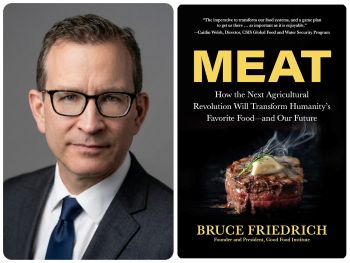
As president and founder of the nonprofit Good Food Institute — a think tank devoted to making the world’s food system more ethical and sustainable — Bruce Friedrich is no stranger to the enormously complex question of how to feed a growing population amid shrinking resources. In his new book, Meat: How the Next Agricultural Revolution Will Transform Humanity’s Favorite Food — and Our Future, he suggests there’s an answer: alternative proteins.
When I picked up your book, I assumed its thesis would be that we should eat less meat — or stop eating it altogether — for the sake of animals. But you argue that it’s really for the sake of the planet. How did you come to see things that way?
I adopted a plant-based diet in 1987, after reading Diet for a Small Planet, which made a powerful case that meat production drives environmental damage while also worsening hunger and malnutrition. For decades, I believed that if people understood those stakes, they would change what they ate. But decades of data tell a different story. Global meat and seafood consumption has risen every single year since the UN Food and Agriculture Organization (FAO) started counting in 1961. Meat’s external costs are enormous, and they include cruelty to animals and a range of environmental and global health problems. But meat is also, I believe, humanity’s favorite food. Once I accepted that people aren’t going to eat less meat at scale, the conclusion became unavoidable: The only solution that works is to make meat differently.
You use the umbrella term “alt meats” throughout to refer to both plant-based and cultivated meat. Everybody who’s ever eaten a Beyond burger knows the former, but can you briefly define the latter?
Just like you can take a cutting or a seed from a plant, bathe it in nutrients, and grow a whole plant, you can do the same basic thing with a tiny amount of animal fat or muscle: That’s cultivated meat, and at scale, we will replace industrial farms and slaughterhouses with factories that look like beer breweries. It’s a far more efficient way of producing meat — far less land and water, far less air pollution and climate change, no need for antibiotics or other drugs. From a biological standpoint, it’s identical to conventional meat; what’s different is the production method. Think of it as skipping the cow and going straight to the burger.
Although Meat is very readable, it seems aimed as much (if not more) at policymakers as the general public. Did you have a particular audience in mind while writing it?
I worked very hard to make it a book that anyone who loves meat and nonfiction will find enjoyable, so I feel gratified that all but one of the reviewers who were given advance copies by NetGalley and Goodreads (i.e., all general readers) were super-positive…That said, you’re right that I didn’t want to write an engaging book for the general reader at the expense of writing an influential book for scientists, engineers, and policymakers. As I discuss in the conclusion, success for the alt-meats endeavor is going to require a lot more science and engineering, and that will require the support of governments.
So I think that’s a fair observation: that I was aiming as much at scientists and policymakers as at the general public, though I sure do hope that anyone who loves meat will find it interesting to read about what meat production might look like in 20 years, and how we could get there.
Twenty years ago, it was tough to find soymilk in restaurants and coffee shops, but today, it’s nothing to have two or three non-dairy-milk options pretty much everywhere. Do you envision that being the case for alt-meat choices someday?
Yes, the goal of the endeavor is to go from “alternative” meat to just “meat.” Just like the goal of energy transition is to shift energy production to renewables, the goal of protein transition is to shift industrial protein production to plant-based and cultivated meat. Just like a phone no longer has to be plugged into a wall, a camera no longer requires film, and a car no longer requires a gas tank, we will get to a place where meat does not require live animals. There will be plant-based meat, cultivated meat, and farmed meat.
I smiled at your remark that “some government should launch a Manhattan Project-level initiative for alternative meats,” although you quickly add that the Human Genome Project is a better analogy. Assuming “some government” does take it on, which one can you imagine it being? I suspect it’s not ours.
In the book, I walk through what more than a dozen countries are doing to support alt-meats science and entrepreneurship. Based on that analysis, the most likely leaders are China, Korea, the U.K., Israel, Singapore, and the United States. It’s a crowded field; until 2019, it was really just Israel and Singapore, but now dozens of nations are active.
This support transcends ideology because it’s driven by economic and food security. For example, in Brazil, Presidents Bolsonaro and Lula — political polar opposites — were both strong allies of the industry. All ideologies are committed to economic growth and a well-fed population.
Right now, the race is the United States’ to lose. We have the world’s most successful startups, two of the world’s largest meat companies (both investing heavily in plant-based and cultivated meat), and the lion’s share of the world’s top scientists.
Even in the U.S., support for alt meats is surprisingly bipartisan. Caitlin Welsh, who wrote my foreword, worked at the State Department under Obama and the National Security Council under Trump. It was the Trump-era National Science Foundation that gave a multimillion-dollar grant to UC Davis for cultivated meat research in 2019 — the first such grant in over a decade. It was also Trump’s USDA and FDA that created the regulatory framework allowing the U.S. to be only the second country in the world to approve cultivated meat for sale.
At the micro level, alt meats are about entrepreneurship, small business, and consumer choice. At the macro level, they are about water security, economic competition, and building a more resilient food supply chain. Those are goals everyone can get behind.
Finally, plant-based meats have come a long way. (You could slip an Impossible Whopper to a carnivore, and they probably wouldn’t notice.) Is there a company or product out there right now that makes you feel especially hopeful about the eventual wide-scale embrace of alternative meats?
I try in the book to be optimistic and realistic at the same time: Plant-based and cultivated meats don’t go mainstream until they compete on price and taste. That is challenging, and I walk through just how challenging. That said, it’s a lot less challenging than many scientific problems that humanity has solved. We just have to bring the will.
In the book, I talk about the fact that just 10 years ago, we were nowhere on taste parity (there was no Impossible Burger). Impossible Foods has shown us that taste parity for plant-based meats is possible; we’re not quite there, but we’re really, really close. We have some remaining scientific challenges and very big scaling challenges, but all of it seems within reach.
Our progress on cultivated meat has been even more remarkable: Less than 10 years ago, there were four research papers and 10 patents, ever. There was no government funding, and there had been one private-sector investment, in all of time, of just $125,000. Most people thought that was a fool’s errand. Now, there are more than 150 research papers per year and [there] have been more than 1,000 patents granted. And every government on the planet that puts significant resources into agriculture or biotechnology is funding cultivated-meat research.
I name some of the pioneering companies in the book, but what I’m really excited about is the ecosystem. The book’s conclusion has as its epigraph: “It’s very hard to achieve things you’re not trying to do.” I wrote Meat to serve as the roadmap for that endeavor — to ensure we’re actually trying to achieve the future we say we want.
[Editor’s note: Bruce Friedrich will discuss Meat with Washington Post climate reporter Nicolás Rivero at Politics and Prose at the Wharf in Washington, DC, on March 25th, at 7 p.m. Learn more here.]
Holly Smith is editor-in-chief of the Independent. She gave up meat 35 years ago.