The journalist talks Black joy, summertime, and the richness of Detroit.
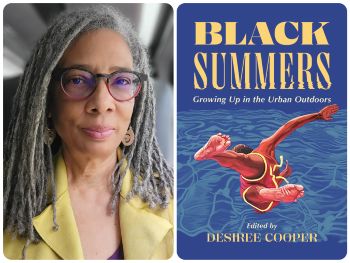
The forthcoming Black Summers is a riveting collection of essays, poems, and comics by Black writers from Detroit. Nostalgia and indignity, comfort and danger live side by side in these works. For many of the contributors, summer evokes childhood hijinks during long, sunny days or the camaraderie of finding their tribe as adults. Others are more expansive in their recollections of summertime, including the book’s editor, Desiree Cooper, whose own piece poetically lays claim to Detroit’s history.
Cooper is a Pulitzer Prize-nominated journalist with bylines in the New York Times, Michigan Quarterly Review, the Rumpus, Best African American Fiction, and many other outlets. “The Choice,” a film about reproductive rights that she wrote, produced, and co-directed, received awards from the Berlin Flash Film Festival and the Best Short Film Festival in Los Angeles. She is also the author of the story collection Know the Mother and the award-winning children’s picture book Nothing Special.
Congratulations on this terrific gathering of incredible writers. You had me at the cover! The image of the kid diving into a pool feels both liberating and menacing. Why did you choose it for a book about Black joy in the outdoors?
The minute I saw this art (from “Make Way for Tomorrow” by Senghor Reid), I knew it belonged on the cover. You’re so right: The kid is plunging into the pool with the kind of abandon that summer inspires in all of us. But the child is Black, and the background is a blue abyss. It makes you smile but gives you the creeps at the same time. Is he being thrown into the water? Is he falling or diving? Is he safe? This can be exactly what a person of color feels in outdoor spaces. Years after integration, we often remain uneasy and unwelcome in public areas. The image conveys both Black joy and the racism that tries to douse it.
I expected childhood memories of swimming and riding bikes in the city. But so many writers looked back upon their parents through the lens of racism and arrived at a new understanding. What do you make of that?
Many describe what Pulitzer Prize-winning journalist Stephen Henderson details in his story: an encounter with racism that “shatters the joy of childhood in an instant.” From the vantage of hindsight, they can now see how their parents were coping with their own racial traumas. The compassion these writers display is breathtaking: for a father helping his daughter heal from the violence of the 1967 Rebellion; for a mother trying to save her family’s sanity with a camping trip to Canada; for a grandfather who rouses his grandson for a predawn walk in the city; for a parent having to give “The Talk” after whites evacuate a public pool after a Black family arrives. They are realizing why their parents sought solace in the outdoors: to insulate their children from the hard edges of city life, but also to find respite for themselves.
The stories are Detroit specific: The ferry to a Canadian amusement park; the Swimmobile (a portable pool for city kids); days spent on Belle Isle, Detroit’s island public park; and going South for family reunions. In writing, the more specific the description, the more universal a story becomes. What is universal about Black Summers?
Summer can be complicated. We romanticize it as a season of freedom and fun, but for adults making a living — and for children growing up without access to summer programs or safe places to play — it rarely is. Readers with their own strong memories of summertime will find 28 versions of what summer means to people who are like them and people who are different. The writers are aged 16-74. They are queer and Afro Latinx. Many write about childhoods, but many write about how they embrace summer joy as adults. Together, they offer a view of Black life in the urban outdoors.
The book captures the outdoor lives of city dwellers during their lifespan, but it also manages to include hundreds of years of Detroit history. Did that breadth surprise you?
I set out to collect tales about the innovative and curious ways Detroiters celebrate the summer: oil-drum barbeques, the African World Festival, the huge boat culture, Slow Roll biking, and driving south to Canada (yes — look on the map!). But the contributors made it clear that they couldn’t talk about how race shaped their summers without talking about history. A lot. How can you talk about the solace of your childhood front porch without talking about how it was shattered by the 1967 Rebellion? How can you talk about summer strolls through a nearby cemetery without talking about the history of the people buried there? How can you write about swimming in the suburbs without talking about the history of segregation around public pools? There are those who wish that we could leave racism in the past. These stories show not only how America’s past continues to shape the present, but also how, in each case, joy triumphs.
Summer evokes an oasis, both psychologically and physically. Readers might be surprised to find that Detroit is such a place for many of the contributors. How do you reconcile the city’s troubled racial history with the fact that these Black writers see it as a haven?
Outsiders are often taken aback by how much Detroiters love Detroit. Residents are not blind to the city’s challenges; they are simply dogged about holding on and forcing change. That comes through in Pamela Hilliard Owens tracing her family’s migration from the South in the 1940s. Eighty-five years later, she writes, “We choose to hold on to our stake in Detroit, the place our parents and grandparents claimed for us decades ago.” Her husband, Denver native Keith Owens, views Detroit as the Mecca where he discovered what it means to be Black. “In Detroit, there was no need to prove anything; you could just breathe deep, surrounded by that chocolate rainbow, and be.” For Kahn Santori Davison, the door to Blackness opened wider at the Afro Nation festival, where “it felt good to be a part of a bigger Black diaspora than just the ‘west side of Detroit.’” The stories collectively build a vision of Detroit as a place where they can be free to express Black joy and also free from the racism that proscribes it.
Mary Kay Zuravleff is the author of four novels, including American Ending, an Oprah Spring Book Pick, and Man Alive!, a Washington Post Notable Book.