The writer’s new collection explores women’s eternal question, “Who am I?”
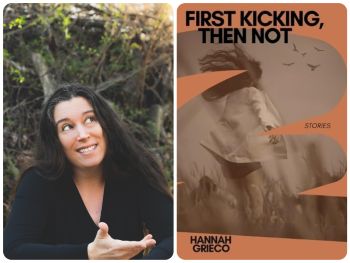
The tales in Hannah Grieco’s First Kicking, Then Not are honest, funny, thoughtful — like the author herself — and explore the turbulence of womanhood and everyday life. A longtime writer, editor, and writing instructor in the Washington, DC, area, Grieco most recently edited Already Gone: 40 Stories of Running Away for Alan Squire Publishing. First Kicking, Then Not is her debut collection.
You’ve edited or contributed to several anthologies, but this is your first solo outing. How does it feel having your name alone on a book’s cover? Is it thrilling or daunting?
It’s wonderful! I am an editor and educator, but I am first and foremost a human who creates art. A writer. I don’t want to forget that. A friend recently told me that it’s easy to become a “facilitator” in the eyes of other writers, particularly when you edit books, teach classes, organize events, etc. But I love to write, love to get extremely weird and vulnerable on the page. This book is distinctly me, my voice, my weird and vulnerable view of motherhood and life. I’m proud of the work I did and the art I made!
How did you decide the order of the stories? Was there a particular narrative or thematic arc at play?
I hadn’t originally planned to put together a collection, at least not yet! I had grand views for a longer book of linked stories, with overlapping characters amidst a shared geography. I still hope to do that. But this shorter collection came about as I played with the stories I’d written individually over the past few years. I had no larger picture in mind when I wrote these! However, we are who we are. We live in these bodies, on this world, surrounded by confusing, terrible people and events. And also hopeful, beautiful people and events. It’s a strange life to live, made even more so when you have children.
So, as I reread my stories, certain ones very clearly spoke to each other. The vibe, the protagonist, the deep need, the ache of isolation, even the craft choices I’d made (not always on purpose)! The young woman who encounters destruction and loss every time she challenges her town’s expectations (“First Kicking, Then Not”) is absolutely in conversation with the woman who decides to abandon her two small children in a Starbucks and start a new life (“To Rest Her Feet, To Feel Like One of the Girls”). The runaway wife in “Gold Standard” wants the same thing as the recently divorced protagonist in “Nina Parker Chooses Nymphomania.” They want to be seen for who they are. They want to finally see themselves.
When it comes to ordering these stories, I looked at the protagonists and what they wanted and needed — and what they thought they wanted and needed. Then I let the stories choose the order. The only tweaks I made after that involved the very short flash pieces. I moved those around to support the flow of the collection.
A lot of the women in your stories are surrounded by others — husbands, siblings, kids — yet still feel isolated and alone. Can you elaborate on that dynamic?
Being a woman is an isolating experience, and we are often automatically cast into the role of caregiver. We take care of siblings, friends, partners, students, even coworkers. Being a mother, for me, has always been an enormous game of identity tug-of-war. I forgot who I was after my first child was born. I stayed lost for a long time. Recently, I started asking: Who am I as a caregiver? Who am I outside of what I do for others? When did I begin defining myself so clearly by that measurement? I didn’t know how to answer these questions, and I didn’t like what I was beginning to suspect about myself and this world.
On the page, I began to explore imagined worlds where women could make new choices, terrible choices, profoundly selfish choices. What would happen? Who would they become? The more I wrote, the more whole I felt. I discovered that what I thought was terrible and selfish was actually the simple act of coming back to life.
I’m never going to abandon my children in a Starbucks, no matter how tempting it might be to do so. But I am a human being before I am a mother or wife or any other label. And I’m a better mother and wife when I live and feel and choose without the shame or guilt of others’ expectations.
The themes in First Kicking, Then Not have been described as “hot flashes of horror and humor” and “sharp, twisted, and honest.” How did you lean into the unsettling nature of the experiences you write about while still having fun with them?
I find it both cathartic and healing to be very honest in my writing. Even when I’m making it all up, I write situations that could be true in another timeline. I write a lot of “what if” stories. I’m not really looking to write something beautiful, to be honest. I’m looking to get the weird and ugly out of me and onto the page. I also believe that’s where people are the most beautiful! I love to read work that surprises me, that gives a giant middle finger to polite society. I love writing that intentionally questions how we were raised and what the world wants of us. I love when writers explore the ideas of good and bad, the roles we play in this giant human game show, the people our parents brought us up to be. I want to write like that myself. I want a reader to finish one of my stories and look at the world a little differently afterwards.
Some of the stories run several pages, while others read almost like vignettes. Did you intentionally vary the length of the pieces, or did things shake out organically?
I love to write short. My focus is on immediacy and believability, even when leaning into the speculative. Some people call my writing “simple” or “spare,” which doesn’t really feel like a compliment, to be honest! But it’s what I love to read and how I love to write. The story decides on its length. I often write flash because I’m focusing on a moment of change, and I’m not interested in diving more deeply into setting or backstory for that particular piece. It’s the pivot, the instant where a person chooses or changes or screws it all up — I love that shit! Some stories do need to be longer, of course. It’s still about the change for me, but sometimes you need several thousand words to get there. Hey, I’m writing a novel now, and it’s taking 60,000+ words to get there!
Finally, what advice do you have for aspiring authors about getting their own books published? Should they brace for a long, bumpy journey?
I think focusing on short work allows you to dive fully into the craft of writing. Short stories, essays, even poems! Learning about immediacy, pacing, character development, etc. This stuff requires practice. Writing a novel without that practice is very hard! Writing a novel even with that practice is very hard, of course.
In my opinion, publishing is easiest when you:
- Practice writing. Take classes. Work with editors. Allow your work to develop so your idea of “success” is a combination of artistic expression and publishing achievements.
- Enter into the literary community. Meet other writers and read their work. Go to events. Interact with writers and literary organizations online. If you support and lift up others, you’ll enjoy this whole writer life much more! And you’ll also become a better writer yourself as you read and listen and learn from everyone else.
- Be patient. (Says the most impatient person on earth!) Publishing a book isn’t for the faint of heart. Learn as much as you can about the presses and agents you’re sending your work to. Do your homework instead of just casting a wide net. You’re looking to collaborate. You’re making art, first and foremost, so don’t rush through this process. Make your book YOURS. Find an agent or press who loves what you do. It’s worth it, even if you end up redefining what success means to you. My short-story collection came out with Stanchion, a small, independent press. It has truly been a profoundly positive, life-enriching experience! And we’ve sold a ton of books, too! I wouldn’t change it for the world.
Jo Sisak is a writer and musician from Los Angeles currently studying music at Bard College. She is co-head of her school’s literary magazine, Feeding the Crows, and hosts a weekly open mic at Taste Budd’s Cafe in Red Hook, NY.