The novelist talks PR, noir, and empathizing with despicable characters.
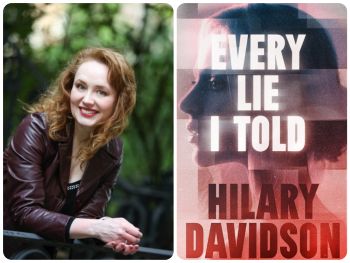
“Jackie Swift’s professional and personal worlds collide one night when she gets a call from her younger sister, Madi, telling her she overdosed. Rushing to the rescue, Jackie stumbles on an awful scene at an Upper East Side mansion. Madi is nowhere to be found, but she’s left behind a dead body. Worse for Jackie, she knows the dead man all too well: He’s her former boss and mentor, and she’s been paid to cover up his crimes in the past.”
– Blackstone Publishing’s summary of Every Lie I Told
Is any industry more naturally corrupt than the field of public relations? The blatant attempts to mislead people and the press, often in service of the worst humans imaginable, makes for an inherent moral rot, but I’ve never seen this concept explored as fully as it is in Every Lie I Told, the newest thriller from bestselling author Hilary Davidson.
Nearly every character is acutely aware of how their work has left them morally compromised, but they all make a choice to either blithely or grimly carry on, like crooked cops or shady lawyers or FIFA presidents. There’s a sense of seductive beguiling in these pages, both in the money and power that these lies will bring, along with an almost instinctual pull to evil.
Every Lie I Told is Davidson’s eighth novel; it joins her nearly 20 nonfiction books and over 50 short stories. The Los Angeles Review of Books described her voice as a “fresh and welcome addition to the noir landscape,” and it’s a landscape that, throughout her celebrated career, Davidson has both navigated and shaped.
The philosophies of Edward L. Bernays, considered “the father of public relations,” features throughout the book and shadows the characters. How did you come across his work?
I did a deep dive into the history of PR because I wanted to understand when it had gotten so shady and learned that it’s always been this way. Edward L. Bernays was Sigmund Freud’s nephew, and he used all kinds of psy-op manipulation techniques during World War I, when he worked for the U.S. government. After the war, he helped companies shape public opinion using the same tactics. He helped cigarette companies popularize smoking and worked for the United Fruit Company, which was involved in overthrowing Guatemala’s democratically elected government. Bernays believed that if you repeated lies often enough, they sank into people’s psyches, even if they knew they were lies.
How much research did you do about public relations, particularly into PR culture and life at the upscale firms?
While I invented the PR companies in the book, the way they’re portrayed is true-to-life. I’m not sure how many people realize that viral online moments are often manufactured by these companies, which are great at manipulating social media and other parts of the internet. I had to learn a lot about it just to have throwaway lines about how they work. They can make a person effectively disappear online, which is something that a lot of wealthy people who aren’t celebrities actually seek out. They can also tar and feather your enemies — something that can be useful if you’re in litigation. Some journalists woke up to manipulation like this when the Johnny Depp-Amber Heard case was playing out in court, but mostly it’s under the radar.
You always maintain empathy for these characters — particularly through Jackie, who understands everyone’s motivations. Was it difficult to sustain that empathy as they performed some of their more callous acts?
It was tough to feel empathy for Jackie at times, even though I understood exactly where she was coming from. She loves her sister and is determined to protect her, so everyone else is fair game. I know that sounds terrible, but it’s very human. As a species, we are great at making excuses for the people we care about, no matter what they do. Jackie is also a liar, in part because she works in crisis PR and is expected to put the best face on everything, but also because she’s genuinely scared of conflict. The reader only gets glimpses of her past trauma until late in the book, but it was something I always knew about her. Even when I hated her lies, I knew exactly the fears that motivated her, and it kept me with her.
Dark sides are so fun to explore, and you didn’t have a shortage of them in Every Lie I Told. Which character was the most fun to write?
There’s a client of Jackie’s nicknamed Death Magnet because all the women in his orbit vanish mysteriously, never to be found. He’s been charged in several cases but never convicted, mainly because he’s both unspeakably rich and clever. He’s an utter psychopath, but he also has a few people in his life he seems to care about. One is Jackie herself, and the other is the man Jackie’s sister killed. It makes for some incredibly tricky footwork on Jackie’s part. Every scene the two of them are in together feels like a dance that could end in total disaster.
What would you say is the constant theme throughout your work?
In every novel, I put my main characters into a pressure cooker and keep ratcheting up the heat. Because my books are thrillers, they require a lot of plotting and structure, but my true motives are character-driven. I want to see who the characters are when they’re in crisis and they’ve lost most of the things they thought mattered, and they can’t hide behind an identity they’ve constructed anymore. Jackie is the most amoral character I’ve ever written in a novel, but she’s also wearing the most armor — metaphorically speaking — and you’d never get the truth out of her unless it’s peeled off layer by layer.
Booklist wrote, of multiple Anthony Award-nominated E.A. Aymar’s most recent thriller, When She Left, “This would appeal to fans of Elmore Leonard…with high-stakes violence tempered by humor and disarmingly sympathetic antiheroes.” In 2025, When She Left was chosen by PEN/Faulkner as one of three books for their prestigious DC Reads program. A former contributor to the Washington Post, Aymar is a former member of the national board of the International Thriller Writers and an active member of Crime Writers of Color and Sisters in Crime. He was born in Panama and now lives and writes in the DC/MD/VA triangle.