The Montana novelist is a man of few spoken but many written words.
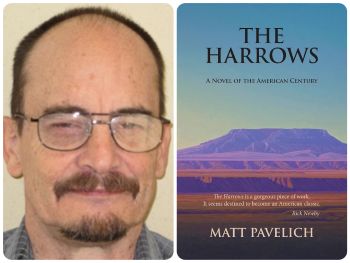
Dubbed one of Montana’s finest fiction writers, Matt Pavelich has authored several novels and short-story collections. Notably, his debut collection, Beasts of the Forest, Beasts of the Field, won the Montana First Book Award in 1990. He has described himself as a “poor fit,” consistently evading societal expectations, and it’s this disconnection that shows through in his writing as he depicts characters who, although surrounded by others, grapple with loneliness.
In his most recent work, The Harrows: A Novel of the American Century, Pavelich takes an empathetic view of the human experience as he tells the story of the Harrow family, beginning in the American West at the start of the 20th century with homesteaders Charlie and Dove Harrow, a freighter and schoolmarm, respectively. The multigenerational saga then wends its way around the globe and across the decades before concluding with Charlie and Dove’s great-granddaughter, who somehow finds her way back to the family farm.
It seems like 2025 was a big year for you, with both The Harrows and the story collection but tell it slant — Fierce Fictions being published! How did the writing process for each compare? And were they written in tandem?
The Harrows was first and slant was second. With respect to the ease of storytelling: It came and went across virtually all the stories.
You’ve called yourself a “poor fit” in various aspects of your life (e.g., your urban interests and country manners; your service, as a pacifist, in the Marine Corps, etc.). How does this disjointedness in your personal life lend its hand to your ability to capture the human experience?
Hmm…It amounts to a long history of being on the outside and looking in.
I found your other novels to be an exploration of loneliness, such as with Henry’s self-imposed reclusion until he meets Karen in The Other Shoe, and the societally imposed reclusion of the character Danny in Our Savage. But The Harrows feels like a sweeping family epic, showing how interconnected we truly are. What called you to change form? Or would you disagree and say you haven’t changed form at all?
Originally, the family story of The Harrows was to be kind of a framing device for the larger story I wanted to tell. The interconnectedness you mention in that book, I only discovered as I was writing it, and I found it very pleasing for once.
What does the word “family” mean in the context of The Harrows?
Again: Connection. That crosses disruptions in time, fortune, any other thing, but remains, to some extent, intact.
What called you to dub this book “A Novel of the American Century”?
Believe it or not, this started in the Obama administration, when things hadn’t even begun to go kerflooey, but it seemed to me that the rise of the American empire and the collapse of the American empire were happening simultaneously, so I thought to try to — through the microcosm of one family’s various experiences — come to grips with the whole phenomenon.
Do you have any hopes for the next American century?
Survival might be nice.
What do you want readers to take away from The Harrows?
Nothing very specific. I just hope that I stirred their pot, entertainingly.
Wiley Clements is a writer living in Brooklyn.