On the art of listening.
The sounds in the village of Rigny-Ussé on a Sunday afternoon are the tolling of the church bell and birdsong — blackbird, chaffinch, and sparrow. That’s what I’m listening to while working in the garden of our house here in the Loire.
Monsieur Taffaneaux, a neighboring farmer, came by with his tractor and plowed up the ground for us several weeks ago. It had been long neglected and was overgrown with brambles and thick clumps of grass. In its place, we’ve planted sheep’s fescue, daisies, micro clover, lemon balm, and thyme. But first, we had to rake and level the ground, which took time and patience.
I feel like I’m listening to the history of this place as I work in the garden. Our property, which runs close to the River Indre, has changed very little through the centuries. So, as I’m gardening and listening to the birdsong, I’m acutely aware that I’m listening to the past as well as to the present.
But what about the future?
There’s a lot of work in renovating this property. It sometimes feels overwhelming when so much is under construction and you’re always waiting for a plasterer, an electrician, or a roofer to schedule you in.
There are also restrictions on what we can change since it’s part of an historical village. We are not allowed to “banalizer” — to trivialize or make banal or commonplace — as we renovate our barn, for example. We must listen respectfully to its history and adhere to historical aesthetics. Only in doing so will the integrity of this property extend into the future.
So, I’m trying to become better at listening. I’ve come to realize that listening is more important than talking, so perhaps, by extension, reading is more important than writing.
Last month, back in DC, I attended a salon at the Arts Club of Washington sponsored by the Alan Cheuse International Writers Center. Alan was my MFA thesis advisor at George Mason University more than 25 years ago. That evening at the Arts Club, we heard a panel of speakers, including Robert Pinsky, talk about their friendships with Alan. Pinsky spoke about him as a deep and extensive reader — better read, he said, than many of their professors at Rutgers, which was where he and Alan met as students.
Alan was one of the first to publish me (in the journal Rattapallax, where he was fiction editor); with my MFA thesis, a novel, in hand, I landed an agent. But when I think back on what he passed down to me, I think about reading more than writing.
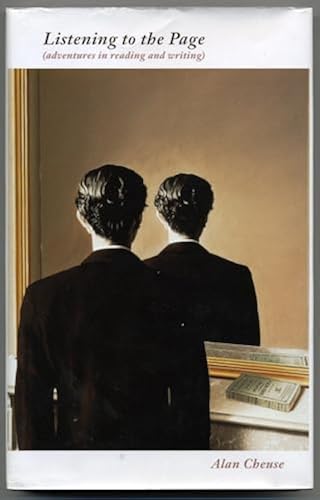
Above all, he wanted his students to become good readers. You cannot write well if you cannot read well. In fact, one of his books about literature was called Listening to the Page. That, to me, says it all.
What’s the point of having good writers if there aren’t any good readers to enjoy them? If poets and authors write from the heart but are never read with the same integrity, their words sing into a void.
Listening to the page takes practice and focus. Through careful listening, we experience the richer nuances of literature and become more discerning as readers. If, on the other hand, we get a bit lazy in our choices or merely skim, we tend to lose the ability to hear. Developing an “ear” for the music of language means everything when it comes to reading — and to producing good writing, of course. That also goes for acting. If an actor doesn’t listen on stage, the dialogue won’t come alive.
From time to time, poets get in touch with me after I’ve reviewed their collections or recorded their poems, expressing appreciation for having been heard. I find these responses very moving. “Being seen so closely, read so closely, is truly the dream,” one wrote to me recently. Another wrote in after I recorded one of her poems for “Read Me a Poem”:
“I don’t know how to express my thanks for the life you breathed into my poem with your reading. I know the poem — which I’ve known for a long time — in a new way.”
And that’s another reward that comes from listening closely to the page. In engaging wholeheartedly with a piece of writing, we might uncover subtleties that the author hadn’t recognized in their own work. We notice what hasn’t been said or what’s been purposely left out, or we discern unconscious psychological connections.
When we listen with open hearts and minds, we harmonize with each other, and that is far from a passive endeavor. In fact, it’s the silent foundation of all true communication, and indeed of all great art.
[Editor’s note: The Cheuse Center’s next event is “In the Writers’ Studio: the Critic,” featuring Ron Charles, Michael Dirda, Sean Murphy, and Holly Smith, in DC on Thurs., May 14th. Learn more here.]
Amanda Holmes Duffy is a columnist and poetry editor for the Independent and the voice of “Read Me a Poem,” a podcast of the American Scholar.