The feminist icon lived a life of genius but failed her own daughter.
George Sand wrote 70 novels, but has anyone ever recommended their favorite to you? I have perused three of them — Indiana, The Country Waif, and Lucrezia Floriani — but find her correspondence much more compelling than her books. I think her legacy rests in how she lived rather than in what she wrote. Oscar Wilde’s line comes to mind: “I put my genius into my life. I only put my talent into my work.”
This summer, my daughter, Rosalind, and I visited Sand’s house in Nohant in central France, which was in the family from 1793 until the early 1960s, when Sand’s granddaughter died and left it to the state. Nothing there has been recreated or changed. It still has a palpable energy, not just of a great writer, but of a great woman who was the head of her household.
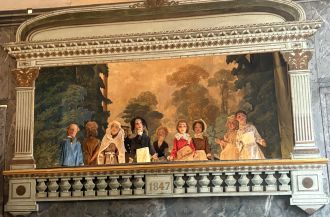
You see this in the family portraits, in the delicate green and blue glassware on the dining table, a gift from Frédéric Chopin. You see it in the woodland paths wending to a grotto and in the growth chart penciled in her study’s doorway, just off the children’s bedroom. Most of all, you see it in the puppets made by Sand’s son, Maurice.
The puppets represent personages from all strata of society, with an extraordinary range of facial expressions. They are hand-painted, dressed in exquisite costumes, and were conceived in 1847 by Maurice Sand and Eugène Lambert, who studied art together at Eugène Delacroix’s atelier. Delacroix, by the way, was a frequent guest at Nohant.
Sand’s visitors — artists, musicians, and writers — were charmed by the puppet shows, as were local villagers who were provided transport to see performances for free. At first, the puppets appeared from behind a chair draped in cloth; later, in a special theater converted out of one of the bedrooms, where there’s also a stage for live performances, where plays were sometimes previewed before being mounted in Paris.
Sand wrote many scripts for the puppets, and Maurice even wrote backstories for them, including elaborate rivalries, with letters between characters and factions siding with one or the other. Clearly, Sand doted on her son.
But what was it like to be her daughter? Sand famously dressed in men’s clothing, had many lovers, and revolutionized the way women were seen. She was one of the first women to obtain a divorce, and the name George Sand (changed from Amandine Aurore Dupin) wasn’t just a pen name. It’s the name engraved on her tomb.
We heard little about Sand’s daughter, Solange, from our Nohant tour guide, but her portrait aroused my curiosity. She didn’t bear such a striking resemblance to her mother as Maurice, and was shown in profile, cutting a rather mournful figure.
I learned about their difficult relationship from a Radio France podcast, “George Sand et Solange, Mere et Fille.” Although Solange received an excellent education at boarding school, she was emotionally cut off from the family. Her letters home plead for contact, for family news, for clothing (when she’d outgrown what she had) or an armoire in which to store linens. Her mother’s replies seem to lack tenderness, accusing the girl of capriciousness and admonishing her to focus on her studies.
Then, bizarrely for one who questioned the institution of marriage, Sand arranged a marriage for Solange when she was just 19. Solange, however, broke that engagement and took up with a sculptor whom her mother disapproved of. Later, there was a dispute over money, which resulted in a rupture between mother and daughter that lasted years.
In an 1847 letter to Chopin, Solange reveals that after this estrangement, she was summoned to Nohant and greeted coldly by both her mother and brother. It was then she discovered the atelier that was to have been used by her husband had been taken over by someone else, and that her bedroom had been completely dismantled and turned into a puppet theater.
So, the room converted into that marvelous theater once belonged to Solange? My daughter and I couldn’t stop speculating about all this on our car rides through the French countryside. Estranged from her own mother at a young age, Sand became strong and independent. She was great at mothering Maurice, as well as Chopin, who suffered pulmonary disease and relied on her care. But Solange was the family scapegoat. She challenged Sand and was seen as an adversary.
And what a metaphor, Rosalind said, that the one who didn’t ascribe to the family narrative had her room turned into a puppet theater! Sand had the last word and would control the story.
As it happens, Chopin took Solange’s part against her mother, a perceived betrayal that caused the lovers to split. Sand even accused Solange of seducing Chopin, although there’s no indication of this in their correspondence. But it was Chopin who informed Sand that Solange was expecting a baby (who died a week after birth). Solange later had a second child, nicknamed Nini, who was beloved by Sand and who died of scarlet fever. But Solange would always have a difficult relationship with her mother.
Sand poured her genius into her life, and that took enormous passion. But her life encompassed tragedy as well as success. And there was a pettiness in her, too. She never visited Chopin when he was dying and got revenge on him in Lucrezia Floriani. It embarrassed mutual acquaintances who heard her read from the novel aloud. And no wonder. It tells the story of a sickly prince nursed to health by a beautiful woman, “the kindest, worthiest most intelligent woman I have met. Thank Heaven,” says one of his grateful friends.
Amanda Holmes Duffy is a columnist and poetry editor for the Independent and the voice of “Read Me a Poem,” a podcast of the American Scholar.