You don’t open minds by closing books.
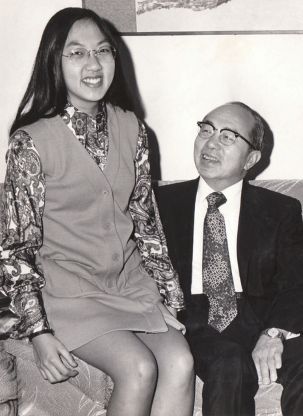
The day after my father attended a PTA meeting at my high school, a teacher stopped me in the hall. “Your father is a remarkable man,” she said. I thought my father, who rarely went to PTA meetings, was an embarrassment. He was a Korean minister and also had an unglamorous job as a translator for Voice of America’s Korean Service. I was a 1968 sullen 11th-grader who smelled like patchouli and postured in homemade hippie bell-bottoms.
By third period, I’d heard from two other teachers that my dad was cool. My father was smart, hardworking, and short, his round head circled with thinning grey hair. He was sonorous on the pulpit and gullible for charity appeals that came in the mail. He wore black suits from J.C. Penney’s. A staunch anti-Communist, my dad, a Republican, believed in the necessity of the Vietnam War.
My dad was not cool.
Though my father, Jacob Kim, came to America before the Korean War of 1950-1953, he remained a loyal nationalist and gave presentations in church basements and Kiwanis clubs to garner support against Communist North Korea. In these community gatherings, he explained how the Soviets and Red Chinese had instigated North Korean aggression to start the Korean War, where their sons were fighting, and he stressed his belief that Communism was an encroaching evil to be feared.
I don’t remember exactly how my father managed to attend the PTA meeting, but the school had been buzzing with news that angry parents would protest the inclusion in a social-studies class of Mao’s Little Red Book and Marx & Engel’s Communist Manifesto. Somehow, my father heard this news, but he wouldn’t have mentioned it to me. In our family, with four kids in college, the remaining two of us were busy with our Beatle-manic Americanized lives, and we orbited distantly around our parents, together only on the occasions we landed at the dinner table or watched “Mission: Impossible” on TV. It’s typical that I wouldn’t have known he’d attended the PTA meeting.
In the last period of that school day, the choral director mentioned my father’s wonderfulness, and I begged to know the whole story. And so the entire chorus heard about the PTA meeting, and much later, I learned additional details from my father.
In the crowded gym where the meeting was held, outraged parents led a heated discussion to ban The Little Red Book and The Communist Manifesto. They insisted that teaching these books would foster dangerous radicalism in their children. The social-studies and history teachers objected, but parents were adamant. Someone called for a vote. My father walked to the front of the seated parents. He would’ve still been in his black suit and wide, colorful tie. I imagine that he used his preacher’s voice.
He told about the Korean War — the entire peninsula in such chaos that every Korean citizen, even those in the diaspora, was affected. He had not heard from his elderly parents in North Korea since before the war, and no longer expected to. One of his daughters, my third-eldest sister, had lived in South Korea during the war and was 3 when North Korea invaded at 1:30 a.m. on a Sunday morning. Our relatives fled Seoul by foot, pulling a handcart, among mobs of refugees. My father spoke about other relatives, a mother and her 5-year-old daughter, who joined the panicked southbound masses. She lost hold of her daughter’s hand and never saw her child again.
The Korean War never officially ended; a stalemate yielded a tenuous peace still threaded together by an armistice. The Communist threat was, and still is, a daily fact for South Koreans. My father, more than anyone else in that room, had the right to request that the teaching of these Communist books be banned — but if it came to a vote, he said, he would vote “no.” Proudly naturalized just six years before, I’m certain my father cited the First Amendment, though freedom-of-speech protections for children in public schools would not become law until the following year.
As I recall this story, an anecdote my mother had told about my father as a young man comes to mind. Sometime in the mid-1930s in Korea, her weekdays meant a two-hour train ride to attend Ewha Women’s College in Seoul. A man from Pyongyang who turned out to be my father’s father took notice and began the process of sharing information for an arranged marriage. She admired my father’s education in theology and his striking, dapper appearance. She learned about an incident when he was so immersed in study that even his stern father couldn’t rouse his attention until, at last, he closed the two books spread on his desk. My father had been simultaneously reading the Bible and Karl Marx.
At the PTA meeting, when my father said that reading Mao’s Little Red Book would not make us Communists, they listened. When he said that reading breeds intelligence and understanding, not treason, fear, or hatred, they heard him. No vote was taken. And my dad became cool, the teachers’ hero.
That day gave me a glimpse into my father’s previously hidden history and something great about his character. To us, his children, he had never once expressed the immense pain he’d experienced throughout Japanese Colonization or the Korean War, but for the sake of education and the freedom to read, he did so to a crowd of other parents who wanted, and failed, to ban books from our classrooms.
[Editor’s note: This essay originally appeared on the author’s website.]
Eugenia Kim is the award-winning author of The Calligrapher’s Daughter and The Kinship of Secrets. Fellowships include three-time Washington, DC, Council on the Arts and Humanities, Yaddo, Hedgebrook, MacDowell, and elsewhere. She’s a newly retired professor at Fairfield University’s MFA Creative Writing Program and served as the 2025-26 board chair of the Writer’s Center. She loves how storytelling changes lives.