At home with Karen Blixen
The train from Malmö Central Station whisked us across the span of the Öresund Bridge. The Bron, eight kilometers long, carrying cars above and trains below, makes it easy and beautiful to cross the sound, the marine border between Sweden and Denmark. On fine days, sailboats dot sparkling water. We transferred to a local train in Copenhagen for a short ride through suburbs and countryside to Rungsted, a small coastal town.
Our destination was Rungstedlund, the Karen Blixen Museum. The author’s father, Wilhelm Dinesen, purchased the estate in 1879. Born in1885, she grew up there with her mother and siblings after Wilhelm’s suicide when she was 10. After the 17 years chronicled in Out of Africa, she reluctantly returned in 1931. She lived at Rungstedlund until her death in 1962, writing celebrated memoirs and stories as Isak Dinesen and eventually being nominated for the Nobel Prize. In Rungsted, she created and endowed the Rungstedlund Foundation as a center of cultural events and a bird sanctuary. The Danish Academy, dedicated to promoting Danish language and literature, continues to meet at Rungstedlund to this day.
Signs at the train station directed us down the main road to the museum. Not far out of town, my husband, Harry, spotted a path in the woods. Following his hunch, we left the posted sidewalk and entered Rungstedlund’s nature preserve. Hidden birds sang in a grove of magnificent beech trees. We emerged into sunlight beside a pasture of grazing cattle.
No fence, no entry gate, we strolled in like neighbors toward a sprawling white house with a red roof. A small arched bridge crossed a stream; a tent pavilion was pitched on the lawn by the pond. Visitors were eating on a terrace beside overflowing beds of dahlias. We wandered around the corner. The parking lot was quite full. I appreciated our inadvertent back-door approach and impression of informal welcome. Across the road, boats bobbed in a small harbor. We purchased tickets in the lobby (eyeing the café menu for later).
The initial gallery, originally a playroom, introduces the author’s family and professional story through displays of photographs, paintings from Blixen’s early art-student days, clothing, letters, newspaper articles, and a listening station with excerpts from her popular radio interviews. Even on a fall weekday, the gallery was thronged with visitors, mostly Danish retirees. But when we crossed the threshold into the family rooms, the crowd vanished.
An elegant woman knelt at the foot of a steep staircase, folding heavy, cream-colored paper into booklets. It took her a moment to notice us. “Oh! I’m putting programs together. Tomorrow is a big day here. We’re not really publicizing it, but the house will be closed. The queen is coming!”
The docent then collected our tickets; we realized why the others had disappeared — the initial gallery is free, and it was lunchtime in the tempting café.
“You’re lucky to be here today,” she continued. “There are going to be some disappointed visitors tomorrow. Please put these booties on.” She then waved us off to explore the house alone, more like guests than tourists.
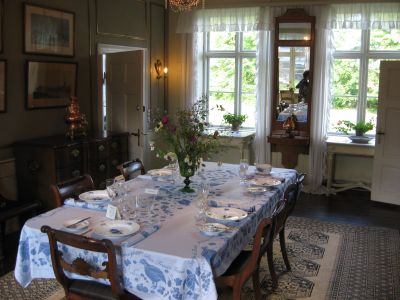
The rooms were comfortable, full of gently worn furniture and eclectic decorations — including a display of African spears. Books lined the moss-green walls of the author’s library. Fresh flowers graced every room. Throughout, on this warm September day, light streamed in tall windows — but in Blixen’s time, much of the house was shut off in winter, impossible to heat. So, she had two studies, one for warm weather and one for cold.
In a life beset by loss and illness, she wrote through some dark days and moods in this house. “All sorrows can be borne, if you put them into a story,” she once said. Upstairs in Blixen’s garret bedroom, there’s another writing desk beside a casement window looking out over the sound, where she swam in the early morning, if she felt well enough. She spent her last weeks in that bedroom, wasting away, wracked by pain, subsisting on a diet of champagne, painkillers, and oysters.
Downstairs, on the day of our visit, the scullery next to the kitchen hummed with life. Gardeners in boots and smocks hurried in and out, carrying armloads of flowers from Blixen’s cutting garden. A woman stood at the deep sink, arranging bouquets for the queen’s party in the tent on the lawn. It was easy to imagine the gardener-author tweaking the flowers in a festive mood, delighted with the prospect of a monarch coming to visit Baroness Blixen. (Her marriage to Baron Bror Blixen failed; she kept and prized the title). She might’ve crafted a story out of the royal occasion. Perhaps, prolific as she was, two tales: one for a sunny day, one for a dark night.
We enjoyed our lunch on the terrace and our ringside seats for the bustle of preparations for the queen — or queen mother, to be accurate. Margrethe II, who abdicated Denmark’s throne in 2024, worked as an artist throughout her 52-year reign. She illustrated a Danish edition of Tolkien and recently served as costume and production designer for a Netflix film based on Dinesen’s story “Ehrengard.” She visits the museum each year, as she would the next day, to present the Rungstedlund Award. The 2025 recipient is author Ida Jessen, honored for her contribution to the Nordic storytelling tradition.
After lunch, we lingered. A woman and her barefoot child came out of the woods and crossed the lawn toward the house. Were we in an illusory stage-set for a Dinesen tale? Once upon a time, one fine September day, in a garden by the sea in Denmark…
House museums can be stuffy shrines, yet Rungstedlund celebrates nature and storytelling — and its imperious mistress, the provocative, creative Karen Blixen.
[Photo by Harry Pskowski.]
Ellen Prentiss Campbell’s collection of love stories is Known By Heart. Her collection Contents Under Pressure was nominated for the National Book Award; her novel The Bowl with Gold Seams won the Indy Excellence Award for Historical Fiction. Frieda’s Song was a finalist for the Next Generation Indie Book Award, Historical Fiction. Blogging as “Girl Writing” in the Independent bi-monthly, she lives in Washington, DC. For many years, Ellen practiced psychotherapy. Her new novel, The Vanishing Point, will appear in spring 2026.
.png)