Nature reclaims the spaces abandoned by people.
I’ve been thinking lately about what the world was like before humans arrived, and what it’ll be like after we’re gone — assuming the planet is fortunate enough to survive the Anthropocene. Maybe, I’ve mused while watching vines trailing determinedly every which way around a manmade obstacle, the end of the world will be as simple as slow-motion entropy. It’s a comforting thought, given the alternatives.
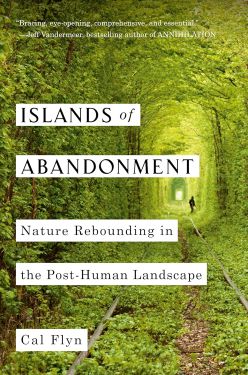
In her invocation in Islands of Abandonment: Nature Rebounding in the Post-Human Landscape, author Cal Flyn voices a similar sentiment:
“This should be a book of darkness, a litany of the worst places in the world. In fact, it is a story of redemption: how the most polluted spots on Earth — suffocated by oil spills, blasted by bombs, contaminated by nuclear fallout, or scraped clean of their natural resources — can be rehabilitated through ecological processes.”
Sometimes, humans learn from their mistakes. And even when they don’t, nature often takes over.
On the West Lothian shale bings of Scotland, the last of which closed in 1962, small islands of wilderness (called “island refugia” by ecologist Barbra Harvie) have made their homes atop the ghosts of destruction. “Harvie recorded more than three hundred and fifty plant species on the bings,” writes Flyn, “including eight nationally rare species of moss and lichen, among them the exquisite brown shield-moss, whose thin tendrils loft targes to the sky like an army in miniature. Over the space of a half-century, these once-bare wastelands had somehow, magically, shivered into life.”
It’s a tough reality to confront, but humans are responsible for unfathomable planet-altering destruction. Flyn notes that “in one South African national park, 98 percent of female elephants are now born without tusks” in response to overhunting; more broadly, “[h]uman predation in general is thought to have accelerated the rate of trait changes in other species by 300 percent.”
We’ve also done great harm to ourselves and to each other: The Zone Rouge in France, as one example, denotes land so riddled with munitions and poisoned by gas from World War I that it cannot be rehabilitated. Writes Flyn:
“[T]he casual observer, treading quietly upon a permitted path, might still stumble upon the dry flakes of shrapnel among the leaf litter, the rotting branch of a rifle, a polished pebble of lead shot, as if the men had simply set down their weapons, laid down on the earth, and turned into trees.”
It’s a peaceful image overlaying the horrors of this blood-drenched zone, which humans have given up for lost but which nevertheless persists. Even in the “sterile wound” where leftover canisters of deadly gas were set ablaze, new life flourishes, including the lichen Cladonia fimbriata, which can limit its absorption of deadly metals, and the moss Pohlia nutans, a “hyperaccumulator” that, for reasons unknown, is able to safely store heavy-metal accretion in its threads. Life, in the words of Jurassic Park’s Dr. Ian Malcolm, finds a way.
In her book’s closing, Flyn asks, as I do, what the inevitable collapse of the Earth might resemble:
“I too cannot help but imagine a rapture sweeping the globe; starting perhaps from the low-lying land and washing inward; settlements collapsing in its wake…How would it unfold, I wonder: the creeping decline, or the sudden collapse?”
It’s a terrifying thought, the loss of everything we hold dear. Should it come during my lifetime, I’m sure I’d face such disintegration not with a sanguine philosophy but with fear and anxiety. And yet, I can’t help wondering: What might grow anew out of all that ruin?
Mariko Hewer is a freelance editor and writer as well as a nursery-school teacher. She is passionate about good books, good food, and good company.