So many indie-published books, so little time…
As a writer, I have a conundrum: A lot of my friends are also writers. Over the summer, this conundrum has come to the forefront: I want these wonderful friends to support my writing — especially since I have a new novel just published (The Other Beautiful People from Regal House Publishing) — so, in turn, I support theirs. I buy their books. In fact, I have for years.
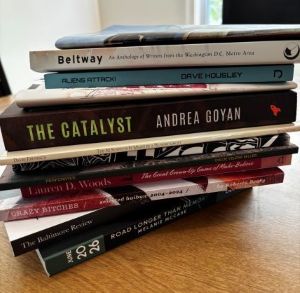
But recently, I found myself with a lot of books on my nightstand from writers I know and admire that are also from small presses. Sometimes, it seems like everyone I know is writing a book and having it published by a vibrant independent press: a poetry collection, an anthology of DC-area writers, a haibun collection on crazy bitches, a speculative fiction book on monsters.
Here’s an unraveling of my conundrum…
Hold Near the Middle by Beth Konkoski is a beautiful chapbook published by the Moonstone Press out of the Moonstone Arts Center in Philadelphia. The collection opens with the poem “Waiting,” and that seems to be a major throughline: a tense, anxious wait for ghosts, for children to come home, for life to happen. “One cannot measure the weight of waiting/how it sits curled and pulsing on the chest” shares the speaker in “L’attesa (a mother’s waiting).” (Moonstone also has several wide-ranging calls for submissions.)
Beltway: An Anthology of Writers from the Washington, D.C. Metro Area is the first book from Night Ginkgo Press, edited by Llalan Fowler, Nick Rees Gardner, Lauren Woods, Andrew Bertaina, and Destini Price. The editors note in their foreword how themes of a particular place emerge when writers from one area are gathered — and gathered so skillfully.
I found the loneliness in the DC area these days to be a resonant theme. From the short story “Dockless,” by Len Kruger, about a prickly retiree and his travails with an electric scooter (I laughed out loud — and cried — while reading it); to Aaron Hamburger’s “You Don’t Applaud Mediocrity,” which starts out, “When Amy and Brian moved from New York to Washington last year, they’d pledged to take monthly mental sanity vacations back ‘home’ to mitigate the blandness of their lives in the nation’s capital”; to David Klepinger’s opening poem, “From Whorl,” where “In the lobbies of the old hotels, I still search for loose change in the obsolete telephone booths,” aloneness abounds.
We are lonely — except when we’re playing basketball in Malcolm X Park in Rion Amilcar Scott’s story “Jesus Saves,” or when we’re smoking cigarettes in Rhonda Zimlich’s essay, “The Ritual of Smoking.” Beltway has stayed with me.
And we’re crazy in the award-winning Crazy Bitches by Bethesda-based writer Roberta Beary, who, working in the haibun form, blends prose and haiku. Published by MacQ, out of Winston-Salem, North Carolina, this collection explores childhood and marital trauma with razor-sharp language. Clare MacQueen, the publisher, is open for submissions for manuscripts and for their online literary journal, MacQueen’s Quinterly. MacQueen does end one of the most detailed and amusing submission guidelines with this: “She will gladly consider scads of submissions while searching for the editor’s Holy Grail, those gems that will make her weep and holler and laugh out loud, or even speak in tongues, all in admiration of their creators.”
We read poetry collections because they expand our horizons — and our own writing. The AI Suspects It Might Be a Hungry Ghost by David Ebenbach (Broadstone Books) is one of those collections. What I really suspect is that this collection is about being distinctly human, but then I am not a poet or an AI, so buy/read it and see what you think.
In Aliens Attack! by Dave Housley, the humans are in bad shape, but the aliens are in even worse shape. It’s published by Mason Jar Press out of Baltimore, a vibrant small press now under the sharp eye of publisher and executive director Sarah Daniels. While neither Broadstone nor Mason Jar is currently open for submissions, I am going to keep a close eye on developments.
Also out of Baltimore, where so much seems to be happening on the literary scene these days, is Barbara Westwood Diehl’s award-winning first poetry collection, Foolish, from L+S Press. I’m a huge fan of prose poems, and Diehl is a master of this form. L+S Press is now open for debut chapbook submissions.
And we are the monsters. I started The Catalyst by Andrea Goyan online, where her publisher, MetaStellar, serialized it, and it’s a thriller delight for fans of Guillermo del Toro like me. The writing is so good — and got under my skin while I was reading it on screens — that I had to buy the novel so I could hold it in my hands. Here’s the end of the first chapter: “Kenneth gasped, and the loofah fell from his hand. Under his exploring fingers, he found firm, tough, rubbery and altogether alien skin. He twisted his neck to face his shaving mirror and screamed. His back was covered in green scales.” (The serialization can be found here.)
Ultimately, I am a writer who hopes other writers (and all book lovers) will buy my novel, but in return, in the spirit of exploration and discovery, as well as karma, I also buy and read their work. We can all be happy writers — and readers.
Caroline Bock writes stories — from micros to novels. She is the author of the novel The Other Beautiful People (Regal House Publishing). A graduate of Syracuse University, she studied creative writing with Raymond Carver and poetry with Jack Gilbert and Tess Gallagher. In 2011, after a 20-year career as a cable-television executive, she earned an MFA in fiction from the City College of New York. She has short fiction forthcoming in the Hopkins Review. She is the co-president and prose editor at the Washington Writers’ Publishing House. She lives in Maryland with her family.