How Virginia’s Stillhouse Press chooses its off-the-beaten-path projects.
Cue “Pomp and Circumstance”! Ready the tassels and caps! With graduation season underway, I thought it timely to speak with another student-run literary press, George Mason University’s Stillhouse Press. I corresponded via email with Taylor Schaefer, their publicist and marketing manager, who shares, “What I can tell writers approaching us is this — if you wrote something incredible and strange that the industry tells you can’t possibly succeed, there is a press for you.” There are also Stillhouse Press books for adventurous literary readers, and so much more in this insightful conversation.
I’ve spotlighted in this column another student-run press, Apprentice House, so I’m interested in this unusual publishing model. Can you describe the Stillhouse Press/George Mason University relationship and what is unique about it?
As a member of GMU’s Watershed Lit: Center for Literary Engagement and Publishing Practice, Stillhouse operates as a student-led professional-development program for undergraduate and graduate students in GMU’s programs in writing and literature. Each year, four graduate students in GMU’s Creative Writing MFA program receive professional assistantships with Stillhouse that come with tuition remission and a standard stipend, and we act as the editorial and operational leadership of the press. These graduate assistants form the core of an executive team that decides what the press will do in a given year.
Our faculty advisor and publisher, Scott W. Berg, a well-published writer himself, acts as an administrative liaison between the press and the university and as a mentor to student staff. Scott has also been leading the way in creating the dynamic publishing minor and the graduate publishing certificate, both of which offer students structured class environments to develop professional skills, including website design, editing, grant writing, print design, cover design, and many more.
So, is this an academic exercise? What should would-be authors be aware of?
Bottom line, Stillhouse allows students in GMU’s MFA, MA, BFA, and BA programs in writing and literature a unique opportunity to develop a huge range of skills in a real-world professional environment. We feel real pressure because we are a real press. The stakes are real for us and for the authors we work with — we hold ourselves, and the students who work with us, to a high standard — but Stillhouse also seeks to be a supportive learning environment guided by student needs. I think much of what makes Stillhouse unique is that we are student-led and based in mentorship outside the classroom. We are learning all the time from alumni, faculty, and our authors — and in turn, we’re always, every minute, learning how to mentor and support each other.
I’m intrigued by Stillhouse publishing three novellas this spring. What do you look for in a novella that’s different from a novel, and what interested you in these three? Do you have plans to publish more in the future?
We initially opened for novellas because we were itching to publish something that experimented with form and style and didn’t fit anywhere in big publishing’s orbit. With a shorter form, the reader’s tolerance for off-the-beaten-path experimentation is higher, and this means that novellas can get away with antics that might fall flat in novel-length work that requires subplots and a different kind of propulsion to fill its pages and hold a reader’s attention.
The novellas we selected, Morgan Christie’s Liddle Deaths, Paul Jaskunas’ The Atlas of Remedies, and Dennis James Sweeney’s The Rolodex Happenings, all had what we were looking for: tight narrative arcs focused intensely on one idea, ideas which were complemented by the unusual form of each novella.
This philosophy doesn’t apply only to novellas. We want to continue to acquire the weird, stylistically fresh work the Big Five (now the Big Four in traditional New York-based publishing) would have no interest in, including novellas, yes, but also essays, hybrid memoirs, poetry, and short-story collections. It’s a firm “probably” on whether we will open for novellas again soon — not because we don’t love novellas, but because we have so many other things we want to publish, and our careful, craft-publishing ethos means that we don’t handle more than a couple titles in a given time.
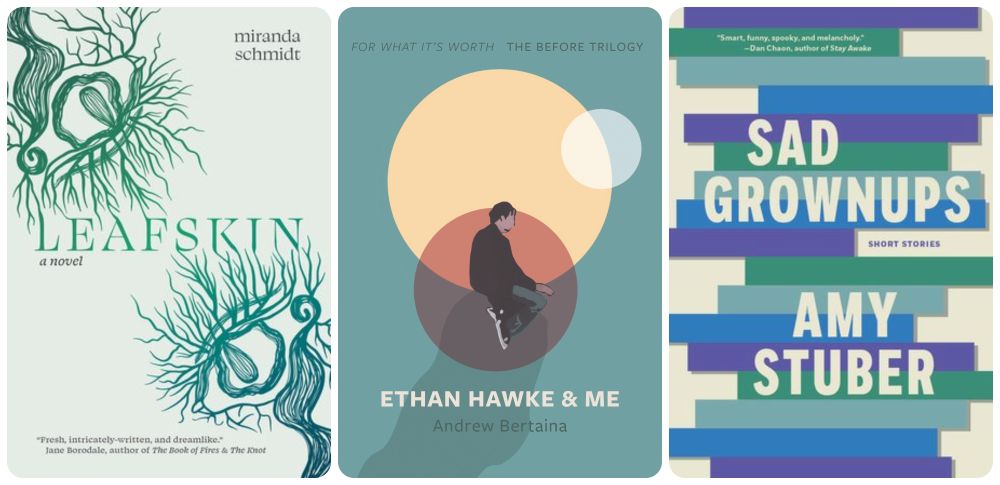
I’m reading Stillhouse’s new novel, Leafskin, by Miranda Schmidt, and I was stopped cold by a question it poses for the main character, a poet struggling to get pregnant via IFV. It’s a question that many women writers struggle with: “Art or normal life, you have to choose.” I was hoping that younger writers didn’t struggle with this in the way that I have. Was this a key theme that drew Stillhouse editors into this book?
I asked GMU MFA alumnus and the acquiring editor of Leafskin, Kate Keeney, for her thoughts on the novel, and she responded, “That question, ‘art or normal life,’ I think is always pulling at artists, and, yes, most especially women because of the sometimes heavier expectation of what ‘normal’ looks like. But one of the things that really drew me to the book was the forgiveness for making that choice, because it is difficult, and even if you don’t completely choose, there are sacrifices, something that the book acknowledges through the relationship between Jo, Ness, and Liam, with all its complications. In some ways, Miranda tells us that we do not have to choose, that the creation of life is its own artistic endeavor and that we can raise children through our art, our writing.”
All of your covers are particularly artful. Are they produced in-house by Stillhouse or by artists associated with George Mason? How involved are authors in the development of the covers and in the production of their books?
In general, we offer writers a creative voice, but not creative control, in the production of their books. At the beginning of each title’s acquisition, the author sits down with the marketing and publicity team to discuss their vision for the book in its final form: their ideal set of readers, how the book might be framed in pitches and cover copy, and their general ideas for the cover. The marketing team then takes that information to the design team, who use it to create several cover concepts. The author then has an opportunity to offer feedback before the design is finalized, and this often offers the opportunity to do something special with the design of each book. When reading The Atlas of Remedies, you’ll notice that each chapter heading features a drawing, all of which were done by the author’s son specifically for the novella and inserted at Paul Jaskunas’ request.
During the first several years of Stillhouse, our covers were produced in-house, but now we and our publisher are pioneering a relationship with the amazing and super-talented faculty and students in George Mason’s School of Art. Book-arts faculty Christopher Kardambikis designed the three novella covers as a matched set, while graphic-design professor Michael McDermott handled Amy Stuber’s Sad Grownups and, along with student Alex Giron, Leafskin. Going forward, most Stillhouse covers will be designed collaboratively by an art student and faculty member as part of that department’s academic and internship offerings. It’s very cool to see students in English and students of art come together this way — because, after all, the real world of publishing is hardly made up only of English majors.
Your recent publication of Sad Grownups seems to be a great success for a nonprofit literary press (great reviews, outreach to readers and booksellers) — I was certainly aware of it on social media and spotted it in local bookstores. What lessons did you learn with this book?
Firstly, we learned that an author who is fully engaged in the literary community is an utterly invaluable asset to a book. Amy Stuber is a cat-5 force of nature when it comes to promoting her own work, but the amazing editors and outlets that gave this book its well-deserved flowers did so partly because they knew Amy — they had seen her work published in American Short Fiction or Joyland or Okay Donkey and loved it. Her strategy, what we have taken to calling the author-led model, is becoming much more popular and necessary in publishing at large as big publishers focus their marketing attention on a small selection of “star sellers” in their catalog each year. We’ve found that many smaller promotional outlets want to hear directly from authors, especially ones they already know, rather than from an anonymous publicist.
Secondly, we learned from our experience with Sad Grownups that people are still hungry for cool, vivacious, original short fiction, even as big publishing believes that most of it simply doesn’t sell.
Stillhouse Press will open for memoir and essay collection submissions in November 2025. Find their guidelines and submission insights here. No agent is required; in fact, agented submissions aren’t accepted.
*****
In other small-press talk: At its Conversations & Connections gathering at American University last month, I learned that Barrelhouse, an innovative, high-octane literary organization (which boasts print and online magazines, conferences, and writer camps) is doing something new. They’re launching a series of books on how pop culture influences/inspires our lives, beginning with Andrew Bertaina’s Ethan Hawke & Me: The Before Trilogy. In it, Bertaina explores how the movie “Before Sunrise,” starring Hawke and Julie Delpy, changed his life. The copies sold out at the conference, so I ordered mine directly through Barrelhouse’s shop.
And speaking of Andrew Bertaina, this polymath of a professor, writer, and organizer of the hip local monthly reading 804 Lit Salon, is launching a small literary press, Night Ginko, with a lean toward the experimental. He’s now accepting submissions to a new anthology of prose (fiction or nonfiction up to 5,000 words), which will focus on writers from DC, Maryland, and Virginia to start. The deadline is May 15th. Find submission information here.
Now, I’m off to Philadelphia to pick up my daughter at Temple University — she’s not graduating yet, but she is playing her clarinet in the TU orchestra, performing “Pomp and Circumstance” at graduation!
Caroline Bock writes stories — from micros to novels. She is the author of the novel The Other Beautiful People, forthcoming from Regal House Publishing in summer 2026. A graduate of Syracuse University, she studied creative writing with Raymond Carver and poetry with Jack Gilbert and Tess Gallagher. In 2011, after a 20-year career as a cable television executive, she earned an MFA in fiction from the City College of New York. She has short fiction forthcoming in the Hopkins Review. She is the co-president and prose editor at the Washington Writers’ Publishing House. She lives in Maryland with her family.