New collections to make life more lyrical.
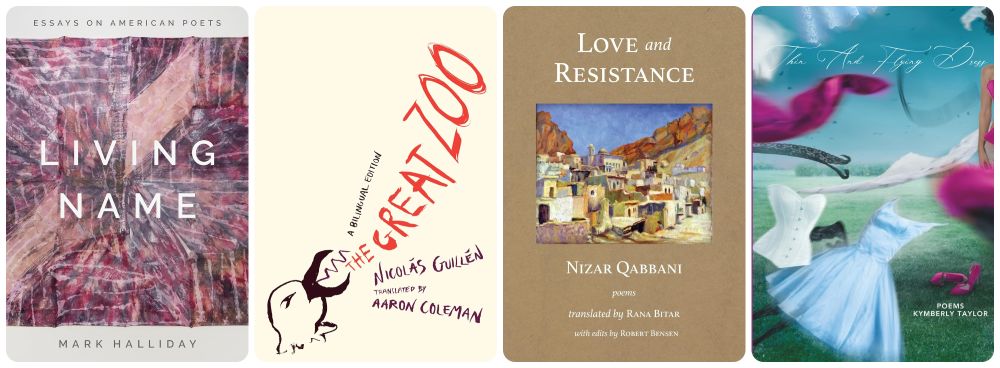
Mark Halliday’s essay collection, Living Name (LSU Press), was, for me, the best kind of rigorous engagement with a writer who shares my love of poetry if not always my taste. In devoting two essays each to several poets he considers underrated, including Kenneth Koch, Kenneth Fearing, and Dean Young, Halliday asks us to bear with him as he makes his case. His analysis is perceptive, clear, and charming.
Fearing, a poet of the Depression era, emerges as particularly relevant and serious. “Fearing keeps reminding us that each sufferer is like a thousand or million others,” Halliday writes. And although a narrow poet, “he is full of surprises within his narrowness.”
Halliday also puts Claire Bateman — a poet I’d not heard of but he admires — on our radar “for a way of being a person that is so different from my own way.”
This isn’t to say he’s a fan of obscurity for obscurity’s sake, especially when it comes to the writing. He takes on Helen Vendler for holding John Ashbery in equal esteem with George Herbert and Walt Whitman. “I think she is trapped in the goo of an attraction she committed herself to in the 1970’s and has been unwilling to stop justifying ever since,” Halliday writes. In his view, “No living poet has benefited more than Ashbery from our craving for greatness in the present.”
In contrast, he admires Tony Hoagland, who “accepted the risk of clarity” and “will never be able to please those readers who are infected by ICFU.”
“This syndrome,” he quips, “‘Instant Contempt for the Understandable’ is always active in people worried about establishing that in poetry they are doing something difficult and mysterious that your aunt and uncle and your average students can’t do.”
Perhaps one essay on Koch, rather than two, would’ve sufficed. And although, coincidentally, I recently recorded “Sakura Park” from Rachel Wetzsteon’s collection of the same title — to which Halliday devotes 14 pages — I don’t buy his claim that she’s more interesting than Edna St. Vincent Millay. He concedes that Wetzsteon, who died by suicide at 42, makes “her emotional wellbeing the central subject, almost the only subject of her poetry,” but I think this wears thin. Millay, on the other hand, was iconic, complex, passionate, and scandalous. Her poetry might now be considered old-fashioned, but she’s an important bridge between the turn of the 20th century and postwar America.
Living Name broadened my scope and made me a better reader. I particularly appreciated Halliday’s comparisons of lesser poets to greater ones — Fearing to Stevens, for instance, or Pinsky to Hardy and Whitman. And having my copy of The Collected Poems of Wallace Stevens on hand while reading these essays made such comparisons all the more stimulating.
*****
The Afro-Cuban poet Nicolás Guillén was born in 1902 and died in 1989. He’s known for incorporating Spanish and African song and dance rhythms (“Son Cubano”) into his poetry and is considered the national poet of Cuba. Guillén wrote The Great Zoo (University of Chicago Press) quite late in his career. In this exciting bilingual edition, a finalist for the 2025 Griffin Poetry Prize, Aaron Coleman’s crisp English translations sing in harmony with the originals.
The conceit here is that the poems are exhibits in a zoo, and the director is escorting us through our first visit. The zoo includes monkeys, eagles, and a tiger, but also habitats such as mountains, rivers, and even the Caribbean itself. Other exhibits contain weather conditions, hunger and thirst, police and a gangster. It’s an imaginative setup that makes the poems immediately accessible.
But there are layers here. Underneath the black humor lies a powerful commentary. What exactly is a zoo? And how much can you appreciate the essence of something which is caged or perused from a distance, for entertainment value? Some poems ask us to think about colonialism, cultural oppression, and the various interpretations we throw upon forces that might suddenly rise and assert themselves.
For example, “The Mississippi with its Blacks/the Amazon with its Indians” are presented in “The Rivers” like serpents in a cage “coiled up on themselves.” Such forces cannot remain forever controlled. The final verse reads:
The great rivers wake up,
uncoil themselves slowly,
gobble down everything, swell, almost bursting,
and then go back to sleep.
And, in the original Spanish:
Los grandes ríos despiertan,
se desenroscan lentamente
engullen todo, se hinchan, a poco más revientan,
y vuelven a quedar dormidos.
In another poem, South America’s highest mountain, El Aconcagua, is depicted as a solemn beast that travels in a herd of others, which conjures its vast command of space. These are the final lines:
In the night,
its soft, heavy lips graze
the cold hands of the moon.
And, in Spanish:
En la noche
roza con belfo blando
las manos frías de la luna.
The two versions mirror each other. While the Spanish suggests the muzzle of an animal grazing from the moon’s cold hands, the English word “graze” can be read two ways, and you get the impression of the mountain reaching up.
The instrument in “Guitar” is a young mulata (a word used in both the original and the translation) cruelly captured against her will. We sense her beauty, musicality, and yearning. At the end comes a warning: “Caution: she dreams.” Interestingly, Guillén formed a lasting friendship with his contemporary Langston Hughes, who saw parallels between Son Cubano and jazz.
Coleman’s translations of Guillén are as fresh as the original poems, and The Great Zoo will make a cool new addition to any poetry library.
*****
Nizar Qabbani (1923-1998) is the national poet of Syria. When his first collection appeared in 1944, it sparked a revolution. At a time when open discourse on love and sex was taboo in the Arab world, Qabbani dared to write about women as passionate and sexually alive equals. Religious and political leaders viciously attacked him. Others were inspired. Love and Resistance (Fernwood Press) is a newly translated collection of his poems, with the originals in Arabic on facing pages.
It’s important to realize that, up until now, many English translations of Qabbani have only been fragments of the originals. I was alerted to this by Robert Bensen (who edited Love and Resistance and co-translated it with Rana Bitar) when he contacted me about my recording of Qabbani’s poem “In the Summer.” He wrote, “Qabbani would never be satisfied with the sort of selectivity that most translations (including the one you read) exercise to reduce his poems to nuggets, lovely as they may be.”
Some time ago, I ran into a similar, though more egregious, example of cultural erasure in poetry. I learned that there are no original poems at all to Daniel Landinsky’s “renderings,” as he calls them, of Persian poet Hafiz. So, I reviewed a legitimate Hafiz translation in these pages.
I’d also like to set the record straight on Qabbani. The poems collected here are not only long, but they build in momentum with an incantatory quality. This includes his well-known “When I Love You.” Readers who, like me, were previously only familiar with a fragment of that poem will find it here in its entirety.
An elegy to his wife, “Balqis,” killed by the bombing of the Iraqi embassy in Beirut, runs 13 pages. I’m guessing the music of the original is hard to render in English, because although this poem is beloved in the Arab world, it wasn’t the standout for me.
But listen to these opening verses from “Maritime Poem”:
In the blue harbor of your eyes
The light rains out loud
And dizzy suns and sails
Plan their ultimate voyageIn the blue harbor of your eyes
A window is open to the sea
And birds appear on the horizon
Searching for unborn islands
The worshipful ardor and seductive quality of Qabbani’s work sometimes reminded me of the Song of Songs, hinting at the lexical and cultural similarities between Hebrew and Arabic. But Qabbani also wrote political verses. “Bread, Hashish, and the Moon” so angered religious leaders that they convened a parliamentary meeting to punish him and forbade its publication in Syria.
Love and Resistance provides English-speakers with a deeper understanding of the breadth and significance of Nizar Qabbani. But more importantly, as Syria rebuilds after another dark chapter in its history, these poems will resonate across the diaspora. Love and Resistance should find its way into many hands and nourish the souls of those who’ve been torn from their homeland and scattered in the conflict. The proceeds from its publication will be donated to Doctors Without Borders.
*****
Kymberly Taylor’s Thinandflyingdress (Forest Woods Media Productions), a lyrical debut, begins with an epigraph by Anaïs Nin: “I saw my light summer dress trembling, ebbing back and forth to every breeze.” The first poem describes an erotic daydream involving a red sofa, chains, and stiletto heels. It ends with the lines:
My hands opening
On whatever they are holding
It’s a foretaste of Taylor’s exploration of freedom and constraint, with female sexual agency and desire at its center. Does liberation come from within, or can it be imposed? Is constraint a key to freedom?
Taylor is particularly interested in moments where things break through the boundaries of one form and metamorphose into another, from woman into bird, from man into stag, from tightly compressed notes and measures composed in a prison camp into birdsong and flight.
Several poems concern Y, a mythical creature that’s part bird and part woman. In “The Mean Between Extremes,” we find her “folding her wings carefully/into her lunchbox before dawn.” Later, in another poem, Y comes across O (from Pauline Reage’s erotic novel The Story of O) “trapped ablood in the femininelocket.” O is being ravished. She imagines that “Surely Y understood that to be /taken those many ways was the only relief.” And yet the poem ends with Y setting O free.
There are hunters and there are victims. But sometimes, the hunter becomes the victim. In “The Death of Actaeon,” a poem inspired by a tale from Ovid’s Metamorphoses, Diana turns Actaeon into a stag who is killed by his own hounds. “Already your mouth goes wild./Your shadow crouches on four hooves.”
In the Greek myth of Leda and the swan, Zeus becomes a swan in order to rape Leda. In Taylor’s telling, Y helps her kill the swan:
He slides from their arms
like a great ruined dress. Already, the marsh birds
are upon him, their subsong drowning
the sound of Leda risingfrom the cut-throat of the pond
This is a poet who loves clothing as much as she loves language. In “Right Dress,” she writes, “If your/lover is a work of art then/ I am meaning searching/for the right dress.”
Another poem, “To the Sister Whose Boyfriends I Stole,” begins:
Even your stockings were fascinating
balled in a shoe. For hoursI sat in your closet. Inhaled, buried
In bras and silk.
Thinandflyingdress is a beguiling collection, a feast of language and mythical imaginings. Some of the Y poems are decorated with bars of music that transcribe birdsong. I took the hint and allowed the poems to unfold for me gradually before taking flight.
Amanda Holmes Duffy is a columnist and poetry editor for the Independent and the voice of “Read Me a Poem,” a podcast of the American Scholar.