New collections to make life more lyrical.
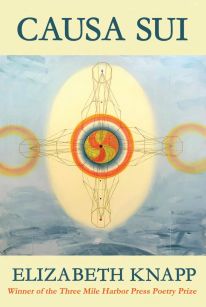
Elizabeth Knapp’s newest collection is a powerful example of contemporary poetry’s ability to reckon with political, personal, and collective disruption. Given the translation of the book’s title, Causa Sui, Latin for “self-caused,” one can almost hear the echo of Radiohead’s song “Just” playing as the background score to all these poems. We do, indeed, “do it to [ourselves].”
The collection, from 3 Mile Harbor Press, explicitly attends to the concept of song and the actions of singing, opening with a consideration of Britney Spears’ mental health, highlighting ChatGPT’s atonal clank, and resisting silence at every possible volta.
Formally, there is a consistent tension with the left margin, sometimes using jagged indents to represent a tug-of-war, sometimes allowing the prose-poem’s rectitude to disrupt a reader’s sense of control. On one occasion, a quite riotous concrete poem arrives in the first section. If a reader browsed the pages just for the variation of shape, there would be no disappointment. This is a book alive with a mid-career poet’s skill at craft and an unpretentious ease that I recognize in many poets who grew up in the American South, as Knapp did.
She is adept at a kind of uncynical gallows humor, as she demonstrates in “Poem with No Agenda,” in which she writes:
& now when I hear little Michael
Sing “ABC,” I want to hang myself.
Isn’t it funny when letters don’t look
Sonnets persist throughout the collection, taking on “The Supreme Court,” or the January 6th attack on the U.S. Capitol in “Epiphany,” or the illusion of progress via William Shatner in “Blue Origin.” In over 20 sonnets, Knapp centers both rhetorical argument and a desire to find resolution. Each is elusive. The arguments turn on themselves and complicate both an individual and collective sense of self. The second poem (and first sonnet) in the book, “Portrait of the Poet as a Child,” exemplifies that complication as it draws a comparison between being taught to hunt by a father and learning to write poems:
through the scope that thing I wanted most —
his approval — then taking a deep breath& holding it while squeezing the trigger. Oh,
the sound the animal makes when it falls
Echoes of Yusef Komunyakaa’s “Ode to a Drum” reverberate in the above poem, but as with many of the movements in Causa Sui, compression is emphasized, mainly because the voices represented here often feel like they are running out of time. That sense of compression and urgency gives way — or perhaps it would be better to say erupts — in the third section of the book, which features found poems from the right-wing Project 2025.
Along with using found language, Knapp arranges each of the poems in this section to mirror Gwendolyn Brooks’ “We Real Cool,” giving it a kind of dramatic irony and verve. The speakers of the source text (ostensibly mostly white men) give shape to a page that was created by one of American poetry’s most famous Black women. By doing this, Knapp, as curator and author, sews a stitch in our collective histories and our need to inventively resist injustice.
Causa Sui builds its power not simply from its topical or formal attention, though, but from Knapp’s own determination to engage, again and again, with a world hellbent on self-destruction. Her invitations to the reader are often accompanied by a playful insistence. She is, after all, “attempting unsuccessfully / to have a Meaningful Conversation / with you, who have already / gotten up & pushed in your chair.”
No matter how unsuccessful the diegetic conversations, the poems are imminently successful, charming, moving, and well crafted. Knapp’s voice sings its contraltos when it needs to, but also brings us to the highest lyrical ranges. Reader, here you will laugh and worry about the world, but never, as Knapp truly intends, give up on it.
Steven Leyva’s latest poetry collection is The Opposite of Cruelty.