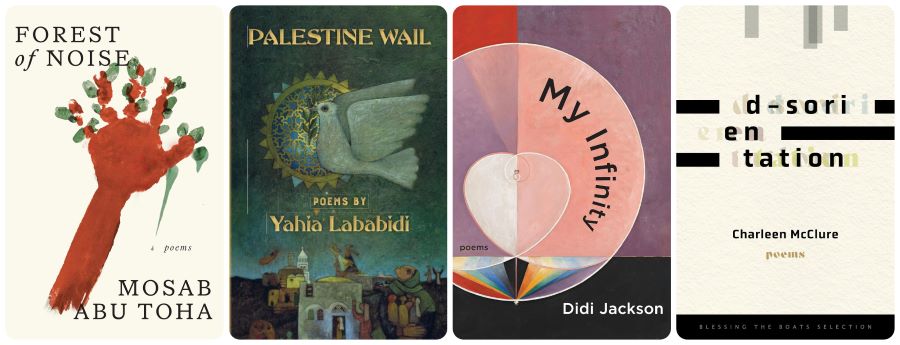
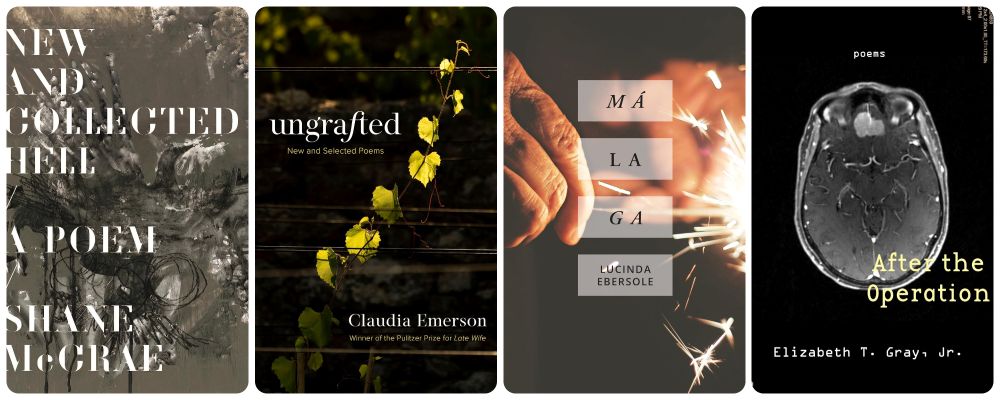
New collections to make life more lyrical.
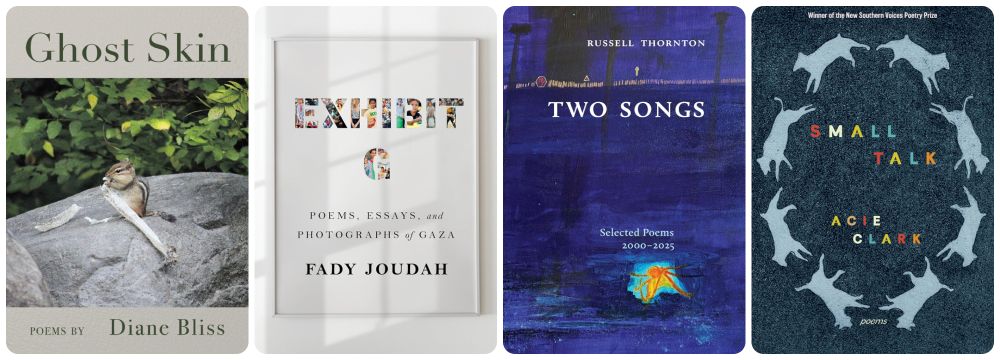
Let me begin with a breath of fresh air by way of the charming Ghost Skin by Diane Bliss (Finishing Line Press).
In crisply constructed poems, Bliss delivers ways of looking at nature that allow us to see more deeply. We go into her poems quietly and, suddenly, something takes us by surprise.
The title poem, “Ghost Skin,” looks at first to be about a water snake shedding his skin in the summer heat. All of a sudden, there’s a chipmunk instead, filling his cheeks “Until he has chewed dried skin / to a pulp, smeared it into his fur” to camouflage himself.
Ever watchful and patient, Bliss seems to possess a kind of ghost skin of her own, enabling her to observe nature without drawing attention to herself. In another poem, she sits with her back against a tree trunk — “you sleep awake” — when along comes a mink:
Brown as wet duff he comes
Undulating along stream bank
Silent as breath, and right at your feet
Then there’s a deer in her back garden, one who knows her. They observe each other quietly, the deer and she, a certain trust passing between them. But a turn at the end invites a step deeper into intimacy, into a question about what it is we expect of each other.
In another poem, a cat worries her with its odd head movements, until the reason becomes apparent — he’s looking at fireflies!
But there’s also cruelty in the natural world. In “The Sandpiper and the Turtle,” a bird is “caught between struggle and surrender,” and Bliss wonders:
...what transfixes us so
traps us into watching such struggles,
mirroring the lunge to get free, even as we feel
the sourness of surrender welling in our gut.
Ghost Skin reminded me of Auden’s definition of poetry: “The clear expression of mixed feelings.” It’s that clarity, that sharp observation, the beautiful mystery that this poet discovers in things.
*****
Poetry blends into prose poetry and then again into essay in Fady Joudah’s stunning new collection, Exhibit G: Poems Essays and Photographs of Gaza (Milkweed Editions).
In an early prose poem, he writes, “First they came for my grandparents, but my parents lived. Then for me but my children lived. Then they came for the media, and the media hailed the kingdom of nothing and severed our tongues.”
As a Palestinian American poet, translator, and physician, Joudah goes beyond his anger and torment at the Gaza genocide. The impulse to justify the existence of Palestine to the Western world in terms of genocide (particularly in the English-speaking world) fails, he writes, to acknowledge the collective inner life of the Palestinian people. This book shifts that narrative:
“When Palestine in English revolts, it’s because Palestine in Arabic gives it life, teaches it revolution. Palestine in English resists becoming ghost because Palestine in Arabic is never ghost, no matter the immensity of ruin or the duration of hibernation.”
Exhibit G celebrates a vital interiority in the living color of Arabic — not as a ghost but as an insistence of itself for itself. The photographs capture children and the openness of their smiles as they hold out bowls, both empty and full of soup; as they haul gasoline canisters for collecting water; as colorful striped umbrellas shade market-goers before a backdrop of collapsed concrete. A young woman pauses in her breadmaking to smile quietly. Child after child holds their fingers in a peace sign for the camera.
And, oh, the horse. He’s seen from above as his owner leads him through water — but his back is skinned. Is this a scene of horror or of ordinary tenderness and a routine domestic task? It cannot all be together in one frame. But it is. I’m looking and I’m seeing too much.
Food is central to culture, and Exhibit G, Joudah writes, “depends upon the work of a Palestinian collective,” and gives special thanks to the Gaza Soup Kitchen.
In “The Land Has Hands,” he writes of a woman returning to her kitchen after more than a year away and her sorrow at discovering the army has stolen a jar of makdous (stuffed eggplant). “Makdous, stacked and bathed in olive oil from her olive trees. The trees now scorched and bulldozed.” The loss of the makdous signifies the loss of domesticity, of sanctuary, the loss of providing for and nourishing your family:
“To eat makdous is an art and bread the artist. Your tongue will need to listen. You must bow to the land that gave you garlic and peppers and bow to the olive trees.”
The women of Gaza continue to prepare food for their families because nourishment is not merely of the body but also of the heart.
Joudah writes elsewhere:
“A brief mention of the effort taken to secure ingredients. A long fragment of a blown corrugated fence is the grille on which a row of large stock pots are placed. A math teacher gathers firewood in a wheelbarrow Chef Mahmoud sends me messages, nicknames me Abdul-Ghalabah, custodian of the wretched, tickles my Fanonian nerve. A giggle releases my tears.”
In “Wallah,” a medic travels in the back of an ambulance after pulling a body from the rubble but doesn’t recognize at first that it’s his mother’s corpse. He asks her forgiveness “like she had caught him sinning, he was pleading his case. Against the death toll. ‘On God’s life, I swear.’ Like he’d never do it again were she to die again.”
One of the final essays, “Exhibit G: Baby Moses & Khalas or Notes on Palestinian Interiority,” is a stunning piece of writing. In it, Joudah dissects and extrapolates from the story of Moses — the killing of every firstborn “to kill a people’s capacity to remain a people. To place their bond to place under unimaginable duress by turning it into nonplace.”
Khalas, he writes, means “redemption” in Arabic but has been abstracted over the centuries to mean “enough/it is finished.”
What is asked for in redemption? Not our humanity. That is surely a given. What is asked is that a people be restored to what was already their birthright, their right to their own interiority. Exhibit G is a radical demand for that justice and the refusal of Palestine to be reduced to a moral lesson.
*****
Russell Thornton’s Two Songs (Harbour Publishing) assembles 25 years of lyrical narrative poems from nine collections along with new, uncollected poems. Some are set in Tunisia, Peru, and Greece. But Vancouver, British Columbia, is the poet’s home. The two songs of the title, life and death, are intertwined and harmonize in his poetry.
Ordinary moments become bittersweet and freighted with the mystical when, for example, a mother lights her cigarette in the rain while waiting for a school bus, or when customers in the checkout line help an old woman locate a forgotten item.
Thornton grounds his poems in concrete detail but draws on light, wind, and rain to make them particularly evocative. Light fills up an empty bird’s nest “digging graves in leaves.” Winds are redolent with the scent of roses or are gusting off the inlet. Rainfall stops and then resumes as a mother lies on her deathbed. In one poem, rain falls like a voice of the dead, filling stillness and falling into itself.
The poet is conscious of the passage of time but equally attuned to continuity. He reflects on the ways in which people live within others, in the cells of the body as well as in memory. Dust and stones are also symbolic:
The dust may be me, but the dust forgets me,
It is too many things and holds too much more than me.
In “Playing with Stones,” Thornton pictures his daughter as an old woman, as though he is her child, grieving her as she will one day grieve when gathering stones to commemorate her loved ones.
Elsewhere, he ties the shoelaces of the father who once kicked him down a flight of stairs, remembering that the man was also once a child, praised for learning to tie his shoes. Different ways of seeing himself in others are everywhere in Thornton’s work.
He sees himself reflected in the natural world, too. In one poem, he encounters a coyote as he returns from dropping his daughter at kindergarten. Thinks about the darkness in himself, he ends:
what is laughter in you and leaves your lips freely
is in me a howl I keep at the bottom of my throat
out of fear it will become sound and I will lose you in the light.
Another coyote, in a more recent poem, protects its young, eliciting in Thornton a confrontation with the vulnerability he experienced in boyhood. Now, he has become the aggressor. By inhabiting the perspective of others, he begins to understand himself. He states this clearly in one of the final poems, “One Morning”:
It is not you at the heart of your life but another,
and wherever you look, it is another who shows you
How you were always hidden in what you see.
Thornton’s 2013 collection, Birds, Metals, Stones & Rain, established him as an important Canadian poet. His 2014 collection, The Hundred Lives, was shortlisted for the Griffin Prize. Two Songs puts this work in a larger context, demonstrating his range and command as a lyric poet. It’s an exquisite collection.
*****
Each of the five sections in Acie Clark’s debut, Small Talk (Hub City Press), begins with a “Small Talk” poem reflecting on change as the poet sits with his morning coffee. Clark has described the collection as a way of reclaiming small talk to engage with others when you move to a new community.
But this isn’t the superficial banter I usually associate with small talk. Instead, Clark employs it to reach across uncomfortable divides into unknown terrain, and, as a trans man, between one version of self to another. In “Submission,” he writes: “My body can be myself and I can be a place to be, / somewhere that can be gone / to.” And elsewhere: “No one here asked for a word to cleave / the moment from what will happen / into what is going on.” And, as a final example:
I recognize there is no separation
between the woods I know and the woods I don’t
only a limit drawn in me by what
has happened so far
But boundaries can be fuzzy, blending into a single identity. These explorations sometimes feel a bit like going through the looking glass. The poems contain many mirrors and reflective windows.
There are also several poems entitled “Temperance.” Temperance, as in abstaining from alcohol, is touched on. But a more resonant reading of temperance is found in the tarot card, which signifies the blending of opposing forces. It depicts a figure with one foot on dry land and the other in water, as water is poured between two cups.
“Is a shared body necessarily a precarious one” Clark asks in one temperance poem. Where does one mark off the divisions? And is it even necessary to do so?
I was moved by these poems but also found myself perplexed and occasionally saddened. In the most wrenching piece of the collection, “Absolution online,” a friend sends Clark a link to a virtual confession site. It’s meant as a joke, but the poem that emerges is far from one:
The first time I said sorry to a man for what he wanted from me, I was 6.
I wasn’t really aware I had a body yet. I can’t help it, he said,so I had to help me split my body from what it meant to survive those
years of what couldn’t be helped, and now I go looking for us in every
poem, hoping to see myself standing there on the cliff of history, waving
back like someone I know.
It’s impossible to leave the old self entirely behind, however painful. “My life is a room I’m always finding myself walking back into.” There’s also the question of the “dead” name that can only be written as a bracketed emptiness “where the breath it took to say the name can live.”
In one poem, Clark writes of his father:
When he calls me by his daughter’s name I understand
he wants to speak to me without crossing the distance
I made by making myself this distance
I find this heartbreaking. When you make yourself into a distance, the onus is on your interlocutor. They must cross the distance by themselves toward you or else accept the distance and pretend it isn’t there. It’s hard to characterize this as “reclaiming” small talk.
Perhaps that’s why I couldn’t seem to get my footing when reading this collection. It might also be what the poet intends. Simple answers are elusive. The best you can hope is to join the poet in the complexity of his questions.
Clark writes in one poem about having been quite chatty as a child and of wanting to be quieter, more confident in empty space. I hope he’s getting there. In the penultimate “Small Talk” poem, he reflects:
I know a poem is not an answer
but a question we can live in. It’s a place to place my voice
It’s a still room still enough to hold the sound of all the change in it.
Amanda Holmes Duffy is a columnist and poetry editor for the Independent and the voice of “Read Me a Poem,” a podcast of the American Scholar.