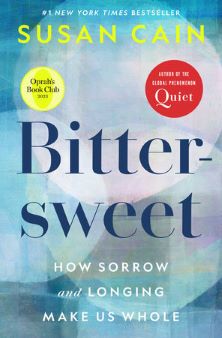
Learning to live in the grey while accepting the black-and-white.
The poem “won’t you celebrate with me” by Lucille Clifton hangs on my wall. It starts, “won’t you celebrate with me/what i have shaped into/a kind of life?” Clifton’s poems have always felt both deeply grounded and extravagant; indeed, after revealing that she “made it up/here on this bridge between/starshine and clay,” she concludes by extolling the fact that, in her life, “everyday/something has tried to kill me/and has failed.”
It’s hard to think of anything more worthy of celebration.
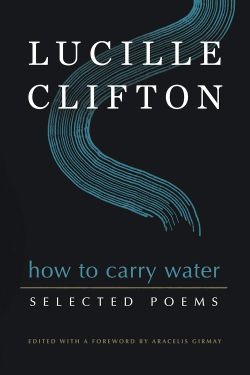
I turned again to Clifton recently in an effort to bring myself more into alignment with my roots, which is to say poetry, during a time when everything else was feeling rootless and unmoored. In How to Carry Water: Selected Poems of Lucille Clifton, editor Aracelis Girmay has compiled works that both astonish and dismay.
“[W]e will wear/new bones again,” Clifton promises in “new bones.” When she continues, “we will leave/these rainy days,/break out through/another mouth/into sun and honey time,” I can almost feel my own bones sing with rediscovery. Another poem, “November 1, 1975,” laments, “My mother is white bones/in a weed field/on her birthday…This is just to note/the arrogance of days/continuing to happen/as if she were here.”
Having watched my own mother endure (successfully!) treatment for breast cancer this year, Clifton’s words resonate and speak to my own deep-seated fears, some of which I’d barely acknowledged. If my mom died, I sometimes felt in the deep undercurrents of my soul, how could the world possibly continue?
The dichotomy of Clifton’s poems is one reason they’ve long called to me. In an era where joy and tragedy exist a hair’s width apart, it’s hard not to swoon at these lines from “new year”:
with too many candles
in her hair
she is a princess of
burning buildings
leaving the year that
tried to consume her…but she opens herself
to the risk of flame and
walks toward an ocean
of days.
It seems as though we’re living in a time particularly marked by highs and lows — living through it, carried along on a tide we’re incapable of stemming. As Clifton opines in “water sign woman”:
the woman who feels everything
sits in her new house
waiting for someone to come
who knows how to carry water
without spilling, who knows
why the desert is sprinkled
with salt, why tomorrow
is such a long and ominous word.
I can’t help but agree as I sit here and wait for what feels like the end of days; the sitting and waiting are the hardest part. Even knowing that so much of life is out of our control, the soul grapples to make sense of things in times of confusion, anxiety, or suffering. Such fear and disorientation can be paralyzing.
Perhaps the key is to remember that today, at least, the world isn’t coming to an end — or that it is perpetually both coming to an end and being reborn.
“when i wake to the heat of the morning/galloping down the highway of my life/something hopeful rises in me/rises and runs me out into the road/and i lob my fierce thigh high/over the rump of the day and honey/i ride i ride,” Clifton tells us in “hag riding,” and this hag intends to keep riding until there’s no more gas in the tank.
As in moments of great joy, such as when Amanda Gorman read “The Hill We Climb” at Joe Biden’s inauguration, poetry can also help us in times of immense flux and uncertainty. Clifton offers this advice in an unnamed poem:
in the middle of the Eye,
not knowing whether to call it
devil or God
I asked how to be brave
and the thunder answered,
“Stand. Accept.”
so I stood
and I stood and withstood
the fiery sight.
May we all be given the strength and fortitude to stand and withstand the fiery sight — and maybe, just maybe, to make a little poetry out of the pain.
Mariko Hewer is a freelance editor and writer as well as a nursery-school teacher. She is passionate about good books, good food, and good company. Find her occasional insights of varying quality on Bluesky at @hapahaiku.bsky.social.