George Orwell’s prophetic vision in 1984.
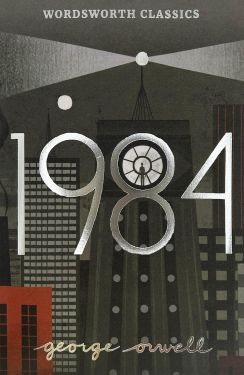
George Orwell’s classic novel 1984 is a masterclass in brand marketing. “Newspeak” is one of its central conceits. Designed by the dystopian government of Oceania to erase critical thought in its totalitarian superstate, this reductive vernacular is easy to remember and full of neologisms. On the lighter side, Newspeak was also Orwell’s genius platform for crafting one of the most recognizable slogans in 20th-century literature: “Big Brother is watching you.”
Dark, catchy, and humorous for those who have a sense of humor, Newspeak found purchase in our popular discourse. Who could forget darling earworms like Hate Week, Victory Gin, or the Anti-Sex League? And most of us, at one time or another, have enjoyed the singular pleasure of calling a preachy adversary the Thought Police. Whether we’ve read the book or not, everybody knows what a thoughtcrime is, and no one wants to visit Room 101.
Reading about absolutist Oceania might hold comic resonance for anyone who works in a bureaucracy, but for people who harbor unpopular opinions during times of hegemony, there is less relief to be found in the pages of 1984, though there is validation. And for those who value beauty in environments where it is unwelcome, 1984 offers reassurance that beauty, and the human propensity to admire it, is hard to vanquish.
With a throbbing varicose ulcer on his right ankle, our protagonist, Winston Smith, or “6079 Smith W,” is an inverted Achilles crossed with a snake-bitten Eve. Like Eve, Winston has cast his lot with knowledge. A disillusioned mid-level functionary, his job is to bring public records into alignment with the government’s always-changing truth. One day, he ventures into “prole” territory, where members of the Outer Party like him have no business being. Winston is looking for someone old enough to remember Britain before the Party took over. He has a simple question:
“Was life better before the revolution than it is now?”
“The beer was better,” says an old prole, whom Winston has chosen for this clandestine interview. “And cheaper! When I was a young man, mild beer — wallop, we used to call it — was fourpence a pint.”
Winston is not impressed. Like any seeker, he wants a thoughtful response, something with perspective and a little more self-awareness. He tries a few more times and gives up, frustrated when his questions are met with prattle and non sequiturs. The proles (the proletariat, or working class) are the 85-percent majority of Oceania. They remain miraculously unoppressed by the government — at least, in the direct sense: Their lack of education and their hand-to-mouth poverty keep them down, so the Inner Party does not have to.
Winston fumes to the reader about the proles’ lack of intellect:
“They remembered a million useless things, a quarrel with a workmate, a hunt for a lost bicycle pump, the expression on a long-dead sister’s face…They were like an ant which can see small objects but not large ones.”
Okay. But how does a well-considered narrative more effectively get to the bottom of Winston’s question than do a handful of memories? Here, he’s blinded by the “large” objects at the expense of the “small” ones. The prole cannot give Winston the critical distance he wants because the man lacks the training to do so. Besides, it would get him killed. Winston is unable at this juncture to see the heart-stopping significance of someone’s remembering “the expression on a long-dead sister’s face” and taking it, philosophically speaking, from there.
In fact, this disappointment with the man is at odds with Winston’s conviction that the future lies with the proles. While he finds it challenging to have a meaningful conversation with the man, it is another prole, a singing washerwoman, who awakens Winston to a different type of intelligence. From a rented room above Mr. Charrington’s shop, Winston witnesses the woman transform an utterly hollow tune (written by a machine) into a mesmerizing, soulful ballad. She does this by bringing her loves and hardships to bear in her interpretation of the song. She does it automatically, without trying, and without knowing she has an audience.
George Orwell was born Eric Blair in 1903. According to his biographer D.J. Taylor, Orwell described himself as “lower-upper-middle-class” — a bit of a head-scratcher for people on my side of the pond. Despite Orwell’s distinguished background (wealthy Scots on his father side, French on his mother’s), his people were not moneyed by the time he came along.
“The poor cousin” among his English betters, Orwell nevertheless attended prestigious Eton College and benefited from that network for the rest of his short life. Still, he was psychologically marked by being rich in bearing if not in income. He overcompensated by identifying with the working classes, who, for their part, could not see the connection and insisted on calling him “sir.”
As a young man, he was a colonial police officer in Burma, and this turned him against imperialism. Curiously, it did no violence whatsoever to his nationalistic sentiments. As with his hero Winston Smith, Orwell was both troubled and enriched by the conflicts of his social standing and politics. His first wife, Eileen, wryly called him “socialist while Tory.”
Having participated in the Spanish Civil War, fighting in an anti-Stalinist but otherwise catch-all leftist group called the POUM, he saw firsthand the particular tensions and challenges associated with left-wing movements. On the other hand, he lived through Nazi Germany’s occupation of France and its attacks on Britain during the Blitz. If his Animal Farm (1945) was a straightforward critique of the Soviet regime, it would be too simplistic to say 1984 was more of the same — nor was it strictly a reaction to the Nazis and the vicissitudes of WWII.
Orwell remained a socialist until his death at 46 years old, but as he matured, his definition of socialism narrowed in tandem with what he thought was possible. What is clear is that he detested authoritarianism and feared its potential rise from all quarters.
He penned 1984 in the late 1940s, while dying of tuberculosis. The novel was published in 1949, and Orwell was buried before its first birthday. This lends dimension to his state of mind as he labored over his final project, weary with failures and losses (Franco’s victory in Spain, Eileen’s death), while smarting under the boot of the biggest tyrant of all: his own mortality.
Today, the bleak world of 1984 resurrects itself in authoritarian regimes that misuse surveillance, attack citizens, target opposition, and wage unjust wars. We also see it increasingly through our technology. Winston knows the few areas of his room and office where the dreaded “telescreen” cannot detect him, yet we tote our telescreens like talismans in our purses and pockets, even leaving them to wink from the bedside table while we sleep.
There’s enormous pressure on language caused by short-form cyber communications like texting and social media. Our own version of Newspeak comprises overused pop-psych buzzwords like “trigger” and “gaslight.” These concepts tempt us with their sing-song economy but ultimately erode our ability to say what we really think and feel, squashing what the Party calls “useless shades of meaning.”
In 1984, the regime tries to kill the meaning of language in order to kill the meaning of everything. Winston and his lover, Julia, resist by attempting to see meaning, increasingly, in what Winston maligned at the beginning of his revolt as “small objects,” such as the coral paperweight he buys from Mr. Charrington’s shop. It’s beautiful and was made before the revolution. Just a piece of coral encased in glass, the lovely relic defies the Inner Party’s creeping narrative that it has always been in power.
When Julia changes out of her Party overalls and applies forbidden black-market makeup so she can feel like a woman, the result is the same: Like the coral in the glass, she is reserving a delicate part of herself from the Party’s dominance.
Winston’s recollection of his mother, who was taken by the regime when he was a boy, grows more vivid throughout his rebellion and during the early stages of his forcible reeducation by the Inner Party. For a time, he counters the Party’s torture by believing that “staying alive is less important than staying human.” In this passage, which is well worth ending on, the memory of his mother helps him define exactly what that means:
“The standards she obeyed were private ones. Her feelings were her own, and could not be altered from the outside. It would not have occurred to her that an action which is ineffectual thereby becomes meaningless. If you loved someone, you loved him, and when you had nothing else to give, you still gave him love.”
You can join Dorothy in next reading One Hundred Years of Solitude, which will be the subject of her column on July 6th, 2026.
.png)